What does Death mean in tarot?
Death is the card of endings that make room for what comes next. Something has reached its limit: a relationship or the rules it runs on, a professional identity, a source of income or a habit that holds you back. The old way can’t simply continue, and its departure clears space for something else.
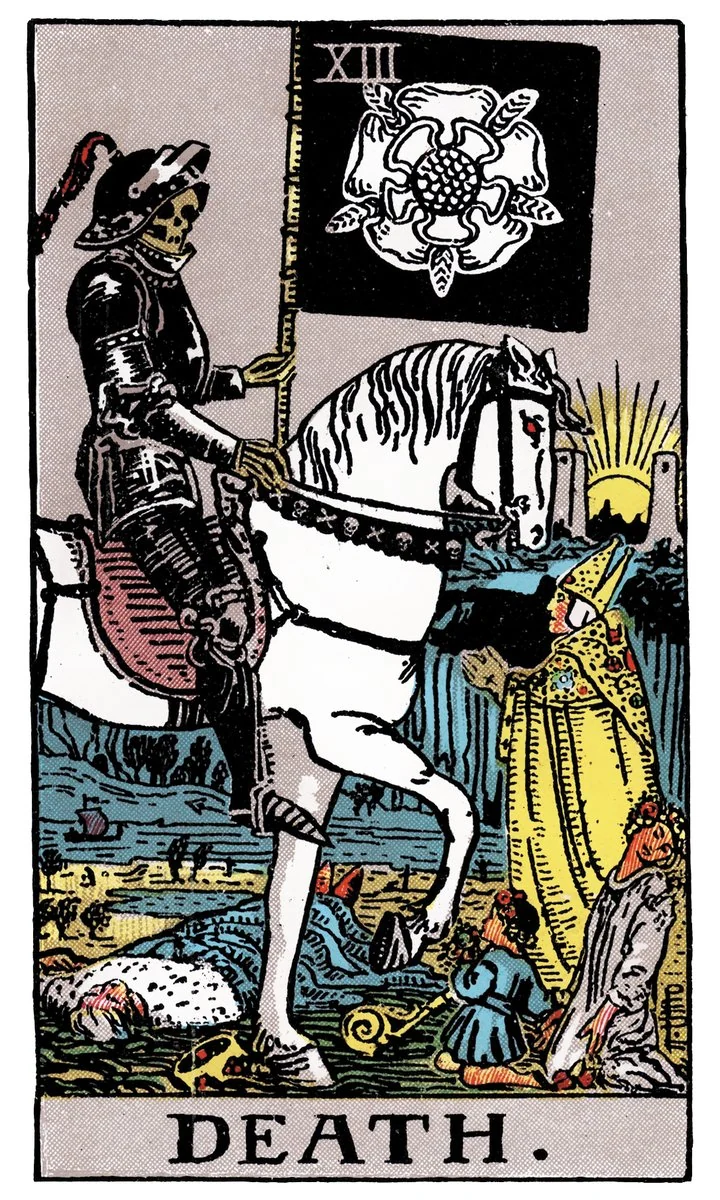
The image holds loss and continuity in the same frame. The rider moves forward and a crown lies on the ground, yet a white rose blooms on the dark banner and the sun still shines in the distance. So start with what is ending, then think about how to bring it to a close and what you want to set up afterward.
- Upright keywords
- endings, transformation, letting go, closing a chapter, transition, making room for the new
- Reversed keywords
- resisting change, holding on, an unfinished ending, fear of loss, repeating old patterns, a delayed transition
- Endings: no crown lasts forever
The fallen king, his dropped crown and the people standing before the rider show that status and past investment can’t keep an old arrangement alive forever. In a relationship or work question, look at what is true now: does anyone still want this to continue, and do the conditions still allow it?
- Letting go: the rider keeps moving
The horse gives the card a sense of moving through a process rather than a single moment. Closing a chapter can mean retiring old rules, settling responsibilities and pulling your time and money out of what has ended. Reversed, Death often appears when you know change is needed but your daily habits still keep the old arrangement going.
- Renewal: a white rose on a dark banner
The rose and the distant sunlight show life continuing after a particular form has gone. Renewal still needs a transition: you carry your experience forward, end the arrangement that no longer works and set up different conditions.
Death upright and reversed meaning
Death upright meaning
Upright, Death means a chapter is ending and needs to be carried through; it may bring grief, but it also lets you stop an exhausting pattern and put your time, energy and resources elsewhere.
An old arrangement gives way
Something real is changing in a relationship, a role or the way your resources are set up. Get clear on how far the change reaches. Then sort out which responsibilities need wrapping up and which skills and connections come with you into the next phase.
Outgrowing an old identity
An idea of who you have to be may be loosening, or an old ambition may no longer fit. You can honor the past and still let what you want now, and the life you have now, shape your next choice.
Death reversed meaning
Reversed, Death usually means a blocked transition: the old situation is hard to sustain, but attachment, fear of loss or unfinished business keeps it in place, so the same problems keep coming back.
Holding on to what has ended
You may be attached to a person, to what feels familiar, to your status or to everything you’ve already put in. Some of it may still have real value; some of it may just be reluctance to admit it’s over. The honest question is whether putting in more can actually change the situation.
An ending that hasn’t reached daily life
Someone may have changed on the inside while their boundaries, duties and money still follow the old pattern. Find the step that’s still missing: telling someone the decision, handing over a responsibility, changing an agreement or accepting what can’t be recovered.
Is Death a yes or no card?
No. Death leans toward no, especially if you’re asking whether something will stay the same or go back to how it was. The card marks an ending, so the old version of the situation isn’t going to continue. If you’re asking whether a chapter needs to close or real change is coming, it leans yes; reversed, resistance is holding the change up, so expect “not yet.”
Death symbolism
Death shows both what ends and how the ending unfolds. The figures, the rider and the distant sun put the goodbye and the transition into one picture.
- The armored rider and white horse
A skeleton in black armor rides a white horse that is moving forward.
The rider stands for the passing of an old form, and the moving horse turns that passing into a process. When you ask where things are going, look at the changes already underway and the handover still to come.
- The black banner and white rose
A white five-petaled rose is set on a black flag.
Mourning and living beauty sit side by side. Renewal means naming what can still grow while giving the loss its proper place.
- The fallen king and the onlookers
A king lies on the ground before the horse, while a bishop, a young woman and a child each react in a different way.
Rank offers no exemption from change, and people don’t all react the same way. In relationships and at work, notice who has accepted the transition and who is still trying to keep things as they were.
- The river, towers and sun
A river crosses the distance, and the sun appears between two towers on the horizon.
The view reaches past the immediate ending to a later stage. Upright, ask how the passage can be completed; reversed, ask where it has stalled and what keeps pulling it back.
Watercolor deck
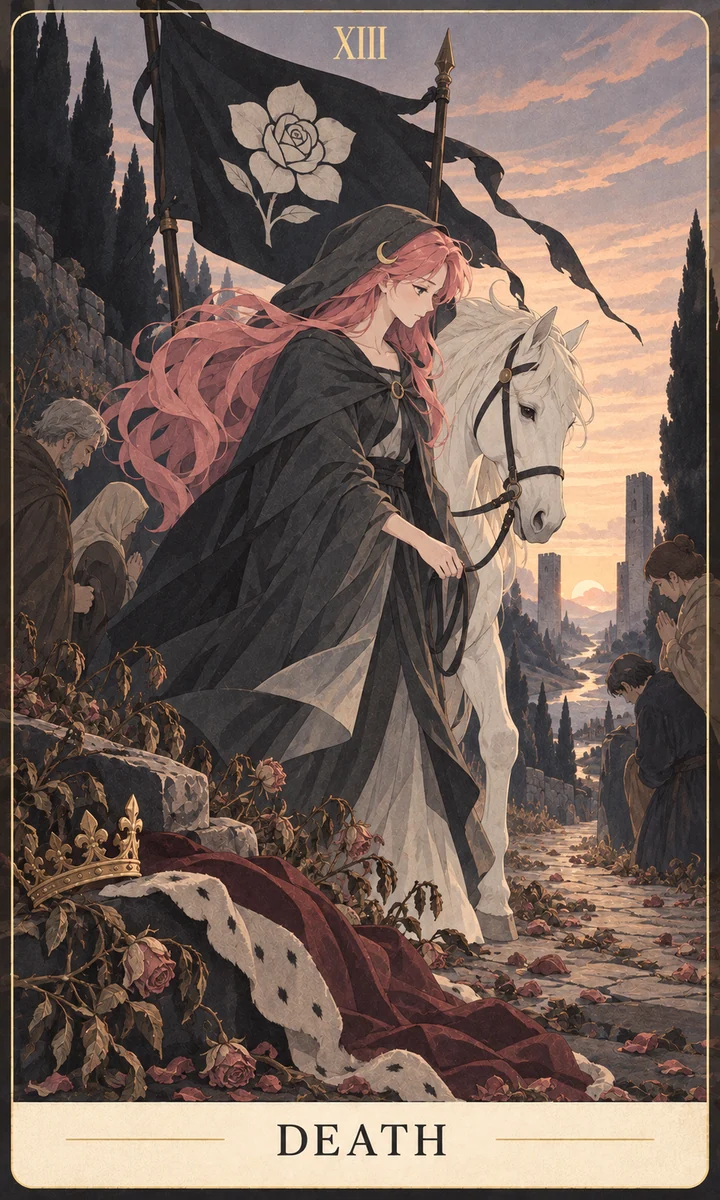
Our watercolor Death shows a woman in a black robe leading a white horse, and keeps the rose banner, the discarded crown and cloak, and the light between distant towers. The dropped clothing makes it easy to see an old role being left behind. Your experience and skills come with you, even when that role no longer defines your future.
Death in love and relationships
In love, Death marks a turning point, and the first thing to work out is whether what’s ending is the relationship, an old commitment or a recurring pattern between you.
Death as feelings
Upright · If you pulled Death for someone’s feelings, they may be letting go of an attachment or of old expectations so they can see the connection differently. Their feelings have changed shape rather than simply staying the same. Whether love continues depends on whether those feelings still point toward the relationship, and whether they want to build a new way of being together.
Reversed · Reluctance, dependence or fear of loss keeps their feelings tied to the past. That unfinished attachment shows the connection still matters to them. Wanting to come back and take responsibility is a separate thing, though, and it needs its own evidence.
The relationship, or the way you relate?
Upright · The old way of being together needs a clear ending or a real change in boundaries, responsibilities and how you treat each other. If you both take part, that change can happen inside the relationship. If one of you no longer wants it, the ending may be the relationship itself.
Reversed · Habit, worry or attachment keeps the relationship running while the problems stay. Or a decision has been made, but contact and shared obligations haven’t been sorted out. Ask what you still genuinely share and what is just a leftover arrangement.
Closing the chapter or rebuilding
Upright · A real restructuring or an ending fits the card better than carrying on unchanged. If you’re hoping to reconcile, the question is whether the old cycle can stop and new agreements can take its place, with both people making changes.
Reversed · A breakup may be announced while the entanglement continues, or an attempt to get back together may repeat the same pattern. Things move forward only when the unfinished responsibilities are dealt with and the change shows up in behavior.
Death career meaning
At work, Death means a task, an arrangement or a professional identity is being retired, and your skills carry over into whatever comes next.
Work arrangements that no longer fit
Upright · A project phase or way of working is ending and needs a handover, a restructure or new rules. Be precise about the scale: finishing an assignment is not the same as losing your whole job.
Reversed · An old process or role is still in place even though it no longer fits the work. Delayed handovers leave nobody sure who is responsible. Look at who is still following the old rules and where effort keeps getting wasted.
Freeing up room for something new
Upright · Room opens up as responsibilities change, wasted effort stops or your experience combines in a new way. Before you jump, check which results you can take with you, which skills you’re missing and what the new opportunity actually offers.
Reversed · Old commitments are eating up your time and energy, or fear of losing an established identity keeps you from stepping in. Separate the preparation you genuinely need from putting things off indefinitely, and decide what “ready” would look like.
A changing professional identity
Upright · How you position yourself professionally can change while your useful skills and experience carry on. Admit which ambitions have run their course, then work out the skills, resources and time you need to bridge to a new direction.
Reversed · What you’ve already invested may keep you on a path you no longer value. The opposite can happen too, when the urge to escape gets ahead of your preparation for the next step. Sort the abilities worth keeping from the role that needs to end.
Death money and finances
With money, Death means an income source, spending pattern or obligation is closing or being reorganized, so the key is bridging the old setup and the new one.
Bridging old and new income
Upright · An existing income source or payment cycle may be closing while another gets established. Keep confirmed income, outstanding payments and the start of the new arrangement separate so you can see any gap in between.
Reversed · You may keep relying on a source that is drying up, or keep paying into a commitment you don’t want to admit isn’t working. Separate what you’ve already spent from the returns you can still realistically expect.
Settling what the old chapter left behind
Upright · Outstanding obligations need to be settled, and spending arrangements that no longer work need to be closed. Get clear on which obligations are finished and which are still active before you decide how much room you have for something new.
Reversed · Old commitments or habitual costs keep draining money because you haven’t closed or renegotiated them. Naming the obligation that’s still running explains why a change you meant to make hasn’t freed up the money you expected.
Staying steady through the transition
Upright · Look at your security through the new mix of money and obligations, especially in the gap between the old arrangement ending and the new one settling in. What you have available and what you still owe show how the transition is supported and whether the new setup can last.
Reversed · An arrangement that looks unchanged may rest on conditions that no longer hold, and fear of loss can delay adapting. Stability depends on whether the setup still works, not on how familiar it feels.
Death in a tarot spread
Your question sets the topic, and the position in the spread tells you what job Death is doing. Upright or reversed shows the state of its themes; the position decides whether they describe where you are, what’s in the way, what to do or where things are heading.
- Present situation
- Upright: a chapter is closing or being reorganized; be clear about what is ending and how far the change reaches. Reversed: change has arrived, but old ties, responsibilities or habits are still holding things in place.
- Obstacle
- Upright: your plan may depend on something that has already ended, or the transition itself leaves a hard gap. Reversed: resistance, an unfinished goodbye or a repeating pattern is blocking progress.
- Advice
- Upright: as advice, Death says to accept the ending, finish what you owe and carry what you’ve learned forward. Reversed: name what you’re clinging to, and turn the wish to change into one specific, doable act of closure.
- Outcome
- Upright: the old form gives way and circumstances genuinely change. Reversed: delay, repetition or a half-finished passage. The cards that follow and your real-world conditions show what can come next.
To read Death alongside the other cards in a spread, start with our Tarot beginner’s guide.
Death tarot card FAQ
What does the Death tarot card mean?
The Death card means endings, letting go and transition. A chapter or arrangement has reached its limit and needs to close to make room for the next one. Upright, the focus is on carrying that change through. Reversed, attachment, resistance or unfinished responsibilities keep the transition from fully happening. Death is card XIII of the Major Arcana.
Does the Death card mean someone will die?
No, the Death card can’t tell you that someone will die. In a reading, it is about the ending or transformation of a phase, a relationship, a role or a habit. Treat the name as a symbol rather than a prediction, and ask what is passing out of your situation and what needs to be brought to a close.
What does Death reversed mean?
Death reversed usually means resisting change or a transition that hasn’t been finished. The old situation is hard to sustain, yet attachment, fear or obligations keep it going. It can also mean you’ve changed on the inside while your outward arrangements still follow the old pattern. Look for the boundary, handover or goodbye that is still incomplete.
Does Death mean a breakup in a love reading?
Not always. The ending may be the relationship, an old commitment or a harmful way of relating to each other. What matters is whether you both still want this and whether you’ll both make real changes. Death asks the old form to give way; reversed, the problems may continue because that old form is being kept alive.
How does someone feel about you if you pull Death?
Upright, Death suggests their feelings have changed deeply: they may be letting go of an attachment or of old expectations about you. Reversed, they may be struggling to let go, held back by reluctance or attachment even as the feelings shift. Whether they want an ongoing relationship still shows in what they say and do now.
Is the Death card bad?
The Death card isn’t a bad omen, though it can be hard to receive. It marks an ending, and endings often come with grief or reluctance. It also brings the chance to stop an exhausting pattern and put your time, energy and money into what comes next. Reversed, the difficulty usually comes from holding on.