How to do a tarot reading in 5 steps
- Ask an open question. Focus on what you can understand or do: “What should I know before I change jobs?” works better than “Will I get the job?”
- Choose a spread. Three cards suit most questions. A ten-card Celtic Cross gives you room for a big decision.
- Shuffle and lay out the cards. Shuffle until it feels right, cut the deck, and place the cards face down in the order of your spread.
- Read each card in its position. Look at the picture first, then the card’s traditional meaning, then the question its position asks.
- Connect the cards and act. Look for repeated suits, numbers and contrasts, then turn the story into one concrete next step.
What is tarot? The 78-card deck
A standard tarot deck has 78 cards: 22 Major Arcana and 56 Minor Arcana. The Major Arcana, from The Fool to The World, stand for big life themes and turning points. The Minor Arcana are split into four suits—Wands, Cups, Swords and Pentacles—that cover everyday life: what you do, feel, think and own.[1][2]
Most readings mix the two. A question about changing jobs might turn up a Major Arcana card about a turning point next to Pentacles cards about money and skills. The big card sets the theme; the smaller cards show where it plays out.
- Major Arcana cards
- 22
- Minor Arcana cards
- 56
- Minor Arcana suits
- 4
Choosing a tarot deck: Rider–Waite, Marseille and Thoth
Tarot began in 15th-century Italy as a card game. Reading the cards for divination came later, first in 18th-century France and then through occult societies in 19th-century England. That history is why the same card can look and read a little differently from one deck to the next.[1]
The best-known deck is the Rider–Waite–Smith (RWS) tarot, published in 1909 and illustrated by Pamela Colman Smith under the direction of Arthur Edward Waite. It was one of the first decks to give every Minor Arcana card a full scene, which is why most beginners start with it and why most card meanings online, including ours, follow its imagery. The older Marseille deck and Aleister Crowley’s Thoth deck use different art and, in places, different names: the Marseille deck calls the High Priestess “the Papess.”[1][2]
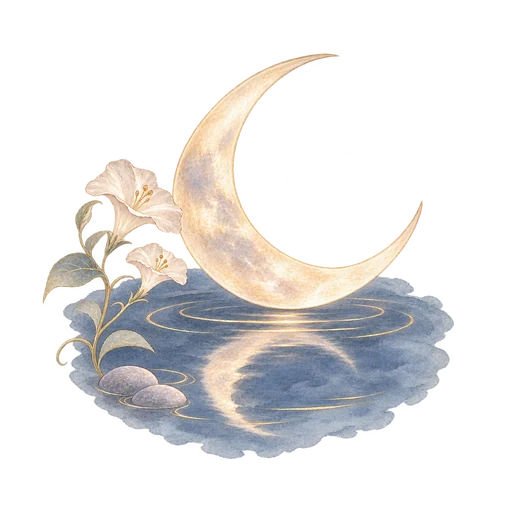
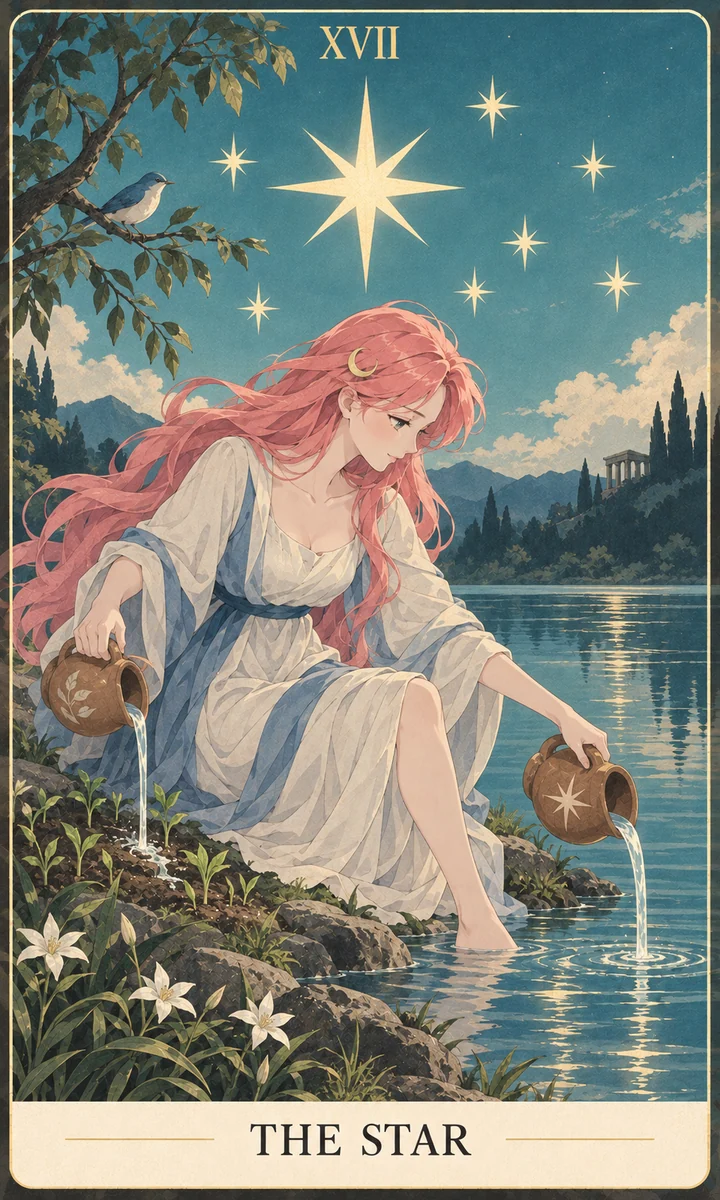
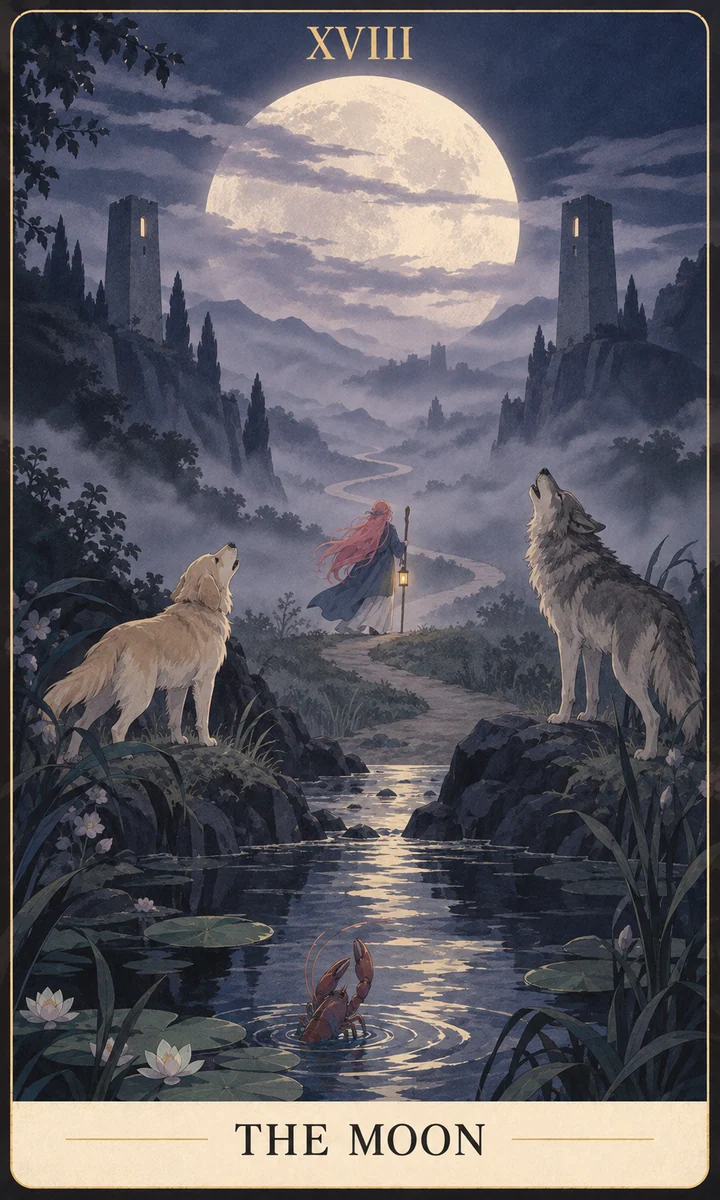
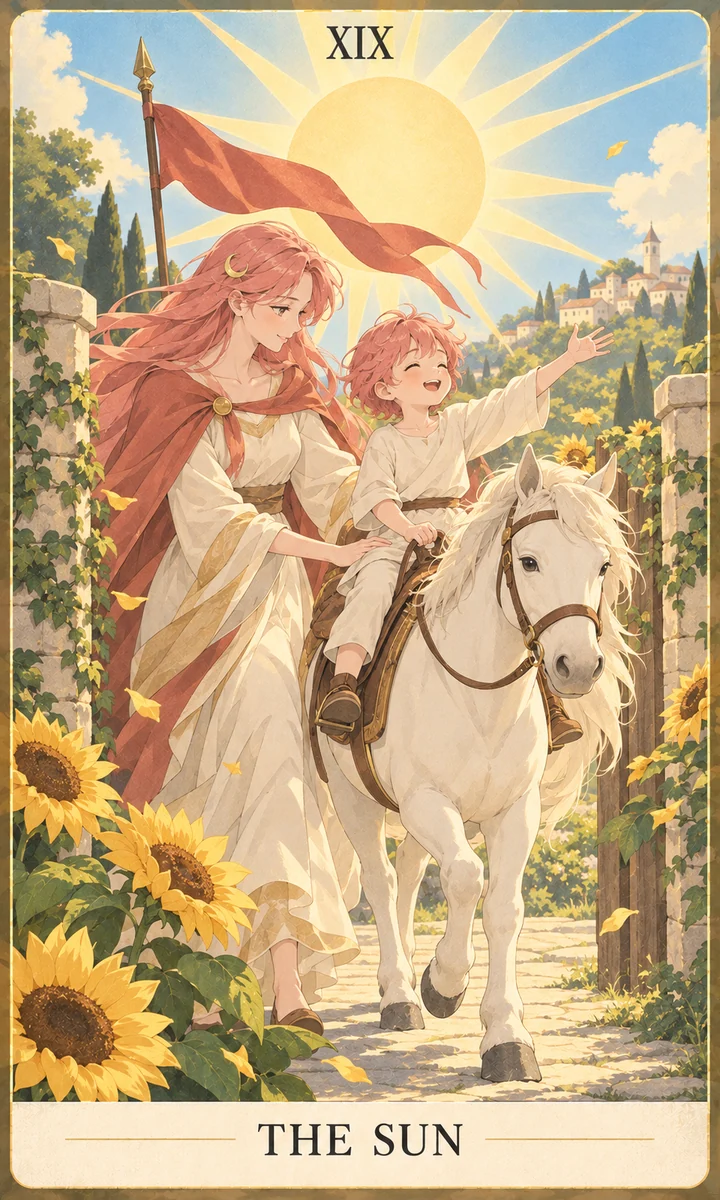
Lunavale gives every card two looks: original watercolor artwork built around moonlight, flowers and leaves, and the classic Rider–Waite images. The worked example in this guide uses the classic cards.
Tarot card meanings and the four suits
Every Minor Arcana card tells you two things before you look at the picture: its suit and its number. The suit points to an area of life, and the number to a stage in it. The picture then fills in the details. Take the Eight of Pentacles: Pentacles means work and money, eight suggests steady progress, and the image shows a craftsman carving coin after coin.
The four tarot suits
Each suit is tied to one of the four classical elements and covers its own part of life:
| Suit | Element | What it covers |
|---|---|---|
| Wands | Fire | Drive, ambition, creativity and taking action |
| Cups | Water | Feelings, relationships, intuition and imagination |
| Swords | Air | Thoughts, words, decisions and conflict |
| Pentacles | Earth | Work, money, health and the physical world |
Real questions rarely stay inside one suit. A job change touches money and skills (Pentacles), whether you’ll fit in (Cups), how you ask for what you need (Swords) and the push to act (Wands). Read the suit against your situation instead of assuming each suit only answers one kind of question.[1]
Each suit runs from Ace to Ten, followed by four court cards: Page, Knight, Queen and King. That makes 14 cards per suit and 56 Minor Arcana in total.[2]
Numbers help, but don’t let them do all the work. The Five of Wands shows a group clashing with staffs; the Five of Cups shows a figure mourning spilled cups. Both are fives, but one is about friction and the other about loss. The picture decides.
The 22 Major Arcana
- The Fool
- The Magician
- The High Priestess
- The Empress
- The Emperor
- The Hierophant
- The Lovers
- The Chariot
- Strength
- The Hermit
- The Wheel of Fortune
- Justice
- The Hanged Man
- Death
- Temperance
- The Devil
- The Tower
- The Star
- The Moon
- The Sun
- Judgement
- The World
The 56 Minor Arcana
- Ace of Wands
- Two of Wands
- Three of Wands
- Four of Wands
- Five of Wands
- Six of Wands
- Seven of Wands
- Eight of Wands
- Nine of Wands
- Ten of Wands
- Page of Wands
- Knight of Wands
- Queen of Wands
- King of Wands
- Ace of Cups
- Two of Cups
- Three of Cups
- Four of Cups
- Five of Cups
- Six of Cups
- Seven of Cups
- Eight of Cups
- Nine of Cups
- Ten of Cups
- Page of Cups
- Knight of Cups
- Queen of Cups
- King of Cups
- Ace of Swords
- Two of Swords
- Three of Swords
- Four of Swords
- Five of Swords
- Six of Swords
- Seven of Swords
- Eight of Swords
- Nine of Swords
- Ten of Swords
- Page of Swords
- Knight of Swords
- Queen of Swords
- King of Swords
- Ace of Pentacles
- Two of Pentacles
- Three of Pentacles
- Four of Pentacles
- Five of Pentacles
- Six of Pentacles
- Seven of Pentacles
- Eight of Pentacles
- Nine of Pentacles
- Ten of Pentacles
- Page of Pentacles
- Knight of Pentacles
- Queen of Pentacles
- King of Pentacles
Tarot court cards: a person or a role?
Court cards can stand for a real person or for a way of acting. A common shorthand: Pages learn, Knights act, Queens nurture and Kings lead. Then layer the suit on top—the Queen of Swords leads with clear thinking, the Queen of Cups with empathy.[3]
If your question is about someone else, a court card may describe them. If not, read it as advice about how to act: a Knight in the obstacle position can warn that you’re rushing. A Queen or King doesn’t fix anyone’s gender, age or status.
How are tarot and astrology connected?
The best-known system linking tarot and astrology comes from the Hermetic Order of the Golden Dawn in late-19th-century England. In it, each suit matches an element and its zodiac signs: Wands go with the fire signs, Cups with water, Swords with air and Pentacles with earth.[9]
Each zodiac sign spans 30° and is split into three 10° slices called decans, giving 36 decans around the zodiac.[10]
The numbered cards Two through Ten in each suit—36 cards in all—get one decan each. Aces stand for their element as a whole, and the court cards have separate assignments.[9]
In Wands, for example, the Two, Three and Four cover Aries; the Five, Six and Seven cover Leo; and the Eight, Nine and Ten cover Sagittarius. Each decan also has a ruling planet. Here is Aries:[9]
| Degrees in Aries | Tarot card | Planet |
|---|---|---|
| 0° to under 10° | Two of Wands | Mars |
| 10° to under 20° | Three of Wands | Sun |
| 20° to under 30° | Four of Wands | Venus |
So a point at 14° Aries falls in the second decan, which pairs the Three of Wands with the Sun. The planet is the traditional ruler of that slice of the sky, not where the Sun is today.
Other astrological traditions assign the decans differently, so check which system a source uses. When you read cards, treat these links as background, not a replacement for the picture and your question.[10]
What to ask the tarot
The best tarot questions are open-ended and about you. Instead of asking for a yes or no, ask what you need to understand or what you can do. “Should I change jobs?” squeezes money, growth and risk into one answer. “What should I understand before I decide whether to change jobs?” gives the cards room to say something useful.
Add a little context. “I want more room to grow, but I’m worried about losing a steady income. What should I prepare before deciding?” tells you exactly what the reading needs to address: your skills, what you haven’t checked yet, and what you can start on now.
Love questions work the same way. A card can’t tell you what someone else is thinking, so ask about what you can see and do: “We’ve been talking less, and I’d like more consistent contact. What haven’t I said, and how could I bring it up?”
Torn between two options? Name both as concrete actions—“stay and look for an internal move” versus “start applying elsewhere”—and judge them by the same standards, so the bar doesn’t move with your hopes.
Write the question down before you draw, along with what you currently think. Afterward it’s easy to see what the cards added and what you already knew.
Tarot spreads for beginners
A tarot spread is a layout in which every position asks its own question. The same card means something different as “the obstacle” than as “the advice,” so choose your spread, and what each position stands for, before you draw.
The easiest spread for beginners is three cards. The classic version reads past, present and future. Another reads situation, obstacle and direction. Both work for almost any question.
Position changes a card’s emphasis. The Eight of Pentacles as your situation points to skills you’re building; as the obstacle, it can mean you’re busy practicing without checking what the job you want actually requires. Lunavale’s readings offer these four spreads:
Three-card spread: situation, obstacle, direction
Present guidance · 3 cardsA good first spread. The first card shows where you stand, the second what’s in the way, and the third which direction to take.
- The Present
- Obstacle
- Direction
Three-card spread: where things are heading
How Events Unfold · 3 cardsShows where things are now, where they’re heading and the key influence that could still change the outcome.
- Current climate
- Growth inclination
- Key Influences
Love and relationship tarot spread
Mirror of Relationships · 5 cardsFor love and relationship questions: your state, how the other person is showing up, the connection between you, what’s blocking it and what you can do.
- My State
- Their Presence
- Connection between you
- Relationship Obstacles
- Actions I can take
Decision tarot spread: two paths
Two Paths · 5 cardsFor decisions and career questions: compare the upside and the cost of two concrete options against where you stand today.
- Current situation
- Opportunity of A
- Cost of A
- Opportunity of B
- Cost of B
Three cards are enough for most questions. Add positions only when you need more angles; every extra card is one more thing to connect.
The Celtic Cross tarot spread (10 cards)
The Celtic Cross is the most famous tarot spread. Waite published it in 1910 in The Pictorial Key to the Tarot, and it is still the standard ten-card layout for big questions. Six cards form a cross, and four more stand in a column to the right.[2]
Lunavale’s readings use the shorter spreads above, but you can lay out a Celtic Cross with your own deck using these positions:
- 1. The present: the heart of the situation.
- 2. The challenge: the card laid across the first, showing what’s crossing you.
- 3. The goal: above the center, the best you can achieve or what you’re aiming for.
- 4. The foundation: below the center, the root of the matter.
- 5. The recent past: to one side, what is passing out of the picture.
- 6. The near future: to the other side, what is coming next.
- 7. Yourself: at the foot of the column, your attitude and position.
- 8. Your surroundings: other people and outside influences.
- 9. Hopes and fears: what you want, and what you’re afraid of.
- 10. The outcome: where things are heading if nothing changes.
How to read tarot cards
How to shuffle tarot cards
There’s no single right way to shuffle tarot cards. Most readers use one of three methods. An overhand shuffle moves small packets of cards from one hand to the other. A riffle shuffle splits the deck and lets the two halves fall together; it’s fast but can bend the cards. A “wash” spreads the cards face down on a table and swirls them around, which is also the easiest way to turn some cards upside down if you read reversals.
Keep your question in mind while you shuffle and stop when it feels right. Many readers then cut the deck into three piles and restack them. Draw from the top and lay the cards out in the order of your spread.
Start with what you see, not what you’ve memorized. Where is the figure looking? What are they holding? What repeats, and what clashes? Describing the picture first keeps your reading grounded and makes it easy to explain how you got there.
Then bring in the question and the position. Ask “How do I prepare to change jobs?” and the Hermit’s lantern and solitude might suggest quiet research or finding a mentor. In the obstacle position, the same card can mean you’ve been thinking alone for too long without talking to anyone in the field.
Next, read the cards together. Repeated suits, numbers and gestures point to a theme; contrasts point to a tension. If one card shows hard work and another shows a pause, the story may be effort that hasn’t turned into a decision yet. Don’t smooth over a tension that’s really there.
Finally, turn the reading into a next step you can check. “Prepare more” becomes comparing two job listings, asking someone about the role or listing your skill gaps. Concrete steps make it easy to see later which parts of the reading fit.
What do reversed tarot cards mean?
A reversed card is one that comes up upside down. It doesn’t automatically mean the opposite, or something bad. Most readers treat a reversal as the card’s theme being blocked, turned inward, or too strong or too weak.
Waite listed a specific reversed meaning for each card, and modern readers such as Biddy Tarot describe several other approaches. Pick the one you’ll use before you shuffle, so you’re not choosing whichever rule gives the answer you want.[2][4]
Reversals are optional. Plenty of readers use upright cards only and let the position and the neighboring cards add nuance. A reversed Eight of Pentacles, for example, might ask whether your practice is missing feedback—but only your real situation can confirm that.
Example: a three-card reading about changing jobs
Situation · Eight of Pentacles, upright. Observation: a craftsman sits at a bench, carving pentacles one after another. Waite links the card to work, skill and preparation, so the reading starts with the abilities you’re building.[5]
In the situation position, it prompts a practical inventory: projects you’ve finished, tasks you can handle on your own and what you’re still learning. That list, not the card, is the evidence for a move.
Obstacle · Two of Swords, upright. A blindfolded woman holds two crossed swords. Waite reads balance and an uneasy truce; in the obstacle position, we read it as a stalemate, or information you haven’t faced yet.[6]
Ask where the hesitation comes from: not knowing enough about the new role, worrying about money, or not deciding whether stability or growth matters more. Each answer needs different preparation. And if you’re deliberately waiting for the right moment, the card may simply describe that balance.
Direction · Two of Wands, upright. A man stands on a castle wall holding a small globe and looking out to sea. We read that outward gaze as research and planning. That is our interpretation for a career question, not Waite’s original wording.[7]
Make “a new job” concrete: pick two real openings, compare the duties, pay and required skills, and find out what a normal day looks like in one of them. You’ll see which gaps you can close and which conditions you’d have to accept.
Put together, the three cards map out a plan: take stock of your skills, find the gap that’s holding up the decision, and research with a purpose. The reading doesn’t tell you to quit or stay. It turns a vague worry into questions you can work on.
Let the reading change as you learn more. If research shows you already know enough and the real conflict is wanting both stability and growth, say so, instead of insisting that the Two of Swords means missing information.
Keep a short record—your skills list, the two roles and what you learned from someone in the field—and come back to it. You’ll get more from the reading than from remembering which cards came up.
Tarot FAQ
How many cards are in a tarot deck?
A standard tarot deck has 78 cards: 22 Major Arcana and 56 Minor Arcana.
The Minor Arcana are split into four suits—Wands, Cups, Swords and Pentacles. Each suit has ten numbered cards, from Ace to Ten, and four court cards: Page, Knight, Queen and King.[1]
Read more: What is tarot? The 78-card deckWhat is the best tarot deck for beginners?
Most beginners start with the Rider–Waite–Smith deck or a deck based on it. Every card, including the Minor Arcana, has a full scene, and most books and websites describe its imagery.
Once you know its structure, other tarot decks are easy to pick up: they share the same 78 cards even when the art and a few names change.[1]
Read more: What is tarot? The 78-card deckAre tarot cards accurate? Can they predict the future?
Tarot can’t verify the future or read another person’s mind. What it does well is help you look at a situation from new angles: the pictures prompt ideas, which you then check against what you actually know.
If a card suggests distance in a relationship, look at the real signs—recent conversations, how often you talk—before acting on it. Lunavale’s AI readings can misread context too, so push back when something doesn’t match the facts.
Read more: How to read tarot cardsCan you read tarot cards for yourself?
Yes. Most tarot readers read for themselves. Write down your question and your current opinion first, choose your spread and whether you’ll use reversals, and then draw.
The main trap is seeing what you want to see. If you’re set on leaving your job, every bright card looks like a green light. Keep at least one other interpretation in mind, and don’t keep redrawing until you get the answer you hoped for.
Read more: Example: a three-card reading about changing jobsWhat questions should you ask tarot about love or work?
Ask open questions about what you can understand or change. For love: “We’ve been talking less, and I’d like more consistent contact. How can I say that?” For work: “What am I missing as I compare these two jobs?”
For questions about the future, ask how things are likely to develop if nothing changes, and what could shift that. Then check the reading against what actually happens.
Read more: What to ask the tarotWhat do reversed tarot cards mean, and do you have to use them?
A reversed card is upside down when you turn it over. Readers usually treat it as the card’s theme being blocked, turned inward or out of balance, not simply as the opposite or as bad news.
You don’t have to use reversals; many readers read upright cards only. Whatever you choose, decide before you shuffle. Lunavale records each card’s orientation, so you can read it either way.[4]
Read more: How to read tarot cardsDo the Death and Tower cards always mean something bad?
No. Death usually stands for an ending and a transition: one chapter closing so another can start. The Tower stands for sudden change, or a structure that can’t hold any longer. Neither predicts a literal death or disaster.
In a work reading, Death might point to a way of working you’ve outgrown rather than to losing your job. Read both cards in their position and against your real circumstances.[2]
Read more: How to read tarot cardsTarot vs. oracle cards: what’s the difference?
Tarot decks share a fixed structure: 78 cards, 22 Major Arcana and four suits of Minor Arcana. Learn one tarot deck and you can read most others.
Oracle decks have no standard size, suits or card names. Each creator sets their own system and explains it in the guidebook. Choose tarot to learn a shared symbolic language, or an oracle deck if you want images built around one theme.[8]
Read more: What is tarot? The 78-card deckMethod and sources
We built this guide around Rider–Waite–Smith imagery. Historical sources explain where the cards came from, Waite’s own book supplies the original images and meanings, and modern authors show how readers work today. The career questions, worked example and suggested actions are our own teaching material.
Each numbered citation links to a source below. The worked example contains no user data. The traditions and methods described here are ways of interpreting images; they are not scientific evidence that tarot predicts events.
- 1. V&A · A history of tarot cards
Rebecca Billingham, Ruth Hibbard and Josephine Nardecchia on the structure and history of tarot decks.
- 2. A. E. Waite · The Pictorial Key to the Tarot
Waite’s 1910 guide to the Rider–Waite images, card meanings and the Celtic Cross.
- 3. Tina Gong · Understanding the Court Cards
Labyrinthos on reading court cards as qualities, roles or stages.
- 4. Brigit Esselmont · How to Interpret Reversed Tarot Cards
Biddy Tarot’s comparison of modern approaches to reversed cards.
- 5. Waite · Eight of Pentacles
The craftsman image and Waite’s account of work, skill and preparation.
- 6. Waite · Two of Swords
The blindfold and crossed swords; Waite’s balance theme, as distinct from our reading.
- 7. Waite · Two of Wands
The figure, globe and distant view. The career-planning reading is our own.
- 8. Brigit Esselmont · Tarot and Oracle Cards
Biddy Tarot on how tarot and oracle decks are structured differently.
- 9. Tina Gong · Astrology and Tarot Correspondences
Labyrinthos on the numbered cards and their decans in the Golden Dawn system.
- 10. Astrodienst · Decan
Astrowiki on decan boundaries and the different ways traditions assign their planets.
Start a tarot reading on Lunavale
Ready to try? Bring your question to a Lunavale reading and choose a spread. You can switch between the original and classic artwork at any time without changing the cards you drew, and keep asking about the same cards.
Start with a clear question.
Look closely at the cards, then bring what you see back to your own life.