
What does the Seven of Wands mean in tarot?
The Seven of Wands means defending a position you’ve already earned. The Five of Wands showed an open scramble and the Six a shared victory; here one person holds the high ground and faces competing claims, criticism or opposition. It’s an image of taking a stand, not of easy dominance.
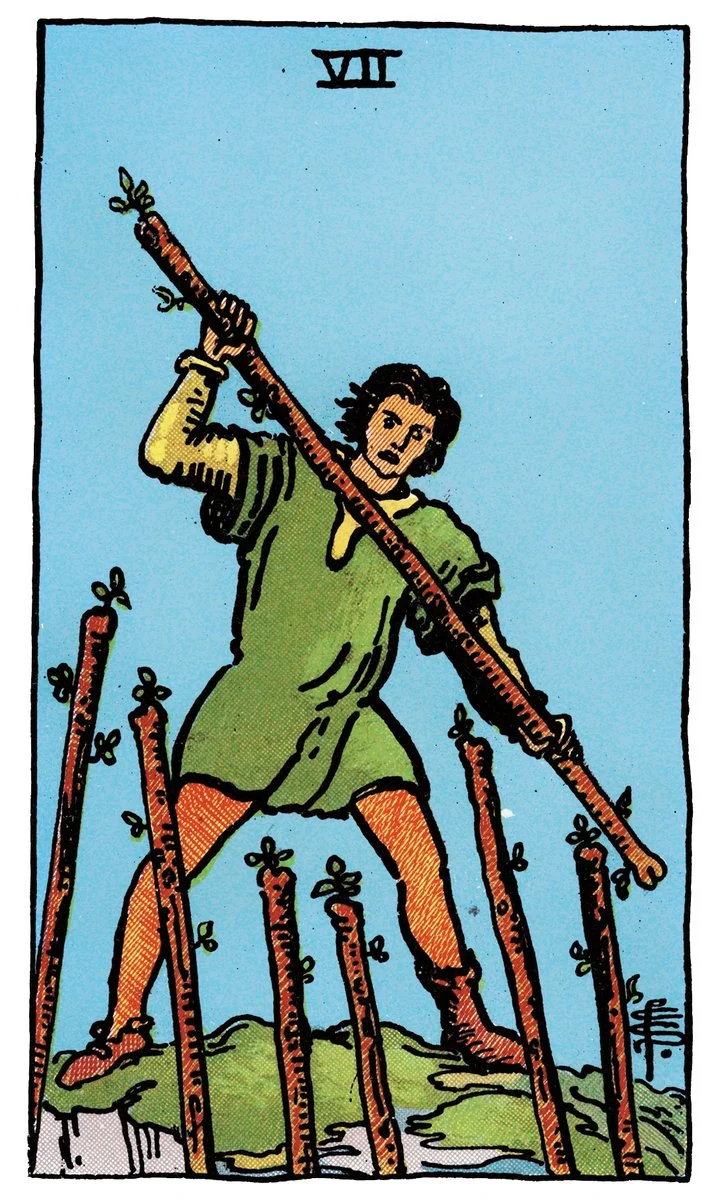
On the classic card, a young man stands on a rough green ridge, swinging a staff against six others pushed up at him from below. He’s outnumbered, but his height gives him an advantage. The card asks what core commitment makes the fight worth it, and whether your energy is going into real priorities or into reflexive resistance.
- Upright keywords
- standing your ground, perseverance, protecting what’s yours, challenge, defending your beliefs, boundaries
- Reversed keywords
- exhaustion, feeling overwhelmed, defensiveness, picking your battles, burnout, letting minor fights go
- The advantage of height
The defender stands above the staves raised against him. That height stands for authority, proven achievement or a right you’ve already established. The challenges come precisely because the position is visible and worth having. Instead of panicking, the figure uses the ground he already holds to keep rivals from overrunning him.
- Holding off many demands
Six staves rise at once, and only one person stands above them. The image shows a response, not an attack. Effective resistance isn’t about destroying opponents; it’s about keeping competing demands at a distance so your independence, focus and essential responsibilities stay protected.
- The cost of constant defense
Standing alone on a crag in mismatched shoes shows that defense takes energy and alertness, often in less-than-ideal conditions. High ground can become an isolating trap if you treat every interaction as an attack. Real endurance means knowing which challenges threaten your core and which you can ignore.
Seven of Wands upright and reversed meaning
Seven of Wands upright meaning
Upright, the Seven of Wands means you hold a strong position and have the resolve to protect your principles or achievements from competing interests.
Holding your ground
Demands, criticism or rival proposals are testing a position you’ve built. Your work or stance has become visible enough to be challenged. Meet the pressure by stating your boundaries clearly instead of escalating every point of friction. Decide which terms are non-negotiable, and let the less important ones pass without a fight.
Standing by what you believe
Holding your ground can feel lonely when no one is backing you up. Resilience here comes from conviction, not from hostility toward the people challenging you. Admit how tiring it is to stay on alert, and remind yourself why this particular ground matters to you, so you’re protecting something real and not just your pride.
Seven of Wands reversed meaning
Reversed, the Seven of Wands usually means constant defending is wearing you out, and it’s time to decide which battles to keep fighting and which to let go.
Worn out from defending
Treating every objection as an urgent threat drains your reserves fast. When the fight outgrows your capacity, stubborn resistance stops paying off. Ask whether holding out protects an essential principle or only delays a change you need to make. Stepping back from side battles protects the boundaries that truly matter.
Picking your battles
Admitting you can’t defend every front isn’t surrender; it’s using your energy wisely. See whether the pressure could ease if you clear up a misunderstanding, hand off part of the defense or step out of a debate you don’t need. Peace of mind often comes from letting go of minor claims, so your core self-respect stays intact without nonstop conflict.
Is the Seven of Wands a yes or no card?
Yes. The Seven of Wands is a yes if you’re asking whether to stand firm, protect your work or hold a boundary, because the card shows someone with the high ground and the will to keep it. It’s closer to a no for anything you hope will be easy, quick or free of pushback. Reversed, it suggests regrouping and cutting back before you take on another fight.
Seven of Wands symbolism
One figure on high ground faces a row of staves from below: leverage, alertness and physical effort make up the whole scene.
- The rocky high ground
The defender stands on a raised, rocky mound above the staves coming at him.
Height gives a physical and visual advantage. It doesn’t remove the opposition, but challengers have to strike upward while the defender can push down with less effort. In daily life, this is the credibility, standing or past achievement that makes your position easier to defend.
- Mismatched shoes
The figure wears two different shoes.
This small detail in the classic deck suggests haste. He seems to have rushed into the confrontation without time to get fully ready, defending on the spot against a sudden surge of demands. Holding your boundaries often happens in imperfect conditions, not after calm preparation.
- Six staves from below
Six staves rise from below the ridge, held by people we can’t see.
With no faces or bodies, the opposition reads as many anonymous pressures: competing assignments, family expectations, public scrutiny or your own doubts. The challenge comes from several directions at once rather than from one clear opponent.
- The staff in both hands
The defender grips a long staff with both hands, holding it between himself and the threat.
Held across the body, the staff works as both shield and weapon. It shows active choice rather than passive endurance. His energy goes into keeping outside interference at a distance he can manage.
Watercolor deck
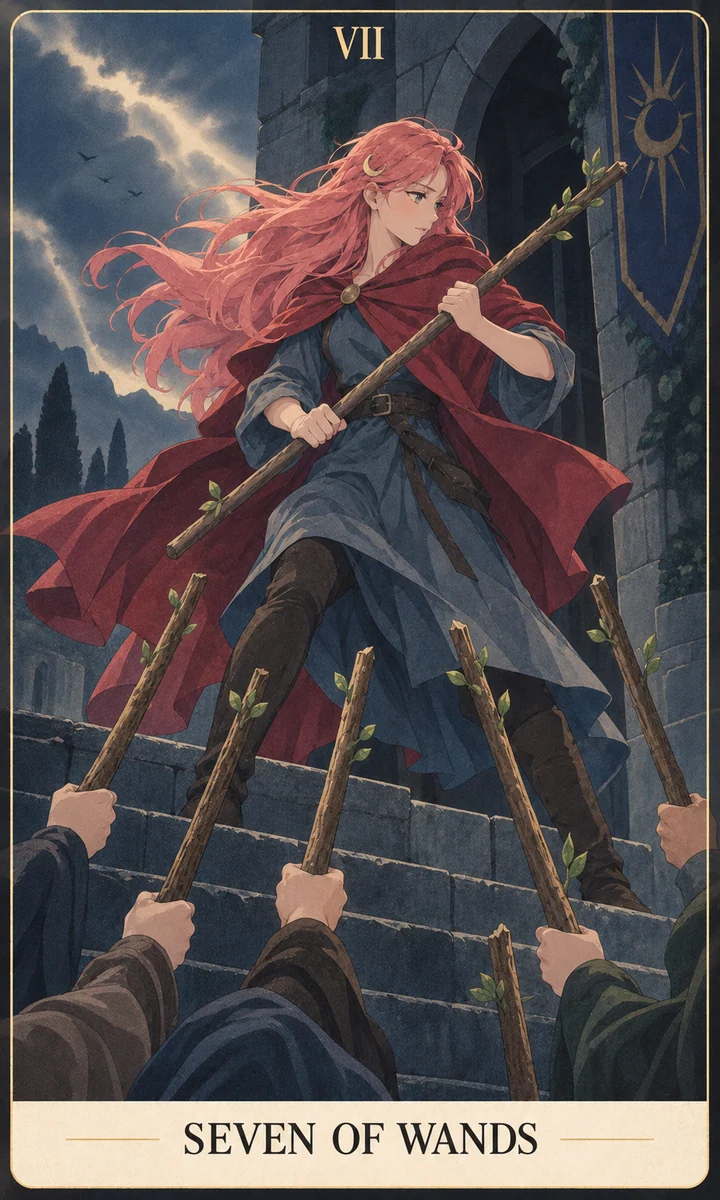
In our watercolor card, the figure stands with both feet planted on high stone steps, holding the staff crosswise as a firm barrier. Hands push staves up from below, while closed doors and a flag behind give the figure something concrete to protect. The boundary is being defended right at the threshold of personal space.
Seven of Wands in love and relationships
In love, the Seven of Wands asks whether protecting your boundaries keeps respect alive between you, or puts up walls against real closeness.
Seven of Wands as feelings
Upright · They feel protective of their values, their integrity or their choice to be with you, even if others disapprove. They’re determined to stand by their commitments despite the friction.
Reversed · Feeling constantly on guard or misunderstood may be turning into resentment, so conversations become counterarguments instead of open sharing. Notice whether their guardedness protects values you share or keeps honest vulnerability out.
Where the relationship stands
Upright · You may face doubts from family and friends, or the strain of busy schedules, and pull together to protect what you have. If the friction is between you, one partner is firmly holding a line on behavior they won’t accept.
Reversed · Arguments turn into ongoing contests where neither of you gives ground, or one person feels worn down by constant criticism. To keep the connection, you need to tell a healthy boundary from an emotional standoff.
Where it could go
Upright · Holding firm through the tension sets clearer boundaries, and the relationship can settle once the critics back off. If you want to deepen the commitment or reconcile, this means standing up for the relationship clearly.
Reversed · Long stretches of defensive strain often lead to exhaustion and emotional distance. To reconcile, both of you would need to lower your guard and see whether there’s still safe, mutual ground.
Seven of Wands career meaning
At work, the Seven of Wands means holding your authority on what matters most without getting dragged into every workplace rivalry.
Your approach at work
Upright · You’re ready to defend your proposals, your ideas or your role against competitors and skeptics. Confidence in your skills keeps you steady.
Reversed · Fatigue sets in as demands pile up from every direction, and you end up reacting instead of planning. Ask whether you’re defending a sound position or just resisting reasonable collaboration.
Working with others
Upright · Being visible invites challenges. Your advantage rests on a documented track record, real expertise and calm firmness, so state the facts and let your work speak for itself.
Reversed · Colleagues or competitors may take advantage of commitments you’ve stretched too thin, leading to missed deadlines or turf fights. Clarifying who actually does what defuses needless clashes.
Where your career is heading
Upright · Staying composed through a period of challenge cements your reputation and secures your authority.
Reversed · Fighting on without allies risks burnout or a public setback. Long-term progress depends on stepping back from minor disputes and saving your energy for your core responsibilities.
Seven of Wands money and finances
With money, the Seven of Wands means protecting what you’ve earned against pushy demands, overspending and competing obligations.
Income
Upright · You negotiate fair pay or hold your rates when people push you to discount your work.
Reversed · Competitors or demanding clients may eat into your margins if you don’t hold firm.
Spending
Upright · Saying no to requests for loans, unnecessary costs or covering family expenses protects your savings.
Reversed · Guilt or fatigue may lead you to agree to costs you can’t really afford.
Savings and security
Upright · Your core savings stay safe because you refuse risky bets made under peer pressure.
Reversed · Spreading your money across too many obligations you feel bound to defend weakens your position, so consolidate.
Seven of Wands in a tarot spread
Your question sets the topic, and the position in the spread tells you what role the card plays. Here’s how the Seven of Wands reads in five common positions.
- Present situation
- Upright: you hold a strong but contested position and need to defend your standards on purpose. Reversed: the pressure is wearing you down, and you’re questioning which fights to keep.
- Feelings
- Upright: alert and determined, aware that you’re mostly relying on yourself. Reversed: guarded, tired or overwhelmed by demands from every side.
- Obstacle
- Upright: constant defensiveness can blind you to useful feedback or cut you off from allies. Reversed: taking on more battles than you have energy for.
- Advice
- Upright: as advice, the Seven of Wands says stand firm on your core values, but don’t waste energy on minor disagreements. Reversed: let go of side battles so you have the strength to protect what matters.
- Outcome
- Upright: staying composed keeps your position secure. Reversed: cut back your commitments before exhaustion costs you your footing.
Related cards and further reading: Nine of Wands · Six of Wands · Strength · Tarot beginner’s guide.
Seven of Wands tarot card FAQ
What does the Seven of Wands mean?
The Seven of Wands means standing up for your position, values or achievements when they’re challenged. You’ve already gained an advantage, and now you have to protect it against outside demands, competition or doubt. The card is about resilience, clear boundaries and using the ground you’ve earned to withstand pressure without letting every challenge pull you into a fight.
What does the Seven of Wands reversed mean?
Reversed, the Seven of Wands means exhaustion from fighting too many battles at once, or from resisting a change you can’t avoid. It warns against digging in stubbornly when your energy is already spent. Read constructively, it tells you to narrow what you’re defending: protect your core boundaries and let the non-essential conflicts go.
What does the Seven of Wands mean as feelings?
As feelings, the Seven of Wands means someone guarded and self-protective. They may feel pressured by other people’s expectations or by past hurts, so their own boundaries come before an easy connection. They may respect you and still stay watchful, keeping their independence safe until they feel ready to lower their guard.
What does the Seven of Wands mean in love?
In love, the Seven of Wands often means standing up for your relationship against outside criticism, or holding an important personal boundary with your partner. It asks you to protect mutual respect and independence without turning everyday conversations into battles for control. Upright, it favors loyalty under pressure; reversed, it points to fatigue from constant friction.
Does the Seven of Wands reversed mean giving up on love?
Not necessarily. The Seven of Wands reversed more often shows fatigue from constant friction than a lack of feeling. Instead of total surrender, it usually asks you to drop defensive habits, let go of petty grievances and have an honest conversation about how much each of you can handle right now.
Why does the man in the Seven of Wands wear mismatched shoes?
The mismatched shoes suggest he rushed into the fight without time to get ready. It’s a small detail in Pamela Colman Smith’s drawing, and readers usually take it to mean the challenge came suddenly and he is defending himself on the spot. The lesson for you: boundaries often have to be held in imperfect conditions, not after calm preparation.