
What does Strength mean in tarot?
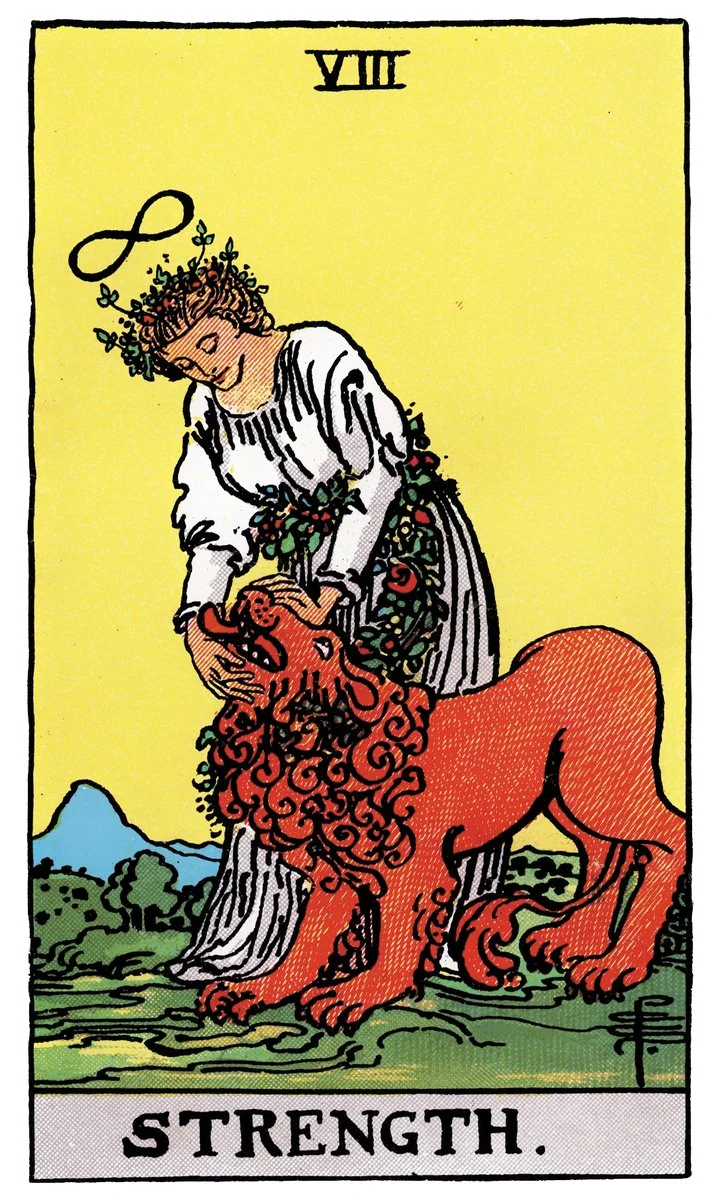
Strength shows courage not as armored conquest but as a steady presence when emotions or pressure run high. The woman carries no weapon and builds no cage. She approaches the lion directly, and with soft hands and a garland of flowers she guides its power instead of fighting it.
The card turns up when life asks for endurance more than a quick win. Courage here means feeling the fear, anger or desire without letting it decide what you do. Lasting influence, it says, comes from self-control, clear boundaries and patience, not from overpowering anyone.
- Upright keywords
- inner strength, courage, patience, compassion, self-control, calm confidence
- Reversed keywords
- self-doubt, exhaustion, impatience, bottled-up feelings, outbursts, insecurity
- Gentle control: her hands on the lion’s mouth
The woman closes the lion’s jaws with a soft touch, not chains or brute force. That makes strength a calm kind of mastery instead of domination. Fear, anger and strong passion settle down when they’re met with steady awareness, and real authority never needs violence or pressure to work.
- Ongoing balance: the infinity sign above her head
The sideways figure eight over her head repeats the sign above the Magician. Self-control isn’t a single victory that wipes out instinct for good. It’s an ongoing rhythm: you renew your patience, clarity and emotional balance each time a new challenge comes along.
- Persuasion over force: the garland of flowers
A chain of flowers circles the lion’s neck and the woman’s waist, linking human mind and animal energy. Willing cooperation makes a far sturdier bond than forced obedience. You influence people best when you respect their nature and invite trust rather than demand it.
Strength upright and reversed meaning
Strength upright meaning
Upright, Strength means quiet confidence and the ability to handle difficult people or strong instincts calmly, leading through patience and persuasion rather than pressure.
Calming conflict without aggression
Tense situations and defensive people respond best to calm. Instead of meeting heat with hostility, you can take the edge off friction by staying consistent, listening closely and keeping your dignity. Notice where you feel the urge to argue, demand an instant surrender or force an outcome. Try stating your boundary quietly instead, give the situation some room, and hold firm on what really matters.
Feeling it all without losing your balance
You can feel fear, vulnerability, grief or intense desire without being ruled by them. This isn’t pretending everything is fine. It’s making room for big feelings without acting on impulse. When stress rises, notice your first gut reaction, ask what it’s trying to protect, and then choose your response instead of letting anger or urgency choose it for you.
Strength reversed meaning
Reversed, Strength usually means your reserves are running low: self-doubt, exhaustion, or feelings held down for too long coming out as harsh, reactive control.
Running on empty
When you’ve been holding everything together for too long, confidence drops. You may doubt your abilities, back away from ordinary friction or mistake normal tiredness for a lack of courage. Your capacity is overdrawn, not broken. Stop demanding stoic performance from yourself, and rebuild with rest, fewer commitments and a break from high-conflict situations.
When holding it in turns into outbursts
Pushing irritation or fear down behind a polite face often ends in snapping at people or becoming overbearing. If boundaries aren’t kept gently along the way, the pressure eventually bursts out as blunt confrontation. Trace recent blowups back to the moment you first put up with something you shouldn’t have. Practice raising small boundaries early, before resentment makes a calm conversation impossible.
Is Strength a yes or no card?
Yes. Strength is a yes, especially for questions about facing a challenge, sticking with something or handling a hard conversation. It says patience and steady effort can get you there, as long as you don’t reach for force or shortcuts. Reversed, it’s closer to not yet: rebuild your energy, confidence and boundaries first, because endurance alone doesn’t guarantee the result.
Strength symbolism
The classic Strength card sets a gentle human touch against raw animal power, and shows the two working together.
- The lion and its jaws
A large lion yields calmly as the woman places her hands around its mouth.
The lion stands for raw instinct, vitality and passion. She calms it without hurting it, which says natural drives are meant to be guided, not destroyed.
- The white robe and flower garland
The woman wears a simple white gown and a garland of flowers that also loops around the lion’s neck.
Clear intentions and a gentle connection take the place of iron chains. The flower chain shows that willing cooperation holds better, and longer, than forced restraint.
- The infinity sign
A sideways figure eight floats above the woman’s head, the same sign that appears over the Magician.
It stands for continuous self-control and renewed energy. Mastering your impulses isn’t a one-time event; it’s an ongoing rhythm between conscious will and instinct.
- The open landscape and mountain
A warm yellow sky stretches over green ground toward a blue mountain in the distance.
Inner strength is rooted in ordinary, peaceful life. The far-off peak suggests big ideals reached through grounded, persistent steps across everyday ground.
Watercolor deck
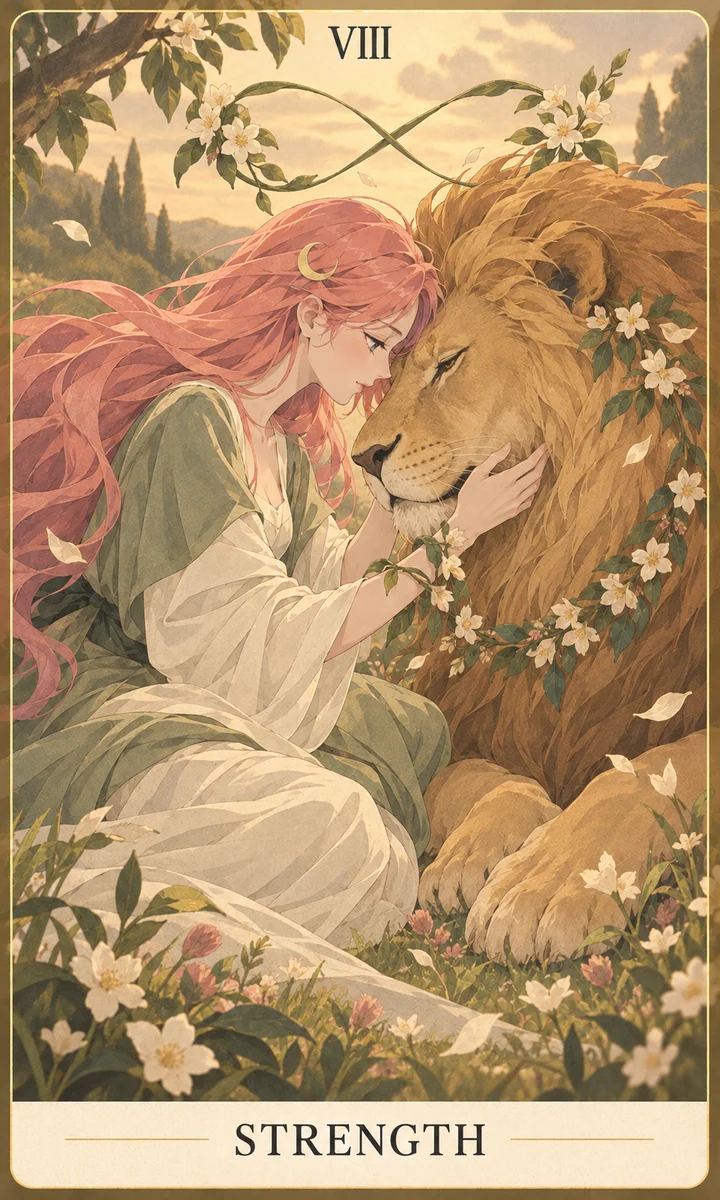
In our watercolor Strength, the woman rests her forehead against the lion’s while her fingers cradle its jaw. Its heavy paws lie loosely on the ground, flowering vines curl around them both, and a faint infinity sign glows above. Trust replaces struggle: instinct softens when it feels heard and safe, and tenderness turns out to hold a great deal of power.
Strength in love and relationships
In love, Strength usually means patience, emotional safety and the courage to stay open, as long as the patience goes both ways and never turns into putting up with mistreatment.
Strength as feelings
Upright · Strength as feelings suggests attraction held with restraint, and a wish to respond patiently rather than rush. Someone who feels this way can hold their attraction steadily, without panic. Holding back doesn’t prove a hidden, intense passion, though; real interest shows up in how they actually treat you.
Reversed · Insecurity, defensiveness or emotional exhaustion are getting in the way. Someone may pull back out of fear of rejection, or lash out because their need for reassurance feels too exposed to say calmly. Inner turmoil is shaping how they show affection, so watch whether they own their reactions or put them on you.
Steady warmth through everyday friction
Upright · The relationship runs on mutual respect and mature communication. You can talk through sensitive disagreements without turning them into power struggles, and you give each other room to work through hard feelings.
Reversed · The relationship has slid into walking on eggshells, constant appeasing or sudden outbursts. One partner may have become the emotional caretaker, wearing themselves out soothing the other’s moods. Strength asks you to hold space, not to absorb disrespect or try to fix someone who doesn’t want to change.
Building trust that lasts
Upright · The relationship is moving toward deeper reliability and closeness. By working through old triggers with patient honesty instead of dramatic ultimatums, you both gain confidence that the partnership can handle rough patches.
Reversed · Progress stalls behind defensive walls, old resentments or boundaries that keep getting crossed. This path leads to burnout unless you both stop avoiding the hard conversations. Notice whether recent fights ended in real repair or just silence; lasting trust needs kindness and honest boundaries, not endless tolerance.
Strength career meaning
At work, Strength means staying composed under pressure, negotiating with tact and having stamina for the long haul, winning people over through competence rather than politics.
Staying calm when work gets tense
Upright · Heavy workloads, difficult clients or office politics call for a steady hand. Your professionalism and refusal to take the bait make you a calming presence, and that earns quiet respect. Keep your core duties separate from the drama.
Reversed · Work stress has worn down your patience. You may feel undermined by aggressive personalities, tempted to get defensive, or simply drained by responsibilities that need more emotional stamina than you have left. Ask whether you’re responding to real work problems or getting pulled into disputes that eat your focus.
Leading through diplomacy
Upright · Opportunities open up where someone needs to mediate, steady a project or change a difficult culture. Showing you can handle complicated people without creating friction puts you in line for valuable responsibility. Point to your record of steady results through uncertainty rather than making loud claims.
Reversed · Opportunities slip away because of self-doubt, reluctance to state your value, or a hard push that alienates key people. Doubting your leadership makes you hesitate just when visible composure is needed. Think about what the next step really asks of you: here, success depends on emotional intelligence and persistence.
Committing to lasting mastery
Upright · Your career benefits from sticking with a hard skill or a long-term goal. A lasting reputation is built through daily, unglamorous craft and staying true to your professional standards despite distractions.
Reversed · You may be wondering whether the grind is worth the emotional cost, stuck between quitting too early and staying somewhere toxic out of misplaced endurance. Perseverance only helps when it’s tied to a goal that works. If the work fits your values, rebuild your stamina; if the setup itself is exploitative, plan a deliberate exit.
Strength money and finances
With money, Strength means steady habits, resisting impulse spending and sticking to a budget over time, managing what you have with patience rather than reacting or speculating.
Steady gains through consistent effort
Upright · Strength favors sustained effort, patient communication and the confidence to ask for fair pay. Make your case with evidence of the value you bring. Endurance doesn’t guarantee payment, and it never means accepting unreasonable terms.
Reversed · Income feels slow to grow, which feeds frustration and self-doubt. You might undervalue your work because your confidence is low, or make hasty moves trying to force fast financial growth. Get your baseline stable before you push hard in a pay negotiation.
Taming impulse spending
Upright · Spending comes down to how you respond to desire or pressure. Notice the impulse before deciding whether a purchase fits what you need right now. Self-control keeps your choices open; denying every reasonable need just becomes another kind of strain.
Reversed · Emotional spending is putting pressure on your budget. Stress, boredom or the wish for a quick lift lead to retail therapy, then regret. Or penny-pinching gets so strict that it snaps into a spending binge. Look back at recent purchases for emotional triggers, and set spending limits you can actually live with.
Building resilience against shocks
Upright · Security includes being able to face the numbers without reacting on impulse. Emotional steadiness helps you talk things through and plan, but you still need practical resources and support behind it.
Reversed · Money worries get worse with catastrophic thinking or a refusal to face real debts. Avoiding the statements out of fear only feeds the anxiety, in a loop of dodging and dread. Lay out the exact numbers and build a realistic savings or debt plan; peace of mind comes from steady habits, not a sudden windfall.
Strength in a tarot spread
Where Strength lands in a spread changes what it describes. Your question sets the topic; the position tells you what part the card plays in the answer.
- Present situation
- Upright: you have the quiet resilience to handle current friction gracefully. Reversed: your emotional reserves are low, and tiredness or self-doubt is making it hard to respond well.
- Obstacle
- Upright: you may be putting up with too much without speaking up, mistaking passive endurance for strength. Reversed: raw impulses, anger or harsh self-criticism are creating needless conflict and clouding your judgment.
- Advice
- Upright: as advice, Strength says to lead with calm, hold your boundaries gently and leave force out of it. Reversed: stop punishing yourself for being tired; rest, rebuild your capacity and step out of power struggles you don’t need.
- Outcome
- Upright: steady persistence leads to a lasting resolution and real self-respect. Reversed: unresolved tension or reactive outbursts could undo your progress unless you step back and find your balance again.
To read Strength alongside the other cards in a spread, start with our Tarot beginner’s guide.
Strength tarot card FAQ
What does the Strength tarot card mean?
Strength means inner courage, patience, compassion and control over strong emotions. Upright, it shows the power of gentle persuasion and steady endurance when you face a hard challenge or a strong desire. Reversed, it points to worn-out resilience, self-doubt, or anger held in until it turns into reactive behavior. It’s about how you handle your instincts and the friction around you.
What does Strength reversed mean?
Strength reversed usually means your reserves are running low. You may be doubting yourself, too tired to respond the way you’d like, or bottling up irritation until it bursts out as snapping or control. It doesn’t mean you lack courage. It means you need rest, fewer demands and smaller, earlier boundaries before your patience can return.
How does someone feel about you if you pull Strength?
Strength as feelings usually means attraction mixed with restraint: someone who cares and wants to handle those feelings carefully rather than rush. Reversed, it can mean insecurity, holding feelings in, or trouble keeping reactions in check. The card can’t read anyone’s mind, so look at whether your actual interactions show interest, mutual respect and room for boundaries.
Does Strength in a love reading mean I should put up with how I’m treated?
No. Strength is about managing your own emotions, not quietly tolerating abuse or neglect. It asks you to answer conflict with calm instead of petty payback, and it also asks for firm boundaries. Holding space for someone doesn’t mean becoming their emotional punching bag, or trying to heal wounds they won’t work on themselves.
Is the Strength card 8 or 11?
Strength is card VIII in the Rider–Waite–Smith deck, with Justice at XI. In the older Tarot de Marseille, the two are swapped: Justice is VIII and Strength is XI. Neither order is wrong; decks simply follow different traditions. When you read, go by the number and image on the deck in front of you.
Does Strength at work mean pushing through or setting a boundary?
It can mean both. Upright, Strength means sustained effort that still leaves room to say what you need. Reversed, check whether endurance has turned into exhaustion, silence or fear of disagreeing. Look at the demands, the support you have and your chance to recover. If you’re facing intimidation or mistreatment, protecting your boundaries and getting support matter more than proving you can take it.