What does the Ten of Swords mean in tarot?
The Ten of Swords is a full stop. As the last numbered card of the Swords suit, it brings mental strain, conflict and constant defending to their end. An effort, an arrangement or a strategy has run its course and can’t be patched up to work the way it used to. The scene is severe because surrender feels severe: fighting on changes nothing, and accepting the defeat is the only way the cycle actually finishes.
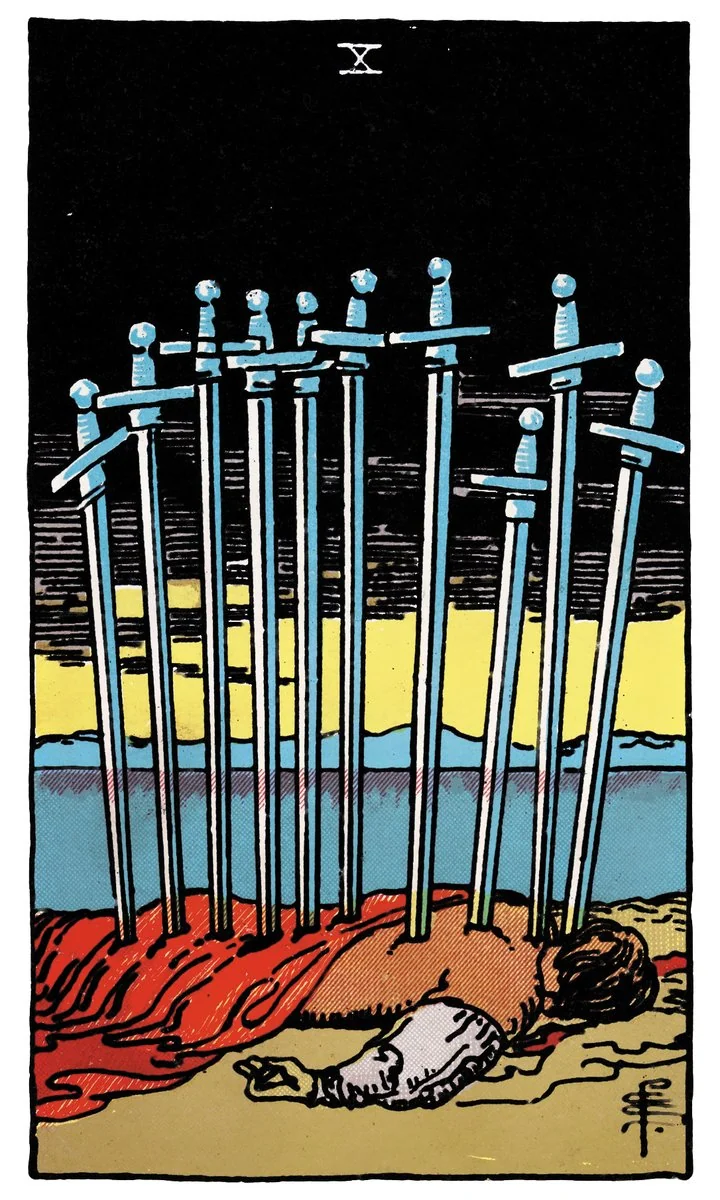
In the classic image, ten swords pierce a fallen figure under a black sky, yet a band of golden light breaks over calm water on the horizon. The card doesn’t promise a quick recovery or an easy aftermath. What it says is that the painful decline itself is over. There’s nothing more to lose to this particular battle, and from this stillness a different chapter begins.
- Upright keywords
- painful endings, rock bottom, exhaustion, defeat, letting go, the end of a cycle
- Reversed keywords
- recovery, the worst is behind you, slow healing, starting to rebuild, refusing to let go, reviving what’s over
- Finality
So many blades in one motionless figure is clearly excessive, and that’s the point. The card shows a way of coping, arguing or carrying strain that can’t go on as before. It speaks to the end of a particular pattern or arrangement, not proof that every option is gone. The image is dramatic, but it isn’t a sign of a physical event or a literal prediction of injury.
- Surrender
The figure lies face down, fully given over to what has happened. As hard as that looks, surrender lifts the exhausting work of constant vigilance and defense. When something fails completely, there’s nothing left to protect or hide. That kind of blunt honesty lets you rest in the plain truth of what happened and stop treating the defeat as something still up for debate.
- Dawn
A bright band of light stays beneath the dark sky, so the picture includes time beyond the ending. The light hasn’t restored the figure, though: a possible next phase and a finished recovery are different things. The contrast supports gradual rebuilding without promising that the worst is over or that no more trouble can come. Real recovery shows up as real changes in stability and in your ability to take part in life again.
Ten of Swords upright and reversed meaning
Ten of Swords upright meaning
Upright, the Ten of Swords means something has reached a painful, final end: a situation or effort is over and can’t be negotiated back.
When a situation is truly over
Outside events show that a project, role or relationship pattern has failed to hold together. Pushing on with the same tactics will only drain you further. When agreements break beyond repair or resources run out, naming the failure plainly stops the self-deception. Admitting it’s finished lets you clear the slate instead of staying stuck in endless damage control.
Too tired to keep fighting
Inside, you reach the point where you simply can’t carry the anxiety or disappointment any longer. Giving up an impossible fight brings a strange, quiet relief. Your mind stops searching for clever ways to save what won’t work. Let yourself admit the grief and the tiredness; stepping back completely comes before any real clarity or energy can return.
Ten of Swords reversed meaning
Reversed, the Ten of Swords usually means the worst is behind you and recovery is slowly starting, though it can also mean refusing to accept an ending that has already happened.
Refusing to let it end
When the reversed card points to resistance, you keep going back into a situation that has already collapsed. You might replay old arguments, try to revive a canceled project or keep up routines whose foundation is gone. Ask honestly whether your effort is building something that can work, or helping you avoid the pain of the loss. Dragging out an ending you can’t avoid only drags out the hurt.
Getting back up slowly
In its gentler reading, the reversal means the lowest point is behind you and things are starting to steady. You’re beginning to step back from the sharpest pain, look at the facts calmly and pick up practical tasks again. Recovery here is gradual, not dramatic. Don’t rush to replace what you lost; give your perspective time to settle while confidence and routine slowly come back.
Is the Ten of Swords a yes or no card?
No. The Ten of Swords is a no, especially if you’re asking whether to save a plan, keep fighting or hold on to something that has already broken down. The card marks a real ending, and pushing on with the same approach only brings more hurt. Reversed, it’s still a no to reviving what ended but leans yes for slow recovery, and if your question is whether to walk away or close a painful chapter, the card supports that.
Ten of Swords symbolism
Ten swords stand still against a brightening horizon: the fighting is over, and there’s room for a new day.
- The ten swords
Ten swords pierce the back of a figure lying face down by the water.
The number and tight row of blades make the strain look excessive, and the figure no longer holds a weapon to fight back. The image gives finality a visible shape: repeating the same struggle can’t keep the situation going. It doesn’t measure the size of a real loss or decide which choices remain. The useful line is between admitting an approach is exhausted and assuming your whole life has ended.
- The red cloth
A red cloth lies across the lower half of the fallen body.
Red stands for vitality, passion and real investment. Against the black sky and cold steel, the red cloth marks where human energy was spent: real care and effort went into what fell apart. Lying still on the ground, it shows that action has stopped for now. It honors what was put in without pretending it can bring back what has fallen.
- The golden horizon
A band of yellow and gold light breaks along the distant water under a heavy black sky.
The contrast between dark sky and bright horizon gives the scene a sense that time goes on past this ending. The light leaves room for another phase without showing how recovery will happen, and it can’t prove that all the bad news is over. Paired with the still figure, it points to rebuilding at a different pace, under new conditions, rather than an automatic return to how things were.
- The still water
Behind the shore, the water lies completely flat and calm.
Water stands for emotion throughout the tarot. Unlike the choppier water in earlier Swords cards, this sea is perfectly still. The calm reflects the deep quiet that comes after a final resolution. There’s no storm, panic or urgency left to manage. Feelings have stopped thrashing, which lets a plain, honest recognition of the truth come through.
Watercolor deck
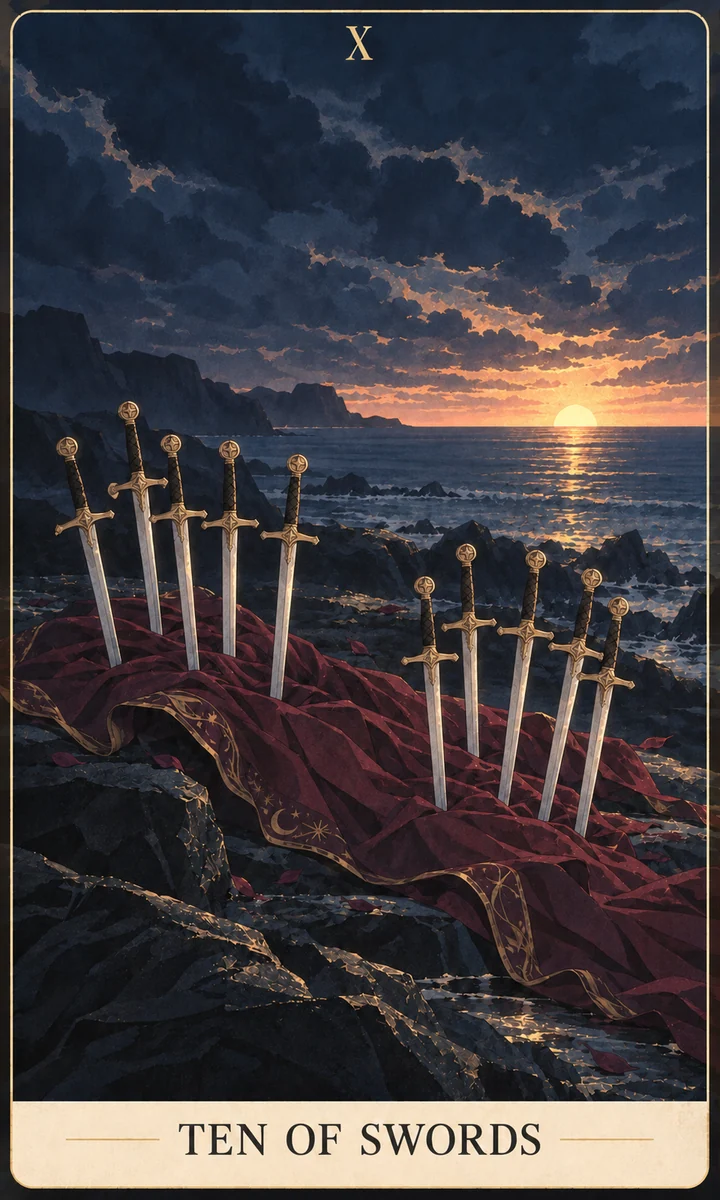
The watercolor lays a crimson cloak across cold coastal rocks among upright blades, with no human figure in sight. That shifts the focus from being a victim to leaving behind a role that has worn itself out. The dawn rising over the sea suggests the struggle has been left on the shore, so your attention can turn to the open day.
Ten of Swords in love and relationships
In love, the Ten of Swords points to a relationship pattern that has reached its end, and asks whether it’s truly over or whether you’re beginning to rebuild from a low point.
Ten of Swords as feelings
Upright · They feel emotionally exhausted. Repeated friction, broken promises or a lack of give-and-take have drained them, and they may want to stop trying altogether. There’s little fight left in them, only a quiet readiness to let the issue go.
Reversed · Their feelings may start to lift as acceptance sets in, or harden into bitter fixation if one of them refuses to accept that it’s over. Look for a real willingness to talk, as opposed to numbness about staying involved.
Where the relationship stands
Upright · Things between you have broken down so completely that the usual repairs can’t save the old arrangement. Pretending it can go back to normal gets in the way of honest closure.
Reversed · You’re either taking careful steps to heal after a blowup, or dragging out a breakup through on-and-off, unclear contact. Notice whether both of you are actually doing the work of repair, or just keeping up an empty shell.
Where it’s heading
Upright · The card points toward a clear parting, or the complete end of an unhealthy habit between you. Accepting that ending stops the cycle of hurt.
Reversed · A fresh start is possible only if the old dynamic is truly left behind rather than patched over. For a reconciliation to work, both of you have to face what broke, with sober accountability, instead of hoping nostalgia will erase the hard facts.
Ten of Swords career meaning
At work, the Ten of Swords means a project, job or strategy has run its course, and letting it end frees your time and energy for something else.
Burnout and disillusionment
Upright · You or your team have hit burnout, or lost all faith in a particular direction. Pouring more long hours into a venture that can’t work won’t change the result.
Reversed · Motivation may slowly come back as the pressure eases, or someone may cling to an outdated plan out of pride. Ask whether the energy you have now is going into recovery or into defending sunk costs.
Endings at work
Upright · A project, partnership or job comes to a hard stop. Mismatched goals or a restructuring make it impossible to continue.
Reversed · The immediate crisis has passed, which leaves room for an honest debrief and gradual rebuilding. Cooperation improves only when the team admits past mistakes openly instead of sweeping structural failures under the rug.
Where your career is heading
Upright · The path leads to a layoff, a canceled project or leaving a role. It hurts, but it ends the lingering uncertainty.
Reversed · A new path starts to appear after the setback. Moving forward means letting the old professional identity or the failed deal go completely, so you can build new skills on realistic ground.
Ten of Swords money and finances
With money, the Ten of Swords points to an arrangement that can’t be kept up anymore, and to the responsibilities that are still there after it ends.
Income and returns
Upright · The theme may be a return you were counting on that fell through, or an arrangement that no longer works as planned. Your real income and losses are in your records, not in the card.
Reversed · Recovery has real support when new, sustainable conditions appear. If all you have is hope that the old arrangement will come back, that points to resistance to change. The card doesn’t call a market bottom or predict a rebound.
Costs left behind
Upright · An ending can leave costs and responsibilities that still need handling.
Reversed · Those obligations may become easier to manage, or delay may stretch the original strain out longer. The difference is between conditions that have truly changed and an old burden under a new name. The card doesn’t tell you to sell, borrow or handle your money in any particular way.
Financial security
Upright · A sense of security or a financial plan may need rethinking, though the card doesn’t mean total collapse.
Reversed · Rebuilding is helped by clearer responsibilities and arrangements that can actually last. Feeling less distressed and being financially stable are different developments, and each needs its own evidence rather than a guess from the card’s orientation.
Ten of Swords in a tarot spread
Your question sets the topic, and the card’s place in the spread sets its job. Here’s how the Ten of Swords reads in the positions people use most.
- Present situation
- Upright: an effort, conflict or pattern has reached its end, so stop fighting what’s already over. Reversed: the worst has passed and you’re starting to recover, or you’re still trying to revive what ended.
- Feelings
- Upright: deep exhaustion and surrender. Let yourself grieve instead of forcing fake optimism. Reversed: relief and acceptance are slowly coming in, or the hurt is turning into fixation.
- Obstacle
- Upright: denying that something is over keeps you stuck in pain. Reversed: clinging to sunk costs, or rushing to replace what you lost, gets in the way of recovery.
- Advice
- Upright: as advice, the Ten of Swords says accept the loss fully and lay down your defenses; stepping away is what makes room for new growth. Reversed: rebuild slowly, and let go of whatever you’re still trying to bring back.
- Outcome
- Upright: the painful phase is finishing. Reversed: healing has begun, or the end is still being resisted; which one depends on whether you keep reaching back for what’s gone.
Cards to compare with the Ten of Swords, and a guide to reading it in a spread: Three of Swords · Death · The Star · Tarot beginner’s guide.
Ten of Swords tarot card FAQ
What does the Ten of Swords mean?
The Ten of Swords means a painful ending, rock bottom or the collapse of a plan that couldn’t work. It shows an old pattern that can’t function anymore. Upright, it asks you to accept that the struggle is finished, so you stop pouring energy into an outcome you can’t change. The dawn on the horizon shows that time, and your life, go on.
What does the Ten of Swords reversed mean?
Reversed, the Ten of Swords usually means the worst is behind you and a slow recovery is beginning. You’re starting to steady yourself, look at what happened calmly and rebuild your routines. It can also mean refusing to accept an ending and trying to revive something that has already broken down. Which reading fits depends on whether you’re making practical changes or circling back to the past.
What does the Ten of Swords mean as feelings?
As feelings, the Ten of Swords means the person feels drained, defeated and unable to carry the emotional weight any longer. They’ve often reached the point where they can’t keep fighting or defending themselves. It hurts, but that exhaustion also brings a quiet willingness to let the issue go. Reversed, their feelings may slowly lift as they accept what happened.
What does the Ten of Swords mean in love?
In love, the Ten of Swords marks the end of a relationship that couldn’t last, or the collapse of an unhealthy pattern within it. Upright, forcing things to work will only stretch out the hurt. Accepting what has happened lets both of you find peace, whether that means going your separate ways or staying together in a completely new form.
What does the Ten of Swords reversed mean in love?
Reversed in love, the Ten of Swords usually means the first shock of a breakup or crisis is easing and you’re starting to feel steady again. It doesn’t promise that you’ll get back together. If you both do consider reuniting, the old harmful habits have to go completely, rather than picking up where you left off.
Does the Ten of Swords mean death?
No. The Ten of Swords doesn’t predict a death or a physical injury, even though the image is graphic. It describes the end of a pattern, plan or struggle that has run its course, and the exhaustion that comes with it. The dawn on the horizon is part of the meaning: something is over, and something else can begin.