
What does the Five of Wands mean in tarot?
The Five of Wands means competition and friction: several people, ideas or demands pushing at once, with no one in charge. Picture a meeting where everyone talks over each other, or a week when every obligation wants your attention at the same time. It’s noisy and tiring, but rarely serious harm.
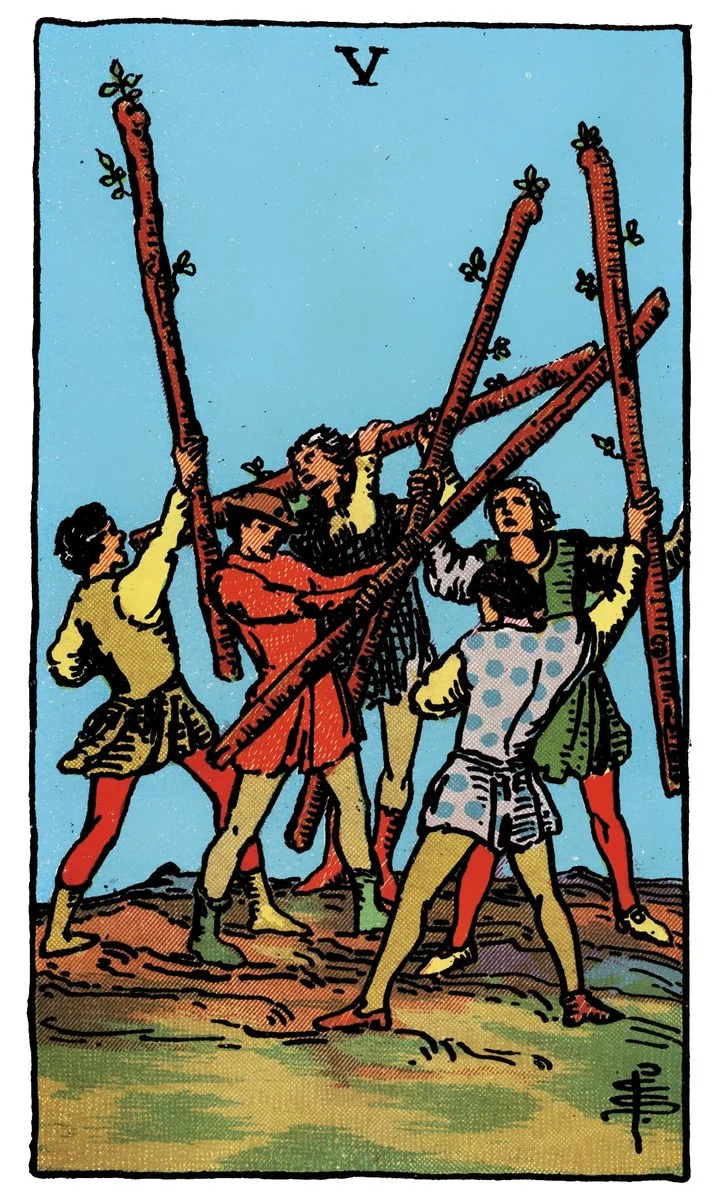
On the classic card, five young men swing wooden staves at one another in a tangle of movement. It could be a game, practice or a real fight; no one has the upper hand, and each seems to have a different aim. Wands are about energy and ambition, so this isn’t the deliberate harm of the Swords. It’s the scramble of testing strength, defending turf and arguing your view when everyone wants the same space.
- Upright keywords
- competition, conflict, disagreement, rivalry, tension, testing your strength
- Reversed keywords
- avoiding conflict, suppressed tension, truce, compromise, resolution, walking on eggshells
- Everyone for themselves
The five figures face different ways, each swinging a staff to their own rhythm. This is what happens when people act on valid, separate motives without coordinating. The tension comes from paths that overlap, not from malice. Friction is almost certain when independent goals meet in a shared space before anyone has set rules or priorities.
- Testing your strength
Nobody lands a decisive blow, which makes the struggle look more like sparring than battle. Resistance becomes a proving ground where ideas, stamina and arguments show whether they hold up under pressure. Pushing against opposition reveals the weak spots in your position, so competition works as a filter that makes everyone sharpen their focus and adapt.
- No firm footing
The ground is uneven, which echoes the lack of order or agreed hierarchy in the group. With staves crossing at random angles, every move gets in someone else’s way. Energy gets used up in the tangle itself. Without someone to mediate or lead, progress stalls in a loop of small collisions.
Five of Wands upright and reversed meaning
Five of Wands upright meaning
Upright, the Five of Wands means competition, clashing viewpoints and everyday friction that call for resilience and clear self-expression.
Too many voices at once
You’re in a crowded situation with competing demands, differing opinions or open rivalry. In a meeting or a negotiation, several people may be pushing their own preferences without really listening. Treat the friction as a chance to test your ideas and clarify your boundaries, not as a personal attack. Show what you can do, stay patient through the noise, and resist the urge to shut other voices down too soon.
Pulled in different directions
You may feel torn between conflicting impulses, duties or ambitions. Part of you wants security while another part wants a creative risk, and your mind keeps churning. Not every desire can take center stage at once. Name each priority, so you can separate healthy ambition from scattered distraction and make your choices one at a time.
Five of Wands reversed meaning
Reversed, the Five of Wands usually means the conflict is either settling down through honest negotiation or going underground through avoidance and forced silence.
Peace on the surface
Disagreements may be swept aside to keep up a fragile look of harmony, while the real grievances go unaddressed. When people stop voicing different views because they’re tired, afraid of conflict or intimidated, open debate turns into quiet resistance and foot-dragging. Ask whether the current calm is a real compromise or tension that will flare up again under pressure.
Calming things down
The reversal can also mean the fighting is winding down because everyone sees it’s getting nowhere. When people say what they really need and listen without getting defensive, the scramble turns into coordination. To tell an exhausted retreat from a real resolution, check whether the core disagreement was actually cleared up or just shelved to avoid discomfort.
Is the Five of Wands a yes or no card?
No. The Five of Wands leans no for anything that needs smooth teamwork, quick agreement or an easy path, because the card shows effort scattered in every direction. If you’re asking whether to compete, pitch or put your ideas up for debate, it’s closer to a yes, though you’ll have to work for it. Reversed, the answer depends on whether the conflict is truly being resolved or just avoided.
Five of Wands symbolism
Five staves clash in midair, showing a scene where everyone’s push crosses everyone else’s, with no center to organize it.
- Crossing staves
Five wooden staves cross in the air at different angles, but none strikes anyone.
Wands stand for drive, passion and initiative. Here they form a web of interference instead of building something together. Each staff follows its own path and blocks its neighbors without doing lasting harm, much like a debate or a bidding war where everyone pushes at once. The tangle stays stuck until someone steps back and gives the exchange some structure.
- Different clothes
Each young man wears a tunic of a different color.
The contrasting clothes point to separate identities and motives. Unlike an army in uniform under one command, these figures have their own agendas and their own stake in the outcome. Read with their clashing stances, the tunics suggest that arguments often come from genuinely different values, not plain stubbornness, so each view needs acknowledging before agreement is possible.
- Uneven ground
The figures stand on rough ground, some leaning in and others leaning back.
The uneven footing keeps anyone from getting a firm stance or the upper hand. It reflects how conditions keep shifting in a contest before anyone takes control. Energy goes into just keeping balance, which is how competitive situations feel: constant small adjustments and no lasting stability.
- A clear sky
A clear, pale sky stretches above the figures, with no storm clouds.
Other cards show grief or crisis under heavy weather; this sky is calm and open. That supports reading the scene as sport, practice or a productive contest rather than ruin. The conflict stays within ordinary human friction, a clash of wills that can be worked out if it’s addressed openly.
Watercolor deck
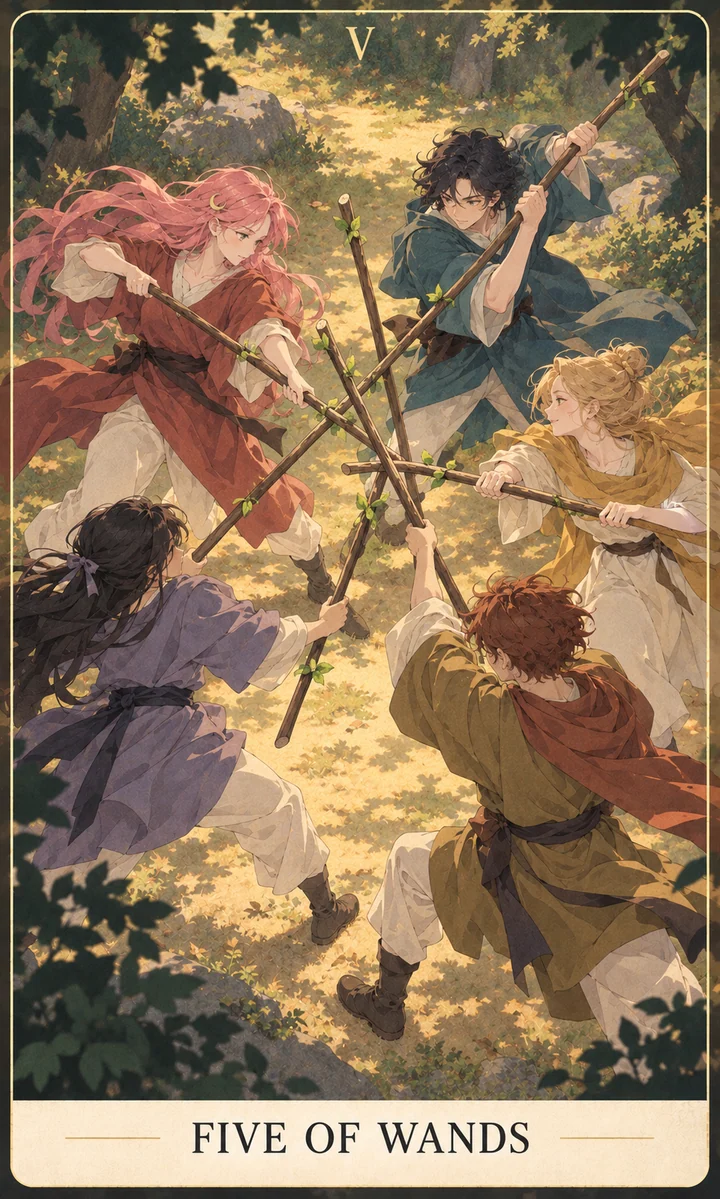
Our watercolor card sets the five figures in a quiet forest clearing, their crossed staves forming a loose lattice among the trees. The woods frame the scuffle as a small, local struggle rather than a war. Because each figure looks a different way, the tension is spread across several personal disputes instead of aimed at one enemy.
Five of Wands in love and relationships
In love, the Five of Wands points to friction, clashing priorities and different expectations, not to a crowd of rivals.
Five of Wands as feelings
Upright · Their feelings are stirred up and a bit combative. Differences in temperament or values may challenge them, so they feel affection alongside a strong urge to protect their independence.
Reversed · They may be holding back frustrations they haven’t voiced, or pulling away from hard conversations to avoid an argument. The five figures describe friction, not a literal count of romantic competitors. Ask whether the tension comes from wanting to be understood or from wanting to win every small disagreement.
Where the relationship stands
Upright · Expect frequent debates, squabbles over routines or the struggle of fitting two busy schedules together. It’s tiring, but handled with respect, this kind of friction can help you both state your boundaries.
Reversed · Either things settle into a healthier calm after you’ve talked it out, or they slide into cold, resentful silence. Notice whether hard topics are being solved together or carefully avoided. A peaceful surface over unspoken grievances does more harm to intimacy than an honest argument.
Where it could go
Upright · The relationship is heading toward a decisive conversation about your different visions for the future. Moving forward means agreeing on fair ways to disagree, not trying to defeat each other.
Reversed · If you find the root of the friction, the relationship can cool into steady cooperation. If avoidance wins, unresolved disputes will slowly wear down trust. For getting back together or committing more deeply, the question is whether you can both work through differences without keeping score.
Five of Wands career meaning
At work, the Five of Wands points to competition, stakeholders who want different things and the friction that comes with brainstorming.
Your approach at work
Upright · You’re ready to assert yourself in a crowded field: defending proposals, showing what you can do and holding your own against competitive colleagues or a tight market.
Reversed · Your energy turns either toward mediating or toward burnout from constant office squabbles. Ask whether the friction sharpens your work or just drains your motivation without moving anything forward.
Working with others
Upright · The team is busy, argumentative and full of overlapping responsibilities. Strong personalities clash over creative direction in brainstorming sessions, so clear ground rules are needed to turn debate into progress.
Reversed · The group either sorts out a sensible division of labor or slips into passive-aggressive resistance and cliques. Check whether the friction produces better ideas through open debate, or simply slows the work because responsibilities were never clearly assigned.
Where it’s heading
Upright · Projects move forward through testing and competition, and only ideas that hold up to scrutiny survive. Expect challenges from competitors or reviewers that push you to raise your standards.
Reversed · It depends on whether clarity replaces rivalry. Reaching agreement gets the work moving again, while chronic avoidance leads to missed deadlines and lingering resentment.
Five of Wands money and finances
With money, the Five of Wands points to competitive markets, contested resources and budgets pulled in several directions.
Income
Upright · Earning takes effort against competition, whether you’re bidding against other vendors or negotiating hard for your pay. The money is there, but others want it too.
Reversed · Pressure eases if you find a niche, or earnings suffer from disorganized, wasteful infighting. Focus where your skills meet the least pointless resistance and clearly deliver value.
Spending
Upright · Several urgent demands compete for limited money: bills, debt payments and things you want. Prioritize firmly instead of trying to satisfy every claim at once.
Reversed · Money friction between partners either gets resolved through a shared budget, or keeps leaking through hidden costs and uncoordinated spending.
Savings and security
Upright · Shifting expenses and competing obligations test your security, which calls for steady oversight, not panic.
Reversed · Your budget steadies when everyone involved agrees on clear limits; unresolved disagreements keep your reserves exposed. Make sure your plan can absorb a rough patch without tipping into reactive overspending.
Five of Wands in a tarot spread
Your question sets the topic, and the position in the spread tells you what role the card plays. Here’s how the Five of Wands reads in five common positions.
- Present situation
- Upright: you’re surrounded by competing agendas, noisy debate or open rivalry; step into the contest and show what you can do. Reversed: check whether people are really cooperating or just hiding their disagreements to avoid discomfort.
- Feelings
- Upright: restless frustration and feeling challenged, though the friction also shows how much you care. Reversed: emotional exhaustion, or bottling up resentment instead of speaking up.
- Obstacle
- Upright: stubborn defensiveness and infighting drain energy that should go into building. Reversed: avoiding hard conversations lets resentment build and undermine long-term goals.
- Advice
- Upright: as advice, the Five of Wands says stand your ground without sliding into petty conflict, and welcome debate that sharpens your arguments. Reversed: start a calm conversation, clarify fuzzy boundaries and stop spending energy on fights that produce nothing.
- Outcome
- Upright: a period of testing and debate that leaves you stronger if you come through it. Reversed: the tension either settles into a workable compromise or keeps simmering under the surface.
Related cards and further reading: Seven of Wands · Five of Swords · Three of Pentacles · Tarot beginner’s guide.
Five of Wands tarot card FAQ
What does the Five of Wands mean?
The Five of Wands means competition, disagreement and clashing energy. Five figures swing staves at each other, showing several people chasing different goals with no one leading. Upright, it can describe healthy rivalry, a heated brainstorm or defensive sparring: a phase when your ideas and boundaries get tested against real opposition.
What does the Five of Wands reversed mean?
Reversed, the Five of Wands means the conflict is moving one of two ways. If people say what they need, the friction calms down into compromise, shared rules and a fresh start. If differences get suppressed out of fear or fatigue, the tension goes underground as avoidance, quiet resentment and problems nobody names, which can undermine progress later.
What does the Five of Wands mean as feelings?
As feelings, the Five of Wands means inner tension, irritation or a competitive edge. They may feel challenged by you, or torn between impulses of their own. Upright, they find the dynamic stimulating but frustrating and want to prove themselves. Reversed, they may be worn out by the friction and tempted to pull away.
What does the Five of Wands mean in love?
In love, the Five of Wands means friction: bickering over small things, crossed signals or routines that don’t mesh. Both of you may be asserting your independence strongly. That can deepen understanding through honest debate, or wear down intimacy if it never lets up. The card asks for fair ground rules, so disagreement doesn’t turn into personal attacks.
Does the Five of Wands mean there’s a rival in love?
Not usually: the Five of Wands rarely points to a literal rival. The five figures don’t count romantic competitors; they show scattered intentions and friction, often between the two of you or within one person. Reversed, it typically means you’re cooling off after an argument or walking on eggshells around ongoing irritation. Ask whether the quiet comes from understanding or from avoidance.
What does the Five of Wands mean at work?
At work, the Five of Wands means competition, clashing personalities and debates over direction. It might show a crowded job market, rival bids or a brainstorm where everyone talks at once. Handled well, the friction tests and improves your ideas; handled badly, it bogs the team down. Clear roles and ground rules decide which way it goes.