What does The Hierophant mean in tarot?
The Hierophant is the card of tradition and shared wisdom. It stands for the ways a community passes on knowledge, ethics and identity: education, tradition and institutions that turn scattered life experience into something that can be taught. Where the Emperor runs the practical rules, the Hierophant looks after what those rules mean. It tends to appear when you’re joining an established group, looking for a mentor, or turning a private intention into a commitment other people recognize.
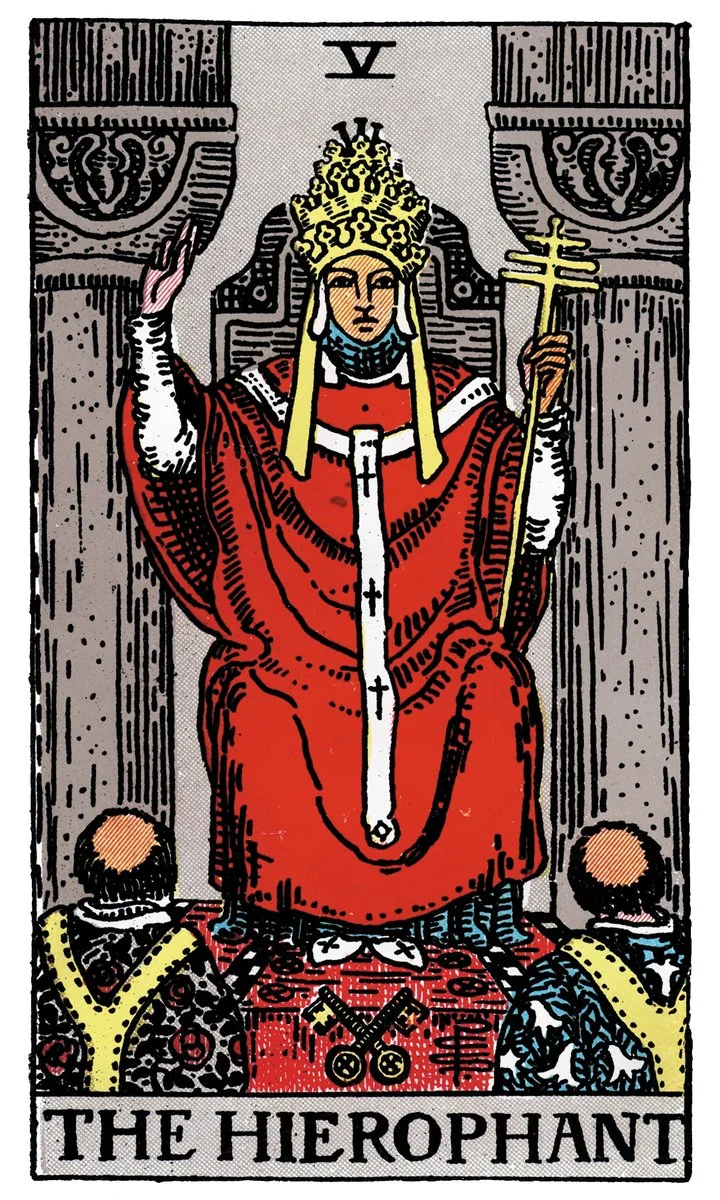
On the Rider–Waite–Smith card, the Hierophant sits between two pillars with crossed keys at his feet, speaking to two kneeling followers. Wisdom here isn’t hidden away or forced on anyone. It’s kept, explained and handed on through teaching and ceremony. The card isn’t about solo adventures; it’s about finding your place in a group and steadying relationships through public promises and shared agreement. Ask which community, teaching or established practice is guiding your judgment right now.
- Upright keywords
- tradition, shared values, mentorship, learning, institutions, formal commitment, belonging
- Reversed keywords
- rebellion, questioning tradition, rigid rules, pressure to conform, personal values, going your own way
- Tradition and shared values
The Hierophant sits between two solid pillars, explaining established teaching rather than private revelation. That ties the card to wisdom a community recognizes in public. In everyday questions, ask which cultural norms, shared ethics and proven conventions are shaping your situation.
- Learning from a mentor
The two kneeling followers show that this kind of wisdom comes through guidance, patience and apprenticeship. For your own growth, the card asks whether you’re respecting the stages of learning, getting advice from people with real experience and building skill on a foundation that has been tested over time.
- Commitment and belonging
The crossed keys lie between the teacher and his two students, linking teaching with access to a shared tradition. In a reading, this can mean joining a community, accepting its standards or making a commitment other people recognize. Ask what the agreement requires and whether you truly share its values. A ceremony or an official label doesn’t, on its own, make an arrangement fair, legal or right for you.
The Hierophant upright and reversed meaning
The Hierophant upright meaning
Upright, the Hierophant means that established methods, experienced guidance and shared values are the way forward, and that it’s a good time to line your choices up with a framework others recognize.
Working within the system
The situation favors official channels, recognized credentials and traditional ways of doing things. Following proven precedents and asking senior people or respected mentors for advice gets the most reliable results. Learn the existing rules, standards and expectations of the group you’re joining; working within accepted practice gives you legitimacy and makes everyone’s obligations clear.
Choices rooted in lasting values
Inside, you want your personal wishes to fit a moral or philosophical foundation that lasts. Meaning comes from belonging to a tradition of study, craft or shared ideals. Get clear on the core principles behind your long-term priorities. Give time to structured study, apprentice yourself to a craft, and let principles that have stood the test of time steady your decisions.
The Hierophant reversed meaning
Reversed, the Hierophant usually means your own conscience is at odds with the rules or traditions around you, and the question is whether you’re thoughtfully going your own way or just rejecting structure.
Rules that no longer fit
Inherited beliefs, bureaucratic rigidity or peer pressure are blocking change that needs to happen. A traditional standard or an authority figure may be giving outdated advice that doesn’t match what you can see in front of you. Notice where going along with things breeds resentment or keeps you from contributing. Separate what an institution genuinely does well from empty ritual, so you know what actually needs to change.
Going your own way, responsibly
Real independence means building your own coherent guidelines, not just reacting against authority. Breaking customs without taking responsibility for the result only creates instability. Spell out the personal ethics, and the ways you’ll hold yourself accountable, that will replace the rules you’re leaving behind. Your path should rest on self-discipline, not on dodging responsibilities you share with others.
Is The Hierophant a yes or no card?
Yes. The Hierophant is a yes, especially for questions about an established path: studying for a qualification, going through official channels, honoring an agreement or asking an experienced mentor for support. It’s a harder yes for plans that depend on bending the rules or going it alone, where it signals resistance. Reversed, it leans toward not yet, because the plan lacks a sound basis or the people involved don’t share the same values; rework your standards before you decide.
The Hierophant symbolism
The Rider–Waite–Smith Hierophant uses symmetrical architecture, religious regalia and a teaching scene to show how culture and shared belief get passed on in the open.
- The two pillars
Two solid stone pillars stand on either side of the seated figure.
Unlike the veiled space of the High Priestess, these open columns stand for institutional order and knowledge that’s written down and available to everyone.
- The crossed keys
A pair of keys, one gold and one silver, lies crossed at the foot of the throne.
The keys stand for access to teaching and shared understanding: the methods and language that let you take part in a community.
- The raised hand and the triple cross
His right hand is raised in a gesture of blessing, and his left holds a staff topped with three crossbars.
The gesture and the staff signal formal teaching authority, with doctrine passed on clearly through layers of hierarchy and tradition.
- The two kneeling ministers
Two tonsured clergymen in decorated robes kneel before him, listening closely.
They show the bond between student and teacher, a reminder that shared wisdom needs someone willing to receive it with respect and real engagement.
Watercolor deck
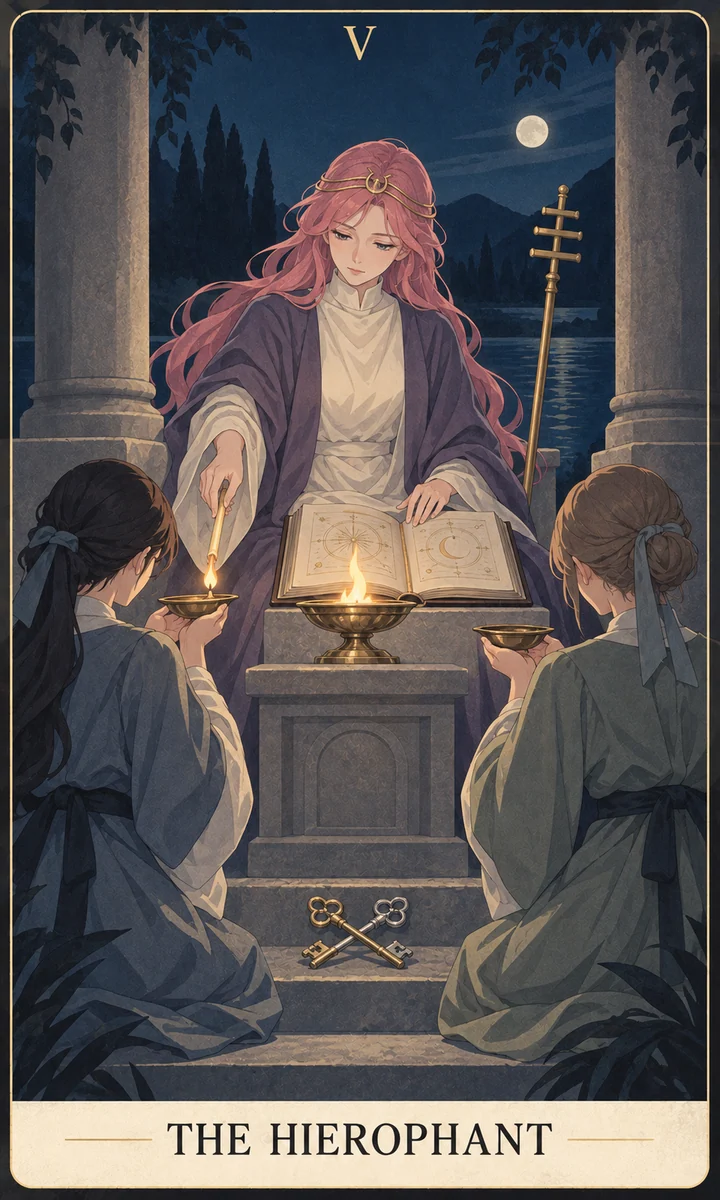
In our watercolor Hierophant, a woman teacher sits between two stone pillars with an open book in her lap, facing two students who hold lanterns, with crossed keys below. Light passes from one lantern to the next. The painting turns the Hierophant’s authority into a gentler image of knowledge lighting the way: experience is gathered in the book, and shared belief is handed on from learner to learner, building a lasting lineage.
The Hierophant in love and relationships
In love, the Hierophant means shared values, serious commitment and the part family and tradition play in your relationship.
The Hierophant as feelings
Upright · If you pulled the Hierophant for someone’s feelings, they likely respect you and want to take things seriously, seeing you through the lens of long-term responsibility. They may be proper and a little reserved about showing emotion, and they may care a lot about whether the relationship fits what family and community expect. Talk about what kind of relationship you each want and what it would involve.
Reversed · They may feel boxed in by family pressure, social expectations or moral rules, or they may have lost interest in a traditional kind of relationship and don’t want obligations defined by other people. Polite behavior with little warmth can mean they care more about form than feeling, so judge by how they actually engage with you.
Traditional steps and clear agreements
Upright · The relationship values clear boundaries, recognized labels and conventional milestones you both invest in. Meeting each other’s families, shared rituals or a public commitment give it a steadying structure.
Reversed · You may want different kinds of relationship, be trying an unconventional arrangement, or be pushing back against social norms. Disagreements often center on marriage, religious traditions or household rules. Ask whether the conflict comes from the relationship itself or from family and social pressure, and tell updating an old custom apart from avoiding shared responsibility.
Moving toward a formal commitment
Upright · The relationship moves forward through formal steps, from private interest to a status other people recognize. You both focus on agreeing on the values and standards for a shared life.
Reversed · Formal commitment stalls because one or both of you question whether the standard model fits what you actually need, and a different kind of partnership may be what keeps the intimacy alive. Ask whether commitment is a goal you genuinely share or a milestone you’re chasing out of habit; any agreement has to be one you can both keep willingly.
The Hierophant career meaning
At work, the Hierophant means navigating institutions, earning credentials, learning from a mentor and following company ethics and standard procedures.
Working inside an established institution
Upright · You’re working within an established company hierarchy, an educational institution or a heavily regulated industry. Success depends on following official processes, consulting senior people and respecting protocol. Know the official reporting lines and who holds formal decision-making power.
Reversed · Red tape, rigid management or office politics smother initiative. Outdated policies block necessary changes and leave little room for creative problem-solving. Ask whether the standard procedures protect the organization or simply protect inertia.
Growth through mentorship and qualifications
Upright · Advancement comes from formal training, recognized certifications and learning under an experienced professional. Connecting with a respected institution builds credibility for the long term. Invest in skills and knowledge your industry recognizes rather than shortcuts.
Reversed · The traditional career ladder or degree requirements may pay off less for your particular goals, and you may need mentors outside the usual channels. Ask whether your field truly needs institutional credentials, or whether a visible record of independent work counts for more.
A calling grounded in values
Upright · Your career fits well with education, law, counseling, public service or other established professions. Purpose grows from contributing to a craft or tradition that will outlast you.
Reversed · A gap between your values and your company’s mission may call for rethinking your path, and freelance work, independent research or niche consulting may start to make sense. If you’re planning to leave an institution, build portable skills and your own network first.
The Hierophant money and finances
With money, the Hierophant means conservative management, conventional savings and investments, and staying on the right side of financial rules and taxes.
Steady, conventional pay
Upright · The Hierophant points to recognized pay structures, qualifications and professional conventions. Find out which standards set your pay and whether they fit the work you do. A traditional route isn’t automatically a dependable one, so check the actual rate, timing, obligations and costs.
Reversed · A conventional pay structure may not fit the work, or you may be weighing an independent arrangement. Check whether the alternative has clear terms and a workable basis. Being unconventional doesn’t make it unreliable on its own; compare both routes on the same concrete details.
Dues, memberships and family obligations
Upright · Spending here involves obligations that come from shared standards or membership. Separate the commitments you genuinely accept from costs you take on only to meet other people’s expectations.
Reversed · Money drains into rigid memberships, heavy administrative fees or guilt-driven social spending, and required contributions may strain your finances. Review recurring dues, subscriptions and traditional gifts, and drop the ones that are only for show.
Security by the book
Upright · Familiar procedures and professional advice can be reassuring. You still need to check the specific terms and limits, because reputation, official recognition or a long history don’t mean there’s no risk.
Reversed · Conventional financial formulas may not hold up as circumstances change. Or ignoring standard tax and compliance rules risks penalties and legal trouble. Make sure your tax filings, insurance and legal agreements meet the requirements, and balance careful saving with realistic adjustments to current conditions.
The Hierophant in a tarot spread
Your question sets the topic, and the position in the spread tells you what job the Hierophant is doing. Upright or reversed shows the state of its themes; the position decides whether they describe where you are, how someone feels, what’s in the way or what to do.
- Present situation
- Upright: you’re guided by established procedures, an institution or an experienced mentor, and there’s a clear way to proceed. Reversed: the rules no longer match reality, and you face a clash of views or a stalled process; ask whether the friction comes from stifling rules or from a wish to dodge legitimate responsibility.
- Feelings
- Upright: deep respect, serious commitment and appreciation for shared values and structure. Reversed: feeling restricted, judged or uncomfortable with social expectations that are being forced on you.
- Obstacle
- Upright: rigid dogma, resistance to new ideas, or caring so much about approval that you lose your own judgment. Reversed: rejecting all authority and guidance, which leaves your plans without the structure or credibility they need.
- Advice
- Upright: as advice, the Hierophant says to consult experienced people, follow the established process and base your decisions on recognized standards. Reversed: question outdated assumptions, think for yourself, and take full responsibility for a well-reasoned standard of your own.
To read the Hierophant alongside the other cards in a spread, start with our Tarot beginner’s guide.
The Hierophant tarot card FAQ
What does the Hierophant tarot card mean?
The Hierophant means tradition, shared values, education and formal institutions. It’s card V of the Major Arcana. Upright, it suggests following proven methods, working within established systems and asking trusted mentors for guidance. Reversed, it points to tension with tradition: rules that no longer fit, and the need to build personal standards you can actually stand behind.
What does the Hierophant reversed mean?
The Hierophant reversed means a rift between you and the rules or traditions around you. Sometimes rigid dogma or bureaucracy is holding things back; sometimes you’re stepping away from blind obedience to find your own values. The test is whether you have a better standard to replace the old one. With it, this is growth. Without it, rebellion just creates chaos.
Does the Hierophant mean marriage?
The Hierophant can point toward marriage, but it doesn’t guarantee it. In love, the card describes valuing formal commitment, shared values and family acceptance, which often supports moving toward a wedding. Whether one actually happens depends on the other cards in the spread and on whether you’re both taking real steps, from family conversations to the legal paperwork.
How does someone feel about you if you pull the Hierophant?
Upright, the Hierophant usually means they respect you and take you seriously, seeing you as someone they could build a long-term commitment with. They may be proper and reserved about showing emotion. Reversed, they may feel held back by family or social expectations, or resist a traditional relationship and the obligations other people attach to it.
Does the Hierophant reversed mean someone doesn’t want commitment?
Not necessarily; the Hierophant reversed usually shows doubts about traditional forms of commitment, not a refusal to commit at all. The person may object to things like meeting the family on a set schedule or a big wedding, while still wanting a real partnership on more private, flexible terms. An honest conversation will show whether they’re resisting the rules or the relationship itself.
What is the difference between the Hierophant and the Emperor?
The Emperor stands for practical authority and rules, while the Hierophant stands for the shared values and traditions behind them. The Emperor sets responsibilities and keeps things running; the Hierophant teaches what the rules mean and passes them on. If your question is about who’s in charge and how things get done, think Emperor. If it’s about beliefs, belonging or a mentor, think Hierophant.