What does the Two of Swords mean in tarot?
The Two of Swords describes an uneasy balance you keep by not looking. You face two options, and choosing either one means losing something, so you choose nothing for now. That keeps the peace in the short term, but only by ignoring the evidence around you and refusing to commit to a direction.
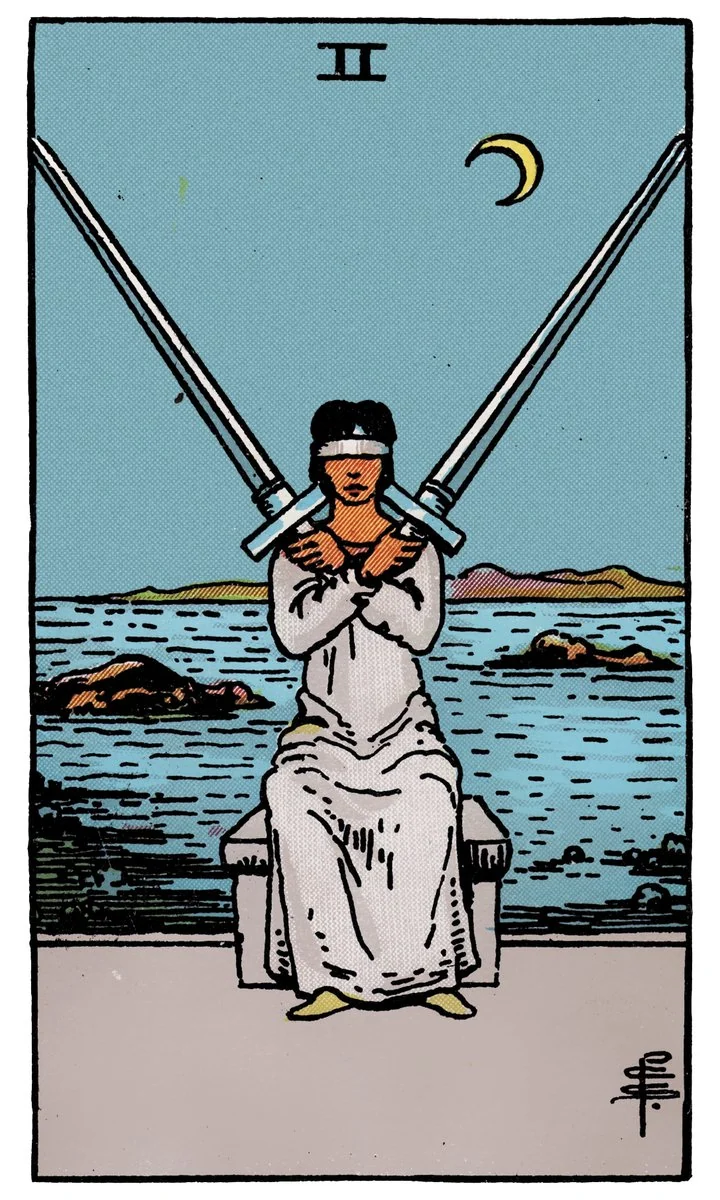
In the Rider–Waite–Smith card, a blindfolded woman sits still on a stone bench with two heavy swords crossed over her chest. The calm sea behind her reflects self-control more than real peace. It is a familiar place to be stuck: not choosing feels safer than facing the discomfort a choice would bring.
- Upright keywords
- stalemate, indecision, avoidance, a fragile truce, blocking out pressure, a choice on hold
- Reversed keywords
- a forced decision, new information, the standoff breaking, the truth coming out, overwhelm, facing trade-offs
- Choosing not to see: the blindfold
The white cloth over her eyes is a deliberate refusal to look outward. With it on, she blocks out unsettling facts, other people’s pressure and the reality of the situation. That buys a little mental quiet, but it also cuts her off from the very information she needs to settle the dilemma.
- Equal tension: the crossed swords
Two broadswords held in perfect symmetry stand for two options that feel equally heavy. Keeping both raised takes constant strength and concentration, which is what a drawn-out stalemate costs you. Holding a standoff is not rest; it is tiring, active defense.
- Surface calm: still water and rocks
The flat sea behind the bench suggests feelings held down by strict mental control. The surface looks undisturbed, but jagged rocks break through the water. Real clarity doesn’t come from pretending those rocks aren’t there, and composure that depends on ignoring your surroundings is fragile.
Two of Swords upright and reversed meaning
Two of Swords upright meaning
Upright, the Two of Swords means a stalemate: you’re keeping a fragile peace by putting off a hard choice and not looking too closely at what it involves.
A standoff that holds, for now
Things have stalled because two competing obligations carry equal weight. Instead of confronting someone or accepting a loss, the strategy is to not engage. That limits the pressure in the short term, but the underlying conflict stays unresolved. Nothing moves until someone accepts the cost of tipping the balance.
Keeping your feelings in check
You may be turning your feelings down so a looming decision doesn’t overwhelm you. Tuning out other people’s opinions keeps you calm, but it also keeps out facts that matter. Notice what you’re refusing to see and the fear behind your hesitation. Staying neutral is a decision too.
Two of Swords reversed meaning
Reversed, the Two of Swords usually means the standoff breaks: new information, a deadline or pent-up feelings force you to deal with what you were holding off.
When the blindfold comes off
The quiet ends as new information or an outside deadline drags the issue into the open. Whether that brings relief or more distress depends on whether you can say what matters most to you. If you know your reasons, the break feels like a weight lifting. If you don’t, the sudden exposure can leave you overwhelmed and reacting at random.
Facing the trade-off you put off
Avoiding reality has stopped working, and the consequences you tried to postpone are arriving. You may feel rushed by events or stuck between contradictory advice. Rather than trying to keep everyone happy, accept that one sword has to come down. Deciding what you’re willing to give up gives you back control far faster than hunting for a painless way out.
Is the Two of Swords a yes or no card?
Maybe. The Two of Swords is a maybe that leans toward “not yet,” because nothing moves until someone makes a choice. It favors pausing to look honestly at the facts and the trade-offs over pushing ahead blind. Reversed, an answer comes sooner, often because new information or a deadline forces the decision.
Two of Swords symbolism
A seated figure shuts out both what she could see and the water behind her, holding two blades in careful balance.
- The blindfold
A white cloth covers the seated woman’s eyes.
The blindfold shuts out what she could see and what others might show her. It is a barrier she chose, not a disability, which suggests she prefers working things out in her head to facing what’s in front of her. It keeps outside pressure away, but it also cuts off the information she would need for a realistic judgment.
- Crossed swords
She holds two broadswords crossed over her chest, points raised.
The blades form a barricade over the heart, and holding them up takes constant effort. Swords belong to thought and conflict, so two crossed blades suggest two arguments of equal strength. No one can hold that pose forever; the strain of balancing two heavy weapons mirrors the strain of keeping an unresolved standoff in place.
- The stone bench
She sits on a plain, gray block of stone.
The hard seat suggests stillness without comfort. Stone gives stability but no flexibility, so she stays put and can’t make a quick escape. Together with the water behind her, the bench describes someone who has dug in and chosen rigidity over adapting to what is changing around her.
- Calm sea and rocks
Smooth water stretches behind her, broken by small, sharp rocks.
Water stands for feelings, which look quiet and flat here under tight control. The rocks poking above the surface hint at hazards she can’t steer around while blindfolded. Holding feelings down creates a calm surface, but the difficulties are still there just beneath it.
Watercolor deck
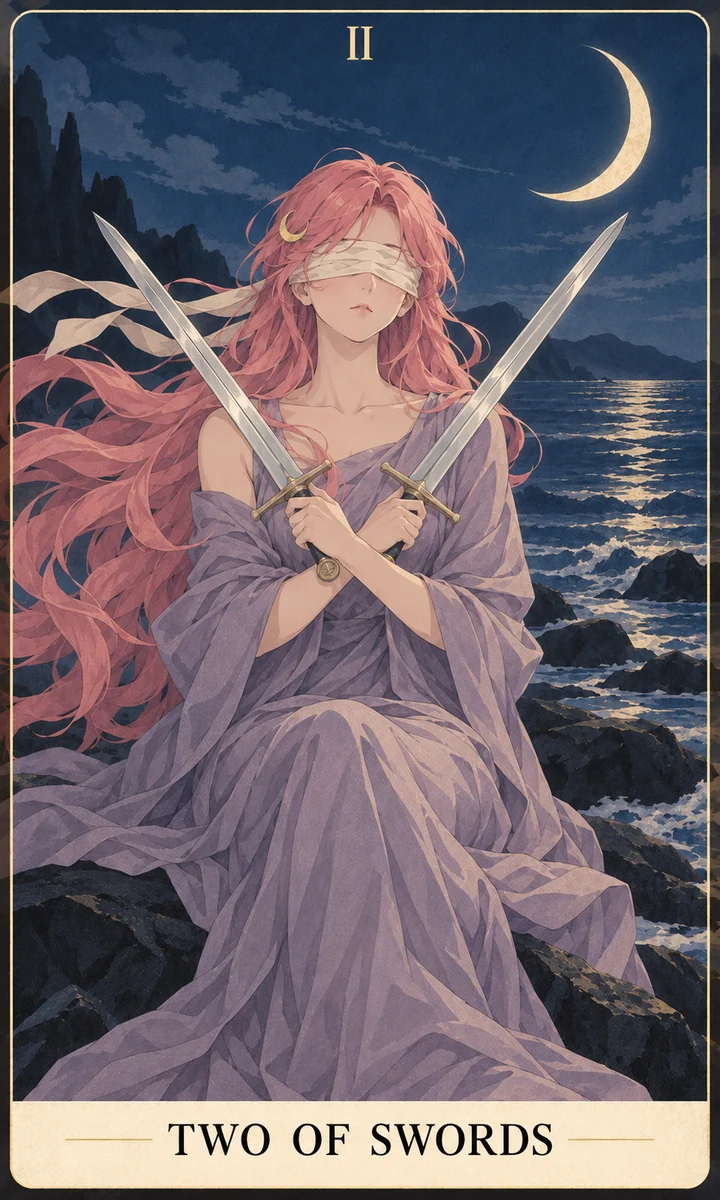
In the watercolor, the figure sits on the shore with crossed blades held firmly over the chest, facing away from the water. A thin crescent moon hangs above the sea, a reminder that feelings keep moving like tides while the figure holds a rigid barrier against them.
Two of Swords in love and relationships
In love, the Two of Swords points to guarded feelings and conversations you both avoid, and asks whether anyone is willing to risk being open.
Two of Swords as feelings
Upright · They are deliberately keeping their feelings to themselves to avoid conflict or exposure. They may care about you, yet they stay guarded because admitting what they want could upset a fragile balance.
Reversed · That guard starts to crack. Either they’re finally ready to say something uncomfortable, or resentment they’ve bottled up is spilling out without much direction.
An unspoken truce
Upright · You may have an unspoken agreement not to bring up certain subjects. That keeps the everyday peace, but it creates distance and stalls deeper commitment.
Reversed · The conversation you’ve both been avoiding can’t be put off any longer. If you can each name your real limits calmly, it opens the way to genuine repair. If you only trade accusations, things get messier.
Where it’s heading
Upright · The relationship stays frozen until one of you is willing to disturb the status quo. Neither reconciliation nor progress can happen while nobody moves.
Reversed · Circumstances push toward a resolution, either an honest renegotiation or an end to the standoff altogether. Progress comes from admitting plainly what can’t change, not from pretending the conflict isn’t there.
Two of Swords career meaning
At work, the Two of Swords means a deadlock: divided loyalties, or a choice between two strategies that nobody wants to make.
Staying neutral at work
Upright · You or your colleagues are staying neutral on purpose, to avoid office politics or a commitment to an untested plan. Caution prevents mistakes for now, but drawn-out hesitation starts to look like passivity.
Reversed · Keeping your head down is no longer an option. You’re pushed to take a public position or carry out a plan, which tests whether your strategy rests on solid facts.
Negotiations at a draw
Upright · Negotiations are stuck because neither side will give ground, so deadlines keep slipping. Standard procedures keep the basics running while the real decisions wait.
Reversed · Outside developments break the deadlock. If clear terms guide the change, the project moves forward smoothly; without agreed standards, the sudden pivot causes friction.
Where your work is heading
Upright · Your path stays where it is while management delays choosing between two directions. Use the wait to get your numbers and evidence ready.
Reversed · A direction gets chosen, either by a decision from above or by changes in the market. Success depends on letting go of the losing option quickly and putting your energy into the one that remains.
Two of Swords money and finances
With money, the Two of Swords means a financial standstill: purchases on hold, income flat and trade-offs you haven’t made yet.
Income on hold
Upright · Earnings stay flat because contracts are delayed or you can’t decide whether to expand. Holding the current baseline at least prevents losses.
Reversed · Cash flow shifts as delayed payments arrive or frozen agreements get renegotiated, and you need to decide quickly where the money goes.
Spending you keep putting off
Upright · Spending is frozen because you can’t tell which purchase really matters. You save money now, but needed updates keep slipping.
Reversed · An expense you can’t avoid forces you to release funds, and a tighter budget elsewhere has to cover it.
Choosing what to fund
Upright · Your stability rests on caution: you avoid long-term commitments and keep things as they are.
Reversed · Staying balanced now means choosing which obligation to pay off first, and accepting that you can’t fund every goal at once.
Two of Swords in a tarot spread
Where the Two of Swords lands in a spread changes what it describes. Here is how it usually reads in five common positions, upright and reversed.
- Present situation
- Upright: a decision has stalled because both sides weigh the same, so nothing moves. Reversed: new facts or outside pressure are breaking the stalemate.
- Feelings
- Upright: they’re keeping their feelings in check to stay calm amid wants that pull in different directions. Reversed: the guard is slipping, and what they held back is starting to show.
- Obstacle
- Upright: refusing to face uncomfortable facts or give up one option keeps a stalemate going that can’t last. Reversed: being forced to choose before you know your priorities.
- Advice
- Upright: as advice, the Two of Swords says take off the blindfold, look honestly at what’s in front of you and accept that a choice means a trade-off. Reversed: decide what you’re willing to give up before events decide for you.
- Outcome
- Upright: the holding pattern won’t last, and moving on will take a deliberate choice. Reversed: an outside disruption is more likely to end it.
To read the Two of Swords alongside other cards, see Ace of Swords · Seven of Cups · Justice · Tarot beginner’s guide.
Two of Swords tarot card FAQ
What does the Two of Swords mean?
The Two of Swords means a stalemate. You’re facing a choice between two options that both cost something, and you’re holding off by not looking too closely. That keeps the peace for now, but it takes steady effort and leaves the real problem frozen. The card asks what you’re refusing to see.
What does the Two of Swords reversed mean?
Reversed, the Two of Swords means the standoff is breaking down. New information, a deadline or outside pressure forces a choice. If you already know your priorities, this brings clarity and relief. If you still won’t accept a trade-off, it can bring overwhelm, panic or scattered reactions.
What does the Two of Swords mean as feelings?
As feelings, the Two of Swords describes someone guarding their heart. They may care about you, but they’re shutting down communication to protect themselves from conflict, hurt or the pressure of a real commitment. That isn’t necessarily indifference; they’re avoiding the vulnerability of saying what they want.
What does the Two of Swords mean in love?
In love, the Two of Swords points to an unspoken agreement to avoid touchy subjects so the peace holds. It prevents arguments today but builds distance over time. Real closeness comes back only when both of you are willing to talk openly about where you differ.
What does the Two of Swords reversed mean in love?
In love, the Two of Swords reversed means tensions you’ve both held down have broken through. It rarely signals sudden harmony. An argument or truth you avoided now has to be dealt with, and how it goes depends on whether you state your boundaries honestly or just trade blame.
What does the Two of Swords mean as advice?
As advice, the Two of Swords tells you to stop waiting for the choice to get easier. Take off the blindfold: look at the facts, ask the questions you’ve avoided and name what each option would cost you. Then decide what you can live without. Staying neutral is also a decision, and it has a cost of its own.