
What does Justice mean in tarot?
Justice is about seeing a situation as it really is. It asks what’s true once excuses and personal preferences are set aside. The card doesn’t grant wishes or hand out random punishment. It reflects cause and effect: every choice carries weight, and sooner or later every situation shows what it’s made of.
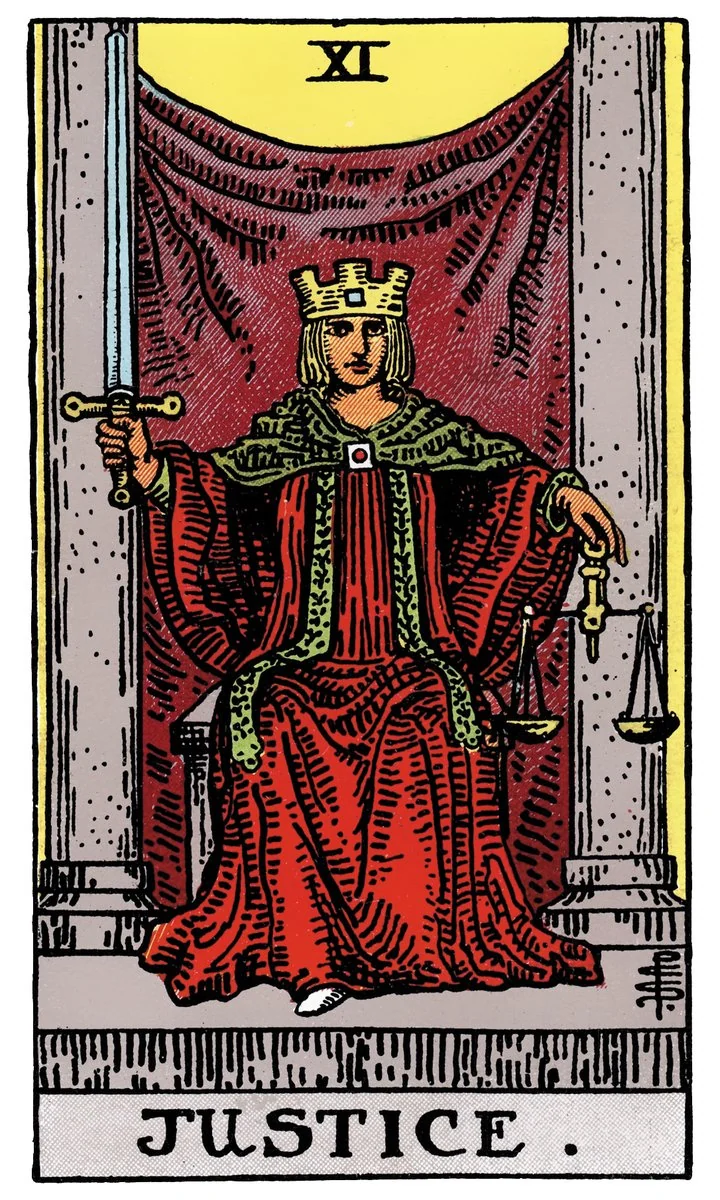
The figure sits squarely between two matching pillars, a picture of stability and one consistent standard. In one hand, golden scales weigh competing claims and evidence. In the other, an upright double-edged sword stands for the clarity it takes to make a decision and set firm boundaries. Fairness here doesn’t mean everyone gets the same outcome; it means actions are measured against reality, and the results are accepted.
- Upright keywords
- fairness, truth, cause and effect, accountability, honest decisions, contracts and agreements
- Reversed keywords
- unfairness, bias, dishonesty, avoiding accountability, double standards, blaming others
- Weighing the facts: the scales
The scales stand for comparing evidence and responsibilities by one consistent standard. Fair doesn’t always mean equal shares: a difference can be justified by an agreement, relevant circumstances or what each person actually contributed. In a reading, work out what each person knows and which standard applies before deciding where the imbalance is. Feelings matter, but being unhappy with a result doesn’t make it unfair.
- A clear decision: the double-edged sword
Held straight up, the double-edged sword stands for clear judgment, firm boundaries and decisive action. Its two edges cut both ways, through other people’s deceptions and through your own excuses. It doesn’t swing wildly. It waits to carry out a conclusion reached fairly, because clarity often means cutting away what is dishonest or no longer workable.
- A steady standard: the seat between two pillars
The figure sits between two pillars, which gives the judgment a stable setting and ties Justice to rules, agreements and boundaries. Ask whether the rules were clear in advance, whether they apply to everyone equally and whether disputed information can be checked. The card points to a fair process; it doesn’t certify that a particular institution or decision is already fair.
Justice upright and reversed meaning
Justice upright meaning
Upright, Justice means seeing clearly, acting fairly and getting outcomes that match past actions, so look at your situation honestly and keep your commitments.
Fair decisions and outcomes you’ve earned
Things are being settled by agreed rules, contracts or facts anyone can check. Decisions by authorities, partners or institutions rest on evidence rather than bias. Negotiations can reach a fair compromise, and past effort can get its proportionate reward. Get your paperwork in order, check your agreements and make sure your own conduct would hold up to scrutiny. Verified facts make a stronger case than emotional appeals.
Honest with yourself
Inside, you’re calm enough to look at your own motives without making excuses. You can see where you contributed to the current difficulty and where you did well. That honesty brings peace, because you stop spending energy keeping up appearances or defending a position you can’t hold. Take an honest inventory, with respect rather than self-punishment, and let your values and real abilities guide your next step.
Justice reversed meaning
Reversed, Justice usually means something is out of balance: biased standards, hidden information, unadmitted mistakes or someone refusing to take responsibility.
Double standards and shifting blame
The reversed card often points to selective seeing, where evidence gets filtered to support a conclusion already reached. Others may be judged harshly while you, or someone else, get a pass. Or an outside system really is treating you unfairly, or someone blames circumstances to avoid owning a mistake. Ask whether you’re asking others for compromises you won’t make yourself. If you’re up against real unfairness, set the resentment aside and focus on solid records and clear boundaries.
Dodging the consequences
Here the pattern is denial: avoiding obligations, or holding on to a grievance long after the matter is settled. You or someone around you may be putting off a necessary decision or refusing to accept the results of past actions, which drags the conflict out. Avoiding accountability usually makes the eventual cost bigger. Face the open issue, admit genuine mistakes and work out a realistic way to make things right. If a decision can’t be changed, move your energy from indignation to handling what comes next.
Is Justice a yes or no card?
Yes. Justice is a yes when your request is fair, your facts hold up and you’re ready to own the consequences. It returns what has been put in, so if your plan relies on shortcuts or keeping something hidden, the answer turns against you. Reversed, it leans no or not yet: something is out of balance or still unclear, and the facts need sorting out first.
Justice symbolism
The classic Justice card borrows old emblems of law and moral balance: careful weighing of the facts, and the finality of an honest choice.
- The golden scales
A pair of golden scales hangs level in the figure’s left hand.
The scales weigh competing views and ask whether an exchange is fair. They point you to concrete evidence over assumptions, and to balancing what you ask for against what you give.
- The upright double-edged sword
A straight, double-edged sword is held firmly upright in the figure’s right hand.
The sword stands for sharp thinking and decisive action. Because it cuts both ways, real clarity leaves no room for special pleading or for fooling yourself.
- The square clasp
A square clasp fastens the figure’s cloak at the neck.
The square stands for order, structure and law. It grounds justice in the real world and in everyday dealings between people.
- The pillars and veil
Two gray stone pillars stand on either side of the throne, with a purple veil hung between them.
The pillars mark the line between a personal reaction and an impartial judgment. The veil screens the process from outside noise, so the decision rests on consistent principles.
Watercolor deck
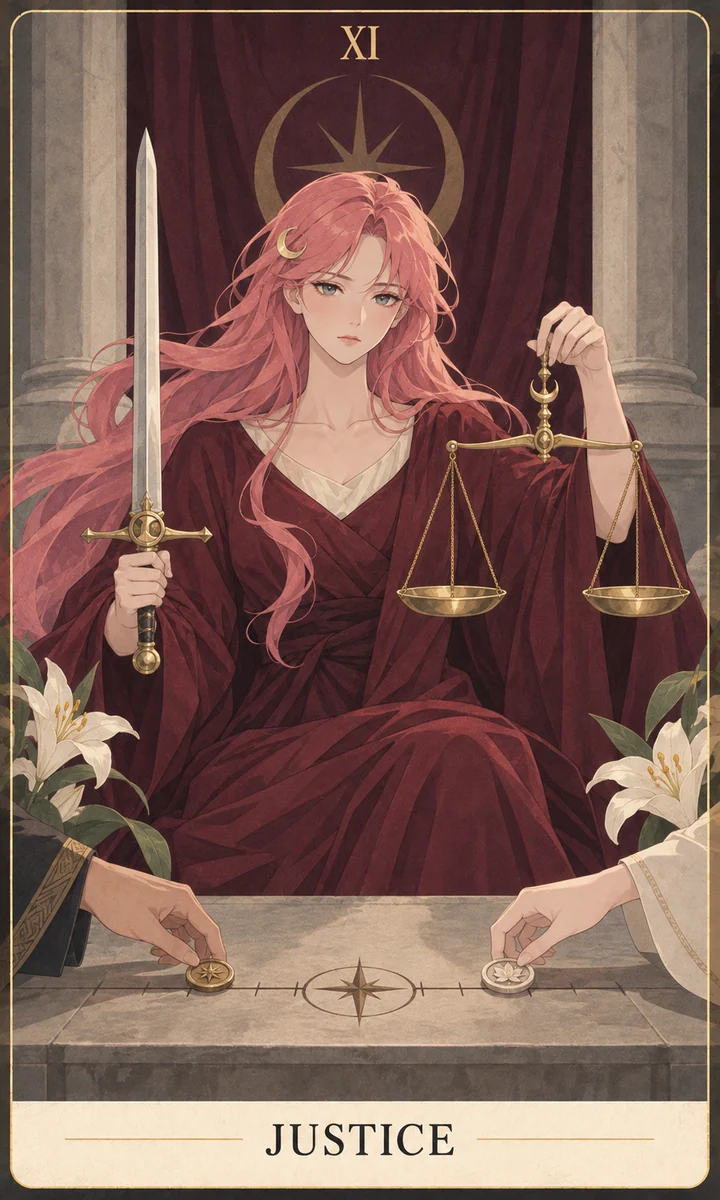
In our watercolor Justice, a woman in deep red robes sits between stone pillars with an upright sword in one hand and level scales in the other. Below her, two hands set coins down on a stone table, as if returning what is owed. The scales stand for weighing, the sword for the decision and its limits, and the returned coins for settling up. Together they tie fair judgment to facts and agreements that can be explained and checked.
Justice in love and relationships
In love, Justice usually means fairness, honesty and a relationship where both people give and take in balance and own their part.
Justice as feelings
Upright · Justice as feelings points to respect, honesty and a wish for things to be even, or to someone still weighing how compatible you are. Careful thinking doesn’t mean they’ve already made up their mind. Look for consistent standards and a willingness to explain what they expect.
Reversed · Feelings are clouded by a sense of unfairness, resentment or suspicion. They may feel judged, defensive or taken for granted. Or they may be weighing the relationship coldly, tallying what they get while holding back warmth. If things have turned formal or tense, check whether an old slight was never resolved, and go by what they do and say rather than assumed hostility.
A fair share on both sides
Upright · Both people pull their weight and keep their agreements. Practical tasks, responsibilities and emotional work are shared fairly. In a newer relationship, you’re both looking realistically at long-term compatibility before making bigger commitments.
Reversed · There’s a clear imbalance. One person carries more of the practical or emotional load while the other makes excuses. Or score-keeping and arguments over who is right have replaced teamwork, and the relationship feels like a courtroom. Look at how effort and support are actually divided, and trade accusations for an honest review of what you agreed.
Clear decisions and honest closure
Upright · Progress depends on honesty, clear agreements and shared responsibility. If there have been disputes, Justice supports a fair resolution or a formal step such as marriage or divorce paperwork. Each person gets the outcome that matches what really happened between you.
Reversed · Progress stalls because of old grievances, avoided conversations or a refusal to admit past mistakes. A breakup may turn bitter and drawn out, or the relationship may linger in tension because neither person accepts their part. Name the conversation being avoided, state your view plainly, listen to theirs and decide based on what people do, not on wishful promises.
Justice career meaning
At work, Justice means contracts, fair treatment and accountability: whether contributions are recognized and duties are shared fairly.
Clear standards and fair reviews
Upright · Work is governed by clear policies, contract terms and objective measures. Your contributions are judged on merit and results rather than favoritism. The card often appears around contract talks, audits or performance reviews where careful work gets recognized.
Reversed · You may run into favoritism, shifting standards or an unfair workload. Someone else may get credit for your work, or you may be blamed for mistakes that aren’t yours. Or you may be tempted to cut corners to hit an unreasonable deadline. Keep written records of your work and approvals, and rely on policy and written messages over verbal promises.
Offers, contracts and integrity
Upright · New opportunities come through proven credentials, open negotiation and a solid reputation. Read the contract terms, pay and job description closely. Justice favors deals where responsibilities and rewards are clearly balanced.
Reversed · An offer may hide clauses, vague pay terms or one-sided obligations. Overselling your skills or going along with shady practices will backfire quickly, and you risk taking on heavy responsibility without matching authority or pay. Ask direct questions about targets, reporting lines and termination terms, and get promises of future advancement in writing.
Work that matches your sense of fairness
Upright · Your career benefits from lining up daily work with ethical standards and clear rules. Fields such as arbitration, regulation, public service and compliance fit this card. Choosing places where merit is clearly rewarded brings lasting stability and self-respect.
Reversed · You may feel stuck somewhere that clashes with your values, or where hard work keeps going unrewarded. Or resentment over a setback is keeping you from taking useful steps. Ask whether the role truly crosses your line on fairness or whether frustration is hiding a skill gap, then look for workplaces that live up to the standard you’ve set for yourself.
Justice money and finances
With money, Justice means balanced accounts, honored contracts and realistic budgets, treating today’s finances as the direct result of past decisions and good records.
Fair pay for work delivered
Upright · Justice is about what your pay rests on: what was agreed, what was delivered and how payment is confirmed. It favors consistent assessment and a clear process. It doesn’t guarantee every amount you’re owed will arrive on time.
Reversed · Payment may be held up by admin errors, disputed invoices or unfair practices. Or someone is trying to profit through shortcuts, questionable deductions or skipped taxes, building up liabilities that will have to be settled. Check your payment records, contracts and tax filings, and follow up late payments in writing with a clear deadline.
Paying what you owe, openly
Upright · With spending, the question is whether a cost is backed by an agreement and fairly shared. Before you call something an obligation or an unfair shift of costs, work out who decided, who agreed and how the amount was calculated.
Reversed · Spending is off balance because of impulse buys, fine-print penalties or unsettled legal costs. You may be ignoring growing debt or using credit to keep up a lifestyle you can’t afford, putting off a reckoning. List every debt and recurring cost without excuses, cover the mandatory ones first and pause extras until the books balance.
Sound records and a clear balance
Upright · Security comes from clear information and clear responsibilities. Records and dispute processes help you judge where you stand, but the real figures and the rules that apply decide whether you have enough and whether you’re being treated fairly.
Reversed · Instability comes from murky accounts, hidden fees or disputes over shared assets. Hiding money trouble from a partner or the bank only deepens the hole and leaves you exposed if questions are asked later. Pull your accounts together, keep your receipts, talk openly about shared obligations and choose a conservative plan over risky moves.
Justice in a tarot spread
Where Justice lands in a spread changes what it describes. Your question sets the topic; the position tells you what part the card plays in the answer.
- Present situation
- Upright: a matter that needs fair judgment, a settled contract or an ethical balance is front and center, so go by the facts rather than your feelings. Reversed: a dispute or dilemma is being distorted by bias, avoided responsibility or unfair treatment that needs correcting.
- Obstacle
- Upright: too much detachment, rigid perfectionism or getting lost in the rules can stall warmth and momentum. Reversed: denying your part in the problem, applying double standards or blaming outside unfairness keeps you from seeing what you could do.
- Advice
- Upright: as advice, Justice says to look at the situation coolly, keep your commitments and act with integrity, whatever pressure others put on you. Reversed: stop deflecting, correct false claims or broken promises, and face the consequences directly to get your balance back.
- Outcome
- Upright: a fair resolution that holds up legally and ethically, with results in proportion to past actions. Reversed: if the avoidance continues, expect unresolved disputes, drawn-out tension or an unfavorable settlement that forces a reckoning.
To read Justice alongside the other cards in a spread, start with our Tarot beginner’s guide.
Justice tarot card FAQ
What does the Justice tarot card mean?
Justice, card XI of the Major Arcana in the Rider–Waite–Smith deck, means fairness, truth, cause and effect, and owning the consequences of your choices. Upright, it calls for consistent standards and honest accountability. Reversed, it points to bias, missing information, unequal treatment or responsibility being dodged or misplaced. It describes a fair process, not a promise that every outcome will be fair.
What does Justice reversed mean?
Justice reversed means something lacks balance, honesty or a fair process. It can point to avoiding your own mistakes, justifying unfair actions, or being on the receiving end of institutional bias. It doesn’t mean disaster is coming. It asks you to find the double standards in the situation and fix the errors that are within your control.
What does Justice mean in a love reading?
In love, Justice means fairness, clear agreements and each person owning how they treat the other. Upright, differences get handled by the same standards for both of you. Reversed, look for uneven expectations, withheld information or blame being shifted. It also helps to tell a real breach of trust apart from a disagreement about what was actually promised.
Does the Justice card mean you will win a court case?
Not on its own. Upright, Justice points to a process grounded in evidence, clear rules and accountability, which favors whoever has the facts and the paperwork on their side. It doesn’t guarantee a verdict, and it can’t tell you how a court will rule. Reversed, it warns of bias, missing records or a party dodging responsibility, so get your documentation in order.
Is the Judgement card the same as Justice?
No. Justice asks what evidence and standards support a decision, and how its consequences should be shared. Judgement asks what you recognize when you look back over a larger chapter of your life, and how you’ll respond to that recognition. Justice is about fair assessment; Judgement is about review, awakening and a renewed sense of direction.
Why are Justice and Strength swapped in some tarot decks?
Different decks follow different traditions. In the Tarot de Marseille, Justice is card VIII and Strength is XI. The Rider–Waite–Smith deck swaps them, making Strength VIII and Justice XI. Neither order changes what the cards mean. When you compare interpretations, use the numbering and images of the deck you’re actually reading with.