What does The Devil mean in tarot?
The Devil is about desire, dependency and how much freedom you really have to choose. Something attractive or rewarding becomes hard to give up, even as the cost of keeping it grows. The card can also describe real restrictions involving money, obligations or an imbalance of power. Read the reward, the cost and your options together.
The figures, the chains and the shared pedestal make attachment visible. Upright, the card shows how the bond works. Reversed, it usually moves toward recognizing the pattern, testing its limits and trying to change it. Real freedom shows up in support, boundaries and behavior, not just in feeling freer.
- Upright keywords
- attachment, temptation, dependency, feeling trapped, obsession, unhealthy patterns
- Reversed keywords
- starting to break free, seeing the pattern, new boundaries, loosening an attachment, breaking through denial, reclaiming your choices
- Desire and appetite
The horns, the downturned torch, the grapes and the flame all point to appetite and instant reward. The Devil can be about pleasure, attraction, money or fixation, and wanting something isn’t wrong in itself. The useful question is whether holding on to the reward hides its costs or narrows your choices.
- Chains fastened to one pedestal
The chains tie both figures to the same block, linking the card to dependency, obligations and limited choices. The limits may come from habit or fear, but also from money, contracts, coercion or a lack of support. The loose loops can suggest options worth exploring; they don’t mean every real-world restriction is voluntary, or that someone who has been harmed is to blame.
- Counting the cost and taking back choice
Follow the chain: what does the attachment give you, and what does it limit? Seeing that trade clearly can point you toward boundaries, alternatives or support. Reversed, the card usually shows that recognition beginning and the grip starting to loosen. Real progress depends on changed conditions and behavior, not only on understanding the problem.
The Devil upright and reversed meaning
The Devil upright meaning
Upright, the Devil means a strong attachment, urge or unhealthy dynamic that you feel locked into, held in place by instant gratification or fear.
Deals that come with strings
The situation involves rigid obligations, an imbalance of power or an environment driven mainly by material advantage. You may be locked into a commitment or relationship where going along is the price of security or access. Look at the formal and unwritten agreements: what do you gain by complying, and what rights or resources do you give up? Seeing the arrangement as a trade keeps you from treating arbitrary rules as fate.
When an urge feels impossible to resist
Strong impulses, anxiety or old coping habits feel impossible to resist. You keep finding reasons to stay in an uncomfortable situation because the familiar discomfort feels safer than the uncertainty of leaving. Notice what triggers the automatic giving in or self-soothing. Acknowledge what you want without judging yourself harshly, but question the belief that you can’t cope without this particular source of comfort or excitement.
The Devil reversed meaning
Reversed, the Devil usually means the first steps toward breaking free: denial cracks, the unhealthy pattern comes into focus and you start testing boundaries, though undoing it fully takes steady effort.
Seeing the chains for what they are
Denial starts to crack as you realize the chains are looser than they looked. You begin to see your own part in keeping the situation going, and to tell real outside barriers apart from fears you’ve absorbed. List the specific things that keep you tied to it, and sort emotional reluctance from actual legal or financial obligations. Seeing yourself as a participant rather than as helpless shows where your choices are.
Taking back control, one boundary at a time
This stage is about stepping back gradually, not a perfect overnight transformation. You start resisting manipulative demands, saying no to arrangements that exploit you or cutting back compulsive habits step by step. Set small boundaries that protect your time, money or dignity, and keep them. The pull of old habits won’t vanish overnight, so measure progress by how consistently you hold your limits when the pressure returns.
Is The Devil a yes or no card?
No. The Devil leans toward no, especially for questions about healthy outcomes, lasting peace or a relationship that is good for both of you. The card points to an attachment or deal whose cost keeps rising, so getting what you want may tie you down. It can lean yes for questions about intense attraction or quick material gain, and reversed it becomes a conditional yes if you’re ready to loosen the hold and set boundaries.
The Devil symbolism
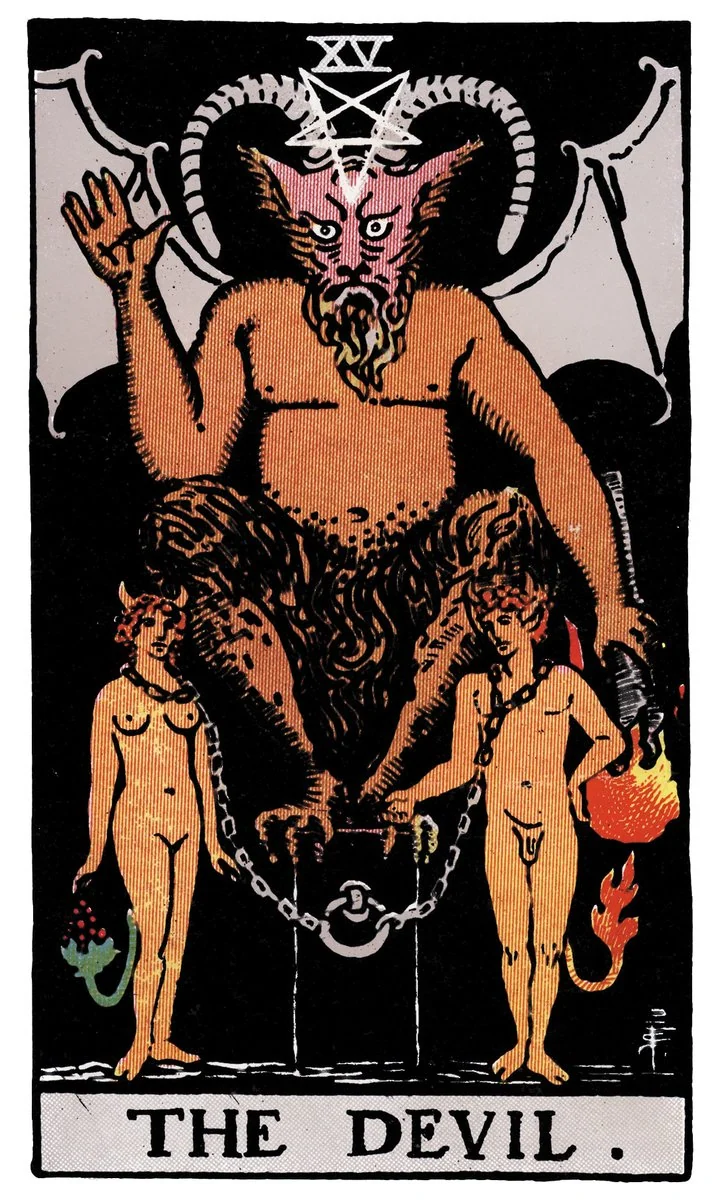
The classic Rider–Waite–Smith card uses blunt physical images to show instinct, material desire and thought bound together in a trap the figures partly keep in place themselves.
- The loose neck chains
Heavy chains loop around the necks of the two human figures, yet the loops look wide enough to slip over their heads.
The chain stands for dependency and restriction. Its loose loop invites you to look for options you’ve overlooked, but real change may also depend on money, safety and outside support. The image doesn’t prove that anyone can simply choose to leave.
- The downturned torch
The horned figure holds a burning torch upside down, its flame pointed toward the man’s tail.
A torch held this way burns through its fuel without lighting the space around it. It stands for passion, energy or resources spent on destructive habits instead of growth, and it is the same fire that burns at the tip of the man’s tail.
- The half-cube pedestal
The creature crouches on a solid stone block shaped like half a cube.
Half a cube suggests incomplete understanding, fixed only on the visible, material world. It points to a life built on an unbalanced, purely material foundation, and it is the block both chains are fastened to.
- Horns and tails
Both human figures have small horns and animal tails; one tail ends in a bunch of grapes, the other in a flame.
These traits show basic instinct, physical appetite and indulgence starting to take over conscious thought. The drives are natural, but left unexamined they overpower judgment.
Watercolor deck
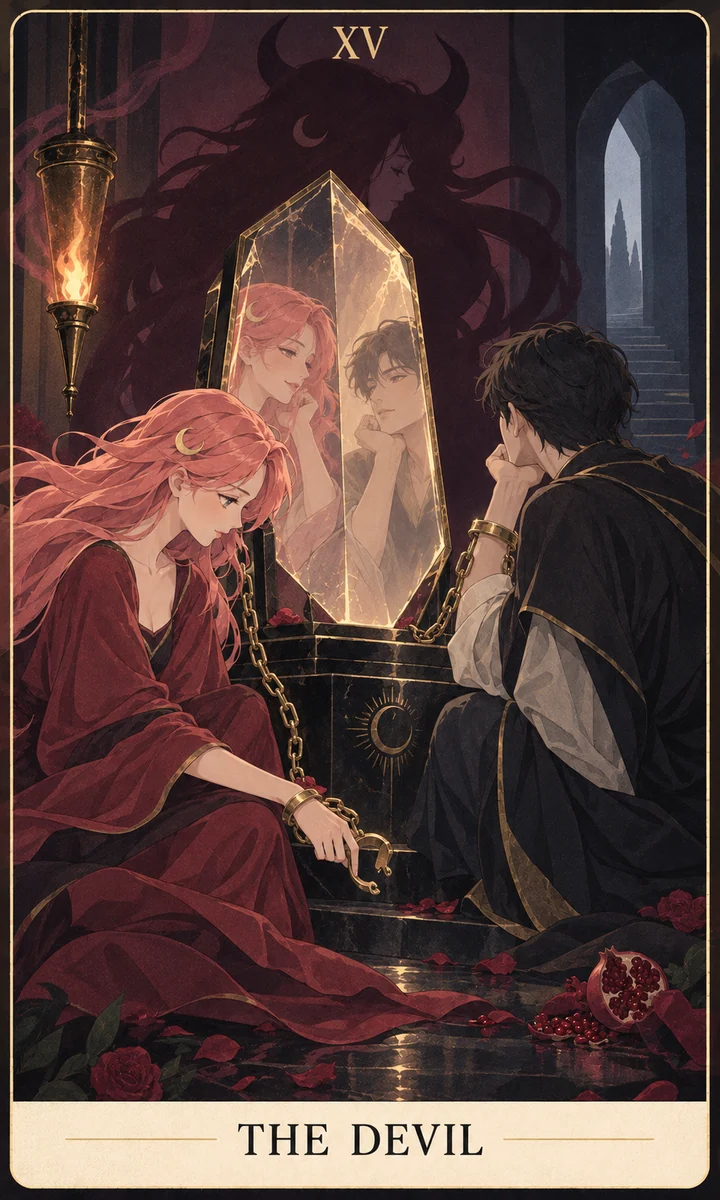
Our watercolor Devil puts a mirror, two figures, a looming shadow and chains into one scene. The mirror draws the eye to what is tempting, and the chains make the cost of that attraction visible. Read them together: what pulls at your attention, what does keeping it cost and how free are you to move closer or step away?
The Devil in love and relationships
In love, the Devil points to intense attraction, power dynamics and emotional dependence, and asks whether the bond is mutual or held together by obsession or fear of being alone.
The Devil as feelings
Upright · If you pulled the Devil for someone’s feelings, they likely feel strong desire, attraction or an attachment they find hard to let go of. It can also include possessiveness or dependence. Intense attraction alone doesn’t mean something is wrong, and control is not proof of deep love. Look at consent, respect and whether either of you can say no, and compare what they say with how they treat you day to day.
Reversed · The intensity is cooling into clearer self-awareness. They’re starting to ask whether the attraction is healthy or just a pull toward drama, and to see that obsession was mistaken for care. Notice whether their feelings steady them or set off mood swings, and whether affection is being used as leverage.
A relationship that’s hard to leave
Upright · The relationship is marked by unequal power, codependency or cycles of fighting followed by passionate making up. You may both feel trapped yet stay, because what you get from it emotionally or in lifestyle feels impossible to give up. Look at who does the emotional work and who makes the decisions, and whether ultimatums, unspoken debts or money keep you from talking as equals.
Reversed · The cycle of manipulation or walking on eggshells starts to break down. One or both of you look for healthier ground rules, refuse to play guilt games or start talking openly about separating.
Breaking the cycle or sinking deeper
Upright · Unless boundaries are set, the relationship sinks further into compromise and emotional fatigue. The pattern keeps taking more of your independence while giving back less real warmth and trust.
Reversed · The relationship either changes through firmly held boundaries or ends as one person takes back their independence. Progress looks like fewer manipulative games and a more honest view of compatibility. Trust changed behavior over apologies: watch how disagreements are handled and whether each person’s independence is respected without punishing silence or withdrawal.
The Devil career meaning
At work, the Devil points to golden handcuffs, toxic workplace cultures and the ethical compromises people make for status, money or job security.
Golden handcuffs
Upright · The workplace runs on demanding management, burnout-level workloads or a culture that puts profit ahead of ethics. You may feel trapped by a comfortable paycheck, a title or restrictive contract terms. Look at your contract, your pay and your daily mental state, and ask whether you’re reaching real milestones or being exploited in the name of dedication.
Reversed · You start to see what corporate loyalty and high-pressure incentives really cost. The fear of leaving an established job fades as you realize that chronic exhaustion outweighs the security the role seems to offer.
Tempting offers with a catch
Upright · Upcoming opportunities come with tempting money or status but ask for major personal sacrifice or ethical compromise. Read the fine print, since the role may limit your creative freedom in the long run. Check the contract terms, hours and targets, and ask whether the job really expands your freedom or just puts you in a better-paid cage.
Reversed · You turn down offers with unreasonable strings attached, or walk away from projects that go against your values. This is a time to choose roles that give you workable independence over prestigious pressure.
Breaking free from needing approval
Upright · Staying on your current course deepens your need for outside approval and keeps you stuck in work that doesn’t fulfill you. Fear of starting over stops you from exploring paths that fit what you can really do.
Reversed · A move toward independence becomes possible through careful planning, new skills and paying down debt. You gradually reduce your dependence on one toxic industry or overbearing boss. Look at how portable your skills are, and build savings and a network that let you negotiate or leave from a position of strength.
The Devil money and finances
With money, the Devil points to debt cycles, compulsive spending and the weight that possessions can carry, and asks how financially free you really are.
Income that comes with conditions
Upright · The Devil is about how attractive the pay is and what strings come with it. What time, independence or other opportunities are you trading for it? Weigh both sides without assuming the income itself is illegitimate, and work out what your work really pays per hour once you count physical strain, commuting and stress-related costs.
Reversed · You start relying less on income that asks for too much compromise. Your total earnings may shift, but the mental relief and extra independence give you a base for earning in a more sustainable way. Ask whether other sources could replace the money that costs you the most.
Spending you can’t seem to stop
Upright · Spending may go to instant rewards that feel hard to stop, or to obligations you took on out of dependence or under pressure. Sort what you chose freely from what you’re genuinely stuck with, and ask what support would make it easier to refuse or change the arrangement. Track recurring costs, card balances and high-interest debt, and notice the feelings that trigger unplanned purchases.
Reversed · You face your debts honestly, rein in impulse spending and set up a disciplined repayment plan. The urge to buy status symbols weakens as you put cash on hand and real freedom from debt ahead of appearances.
Real security or a golden cage
Upright · Security depends on who controls the resources, what restricts you and what you would practically need for an alternative. The limits may be real, and seeing them isn’t the same as being able to leave. Information, support and options you can actually reach matter most.
Reversed · Your finances grow more resilient as debts are paid off and unnecessary costs are cut. You move toward a simpler setup where your spending fits comfortably within reliable reserves. Compare your total debts with your emergency fund, and build savings of your own so a job change or a coercive financial arrangement leaves you less exposed.
The Devil in a tarot spread
Your question sets the topic, and the position in the spread tells you what job the Devil is doing. Upright or reversed shows the state of its themes; the position decides whether they describe where you are, what’s in the way, what to do or where things are heading.
- Present situation
- Upright: you’re caught in an intense, addictive dynamic or a rigid setup where the immediate payoff hides the long-term cost. Reversed: you’re waking up to an unhealthy dependency and getting ready to renegotiate your position.
- Obstacle
- Upright: fear of loss, comfort with familiar dysfunction or strong cravings keep you from thinking clearly. Reversed: reluctance to sit through temporary discomfort or withdrawal slows your exit from a compromised situation.
- Advice
- Upright: as advice, the Devil says to look honestly at the trade-offs you’re making and find where the loose chains could come off. Reversed: stop excusing bad behavior, set firm limits and steadily reduce how much you depend on others in practical terms.
- Outcome
- Upright: staying entangled deepens the sense of being trapped and raises the emotional or financial cost. Reversed: holding to healthy boundaries leads to regained independence, clearer feelings and practical freedom.
To read the Devil alongside the other cards in a spread, start with our Tarot beginner’s guide.
The Devil tarot card FAQ
What does the Devil card mean in tarot?
The Devil card means strong desire, dependency and limited choice. Upright, it shows the cost of an attachment and how habits, rewards or unequal power can make it hard to walk away. Reversed, it usually means recognizing that bond and starting to change it. The point is to see the restriction and the support available, not to judge anyone’s character.
What does the Devil reversed mean?
The Devil reversed means recognizing a dependency, questioning control or starting to rebuild boundaries. It doesn’t confirm that you’re already free. Look for real changes in resources, support, behavior and who gets to make decisions. Awareness helps, but it may take practical help to turn it into a workable alternative.
What does the Devil mean in love?
In love, the Devil means strong attraction, possessiveness or dependence, though intense chemistry alone doesn’t make a relationship unhealthy. Check whether both of you take part freely, whether either of you can say no and whether boundaries are respected. Attraction isn’t proof of commitment, and control or harm shouldn’t be romanticized as unusually deep love.
How does someone feel about you if you pull the Devil?
Upright, the Devil suggests they feel a powerful pull toward you: desire, fixation or an attachment they find hard to let go of, sometimes with possessiveness. Reversed, the intensity is cooling, and they may be questioning whether the attraction is healthy. The card describes the strength of the pull, not whether they will commit, so watch how they treat you.
Is the Devil tarot card bad?
The Devil isn’t a sign of evil or a curse, but it is a warning card. It explores temptation, dependency and power, and asks you to look at a reward that feels hard to refuse, what it costs you and any real constraints. Desire itself isn’t the problem; the card asks whether it is narrowing your choices.
Does the Devil reversed mean an unhealthy attachment is over?
Not by itself. The Devil reversed can mean a first recognition, an attempt to pull back or more lasting freedom from the old pattern. Tell these apart by concrete changes: support you can reach, control over your own decisions and fewer repeated harms. Where there is coercion or there are threats, safety and outside support matter more than willpower.