What does the Nine of Swords mean in tarot?
The Nine of Swords is the card of worry, guilt and thoughts that circle in the night. Someone wakes in the dark and sits alone, caught up in alarming scenarios and self-blame. The distress is real. The card also reminds you that dread tends to exaggerate consequences and to mistake anxiety for certainty.
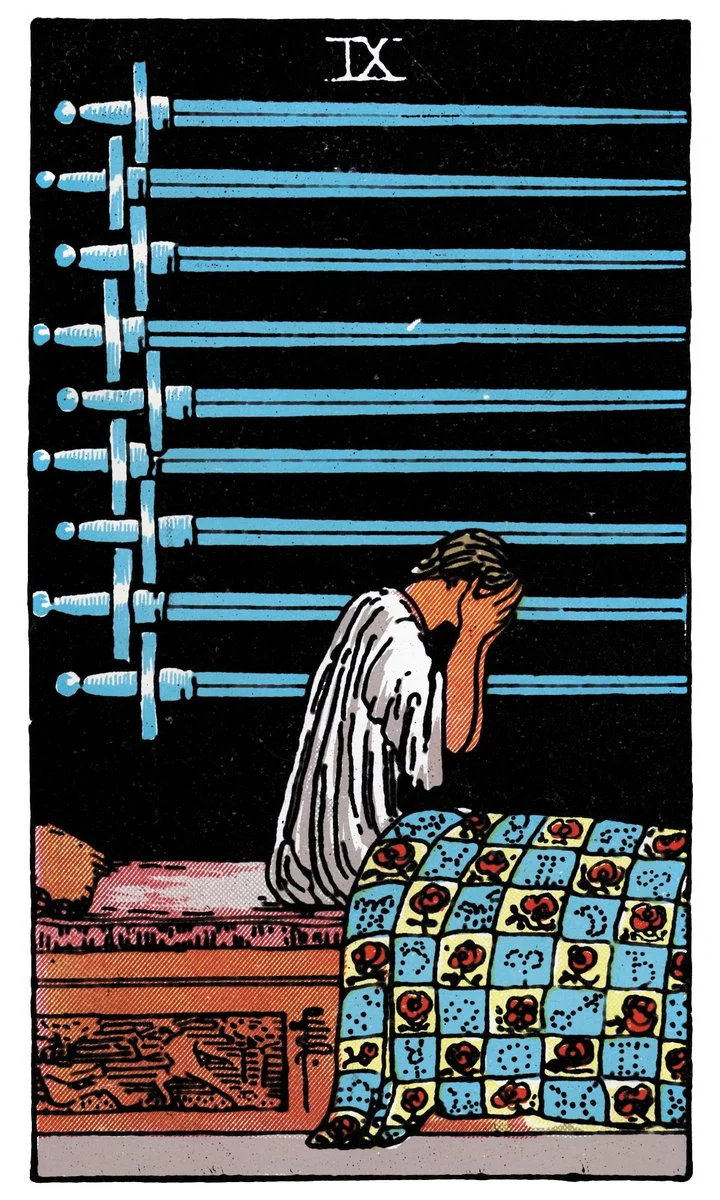
In Pamela Colman Smith’s classic illustration, a figure sits up in bed and weeps into both hands while nine swords hang in rows against a black wall. The swords don’t pierce the body; they loom like thoughts that fill the mind. The card describes a very human experience of fear and guilt, and shows how worrying alone distorts the picture until it meets the outside world again.
- Upright keywords
- anxiety, worry, guilt, sleepless nights, overthinking, fearing the worst
- Reversed keywords
- relief after speaking up, reality checks, reaching out for support, hidden distress, shame and secrecy, mistrusting reassurance
- Worry
Nine swords hang above the bed in rigid, even rows. They fill the picture without touching the figure below. That’s how anxious thinking works: fears multiply and line up into what feels like a solid wall of threats. The swords are thoughts that loom over you and make dread feel heavy and immediate. The card asks you to tell the difference between having frightening thoughts and something actually going wrong in the room.
- Guilt and regret
The covered face puts the distress at the center of the card and hides its cause. The gesture can suggest grief, fear, remorse or thoughts that won’t stop coming back; it doesn’t show that the person has done anything wrong. Next to the repeated blades, it shows attention swamped by something painful. The feeling is real. The conclusion it points to still needs its own evidence.
- Waking at night
The figure sits alone on a decorated bed against a flat black background: the particular misery of waking in the night, when your defenses are down and every problem looks unsolvable. A bed should mean rest and safety, but here it holds unresolved tension. The black background strips away daytime distractions and leaves the mind to its own devices. Proportion comes back with daylight and with steady, real-world conversation.
Nine of Swords upright and reversed meaning
Nine of Swords upright meaning
Upright, the Nine of Swords means worry, guilt and repetitive thoughts are taking up all your attention, until the fear starts to feel like fact.
Bracing for trouble
There may be real complications, but fear turns every risk into a certain disaster. You might expect blame, public failure or a serious loss before anything has happened. Try to see the actual problem apart from what panic adds to it. Concrete facts and practical conversations show whether you need to act now, or whether your thoughts are running with nothing to push against.
The loop of overthinking
Self-blame, regret and sleepless going-over keep your attention turned inward and convince you there’s no way out. Strong emotional pain doesn’t prove your worst conclusions are right. Breaking the loop starts with taking the distress seriously without treating every anxious thought as a verdict. Talk to someone steady, or write down the details you can actually check.
Nine of Swords reversed meaning
Reversed, the Nine of Swords usually means the worry is starting to ease because you’ve brought it into the open, or going deeper because shame keeps you silent.
Relief through a reality check
When the reversal points to relief, worries you hadn’t voiced come into the daylight through a direct conversation, practical advice or an honest look at the facts. Saying a fear out loud strips away the drama and shows what can actually be solved. Once you compare what you dreaded with what’s really there, a practical next step becomes possible.
When shame keeps it hidden
When the reversal points to deeper trouble, shame or fear of judgment leads to withdrawal, and the worry stays where no outside view can reach it. You hide the distress, nurse suspicion or guilt in private and mistrust reassurance. The question is whether you’re opening the problem to a real reality check, or guarding a painful story so closely that no one can help.
Is the Nine of Swords a yes or no card?
No. The Nine of Swords is a no, especially for decisions that need a clear head or a confident start. Worry and untested assumptions are clouding your view right now, so a choice made in this state is likely to be driven by fear. Reversed, it moves closer to a maybe: once you talk the problem through and check the facts, the answer can change.
Nine of Swords symbolism
A lone figure weeps beneath rows of swords in the dark: this is what thinking looks like when it turns on itself, cut off from the waking world.
- Nine horizontal swords
Nine swords lie horizontally in parallel rows across the black wall behind the bed.
The repeated blades look like thoughts that keep coming back and fill the whole field of attention. They don’t strike the figure, which puts the weight on distress rather than the outright ending shown in the Ten of Swords. That doesn’t prove nothing harmful has happened. It’s why the card is useful for looking at worry and what it does to you, without treating every feared outcome as fact.
- Hands covering the face
The seated figure buries their face in both hands, hiding it completely.
Covering the face turns attention inward and shows distress that’s hard to bear or put into words. The gesture doesn’t say whether the source is grief, fear or remorse, and it isn’t a deliberate refusal of help. With the figure sitting up in bed, it shows broken rest and how hard relief is to find. The person’s need to be understood matters as much as the facts of the situation.
- The carved bed
The side of the bed is carved with a scene of one figure overpowering another, and the quilt is covered in roses and astrological symbols.
A bed is meant for rest, vulnerability and recovery, which makes its turn into a place of anguish especially painful. The carving of one figure beating another hints at an old struggle, dispute or defeat that feeds the present remorse. The rich quilt shows that comfort in your surroundings can’t quiet a mind caught in relentless self-blame.
- The black background
The wall behind the bed is flat black, with no window or other detail.
The black backdrop is the isolation of night, when familiar reference points disappear. With no window, no horizon and no sky, the room works like a closed chamber of the mind. Rumination thrives when it’s cut off from daylight and other people. In that solitude, worries no one has checked can grow without anything to stop them.
Watercolor deck
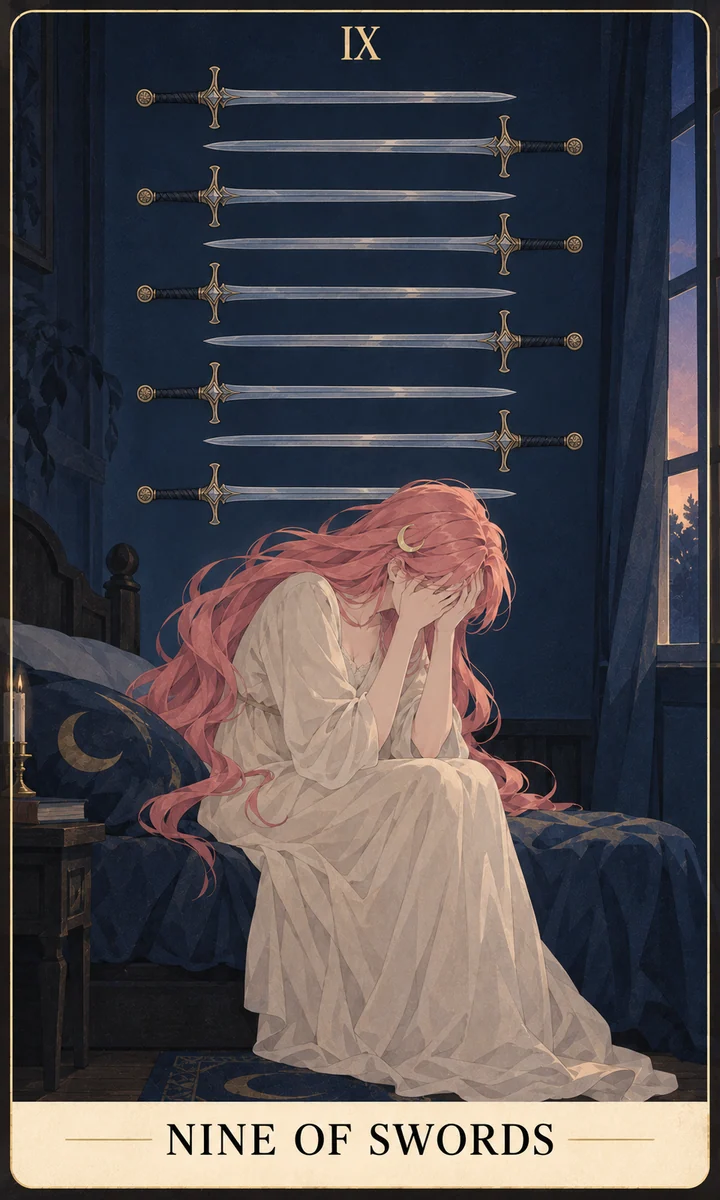
The watercolor shows a lone figure perched on the edge of a bed at night, head in both hands, with nine swords mounted horizontally on the wall. It captures the stillness of nighttime anxiety, when heavy thoughts line up behind you like a catalog of doubts. Sitting on the edge of the mattress, the figure looks suddenly awake and alone with the worry.
Nine of Swords in love and relationships
In love, the Nine of Swords points to anxiety, guilt or unspoken fear that is distorting the connection, and asks you to separate what you fear from what’s actually happening between you.
Nine of Swords as feelings
Upright · They feel weighed down by remorse, fear of being left or anxious replaying of past mistakes. They may want closeness but fear that honesty will lead to rejection, so they lie awake overthinking.
Reversed · They either risk an honest confession to ease the tension, or retreat further into silence out of embarrassment. Notice whether they’re looking for a reality check, or holding on to private dread without ever asking whether you actually feel what they fear you do.
Where the relationship stands
Upright · The relationship is shadowed by unspoken suspicion, jealousy or old regrets that crowd your conversations without resolving anything. Fear of a breakup or betrayal can make both of you defensive and cool the warmth between you.
Reversed · Things either clear up because hidden concerns finally get put on the table, or harden into mutual distrust where secrecy blocks any repair. Progress comes from talking about real agreements and real behavior, not disasters imagined alone.
Where it’s heading
Upright · Unresolved worry can wear you both out unless facts start replacing panic. Making up stalls if one person expects the other to soothe fears they won’t put into words.
Reversed · Everything depends on an outside reality check. If you both speak plainly, relief follows and repair can begin; if shame drives more withdrawal, the gap widens. Commitment grows from dealing with real problems together, not rehearsing worst-case scenarios alone.
Nine of Swords career meaning
At work, the Nine of Swords points to worry about mistakes, failure or an overloaded schedule, and to whether that worry pushes you toward clarity or freezes you.
How you’re coping at work
Upright · Anxiety about deadlines, a performance review or a recent mistake eats your energy and makes normal tasks feel impossible. You may lose sleep over a reprimand long before you get any feedback.
Reversed · You either face the issue, admit the error and ask for help, or hide the mistake out of fear and make the risk bigger. What matters is whether the worry leads you to check the facts or keeps you from getting the day’s work done.
Working with others
Upright · Anxiety makes people hypervigilant, so routine feedback gets read as hostility or a sign that someone is about to be let go. Distrust gets in the way of solving problems together.
Reversed · Bringing the source of pressure into team discussions often shows that the workload can be managed together. Keep hiding it, and small oversights grow into emergencies. Pay attention to whether your workplace lets people adjust openly or quietly encourages them to hide problems.
Where your career is heading
Upright · Constant panic drains momentum and risks burnout if you treat every project as a career-ending test. Checking the real stakes with a manager or mentor brings back some stability.
Reversed · Recovery starts once hidden bottlenecks are acknowledged and the work is shared out differently. If the avoidance continues, disciplinary trouble becomes more likely. Steady, organized task management will take you further than enduring silent pressure that warps your sense of your own competence.
Nine of Swords money and finances
With money, the Nine of Swords points to financial worry that keeps you up at night, and asks you to look at the actual numbers apart from the fear.
Income
Upright · Worry that income will stop or fall short may take over your attention. The card can’t tell you whether that has happened or what’s in your accounts.
Reversed · Clearer information or available help may reduce the uncertainty, while finding it hard to talk about the problem may drag it out. Your actual income and the emotional weight of fearing for it both need attention, separately.
Bills and obligations
Upright · A payment or obligation may bring distress, guilt or worry that lingers long after you’ve looked at it.
Reversed · The question is whether you can describe the problem clearly and whether the right help becomes available. The card doesn’t recommend borrowing, consolidating or selling anything, and it doesn’t mean a responsibility has gone away.
Financial security
Upright · Feeling financially insecure can break up your sleep and keep possible losses constantly in view.
Reversed · Your understanding may improve, or the same distress may stay hidden. Feeling relieved and being financially secure are different changes. The card describes how uncertainty feels; your records and circumstances show where you actually stand.
Nine of Swords in a tarot spread
Your question sets the topic, and the card’s place in the spread sets its job. Here’s how the Nine of Swords reads in the positions people use most.
- Present situation
- Upright: you’re caught in a loop of worry, guilt or sleepless dread, so check the facts before assuming the worst has happened. Reversed: notice whether you’re starting to speak up or pulling back into shame.
- Feelings
- Upright: anxiety and remorse dominate, and the pain feels isolating. Take the distress seriously without accepting every bleak thought as true. Reversed: relief may be dawning, or the fear may be turning defensive.
- Obstacle
- Upright: unchecked rumination keeps you frozen, and treating imagined disasters as certain blocks workable solutions. Reversed: the main obstacle is keeping the truth to yourself out of embarrassment.
- Advice
- Upright: as advice, the Nine of Swords says bring the worry into the light. Check the actual records or talk to someone you trust, and break the loop with steps you can verify. Reversed: don’t bury mistakes; plain honesty shrinks the crisis to a size you can handle.
- Outcome
- Upright: the acute distress will peak, but lasting relief comes from grounding yourself in what’s actually happening. Reversed: relief comes if you test your assumptions in daylight, while continued hiding keeps the pressure going.
Cards to compare with the Nine of Swords, and a guide to reading it in a spread: Eight of Swords · Four of Swords · The Moon · Tarot beginner’s guide.
Nine of Swords tarot card FAQ
What does the Nine of Swords mean?
The Nine of Swords means anxiety, guilt and the kind of worry that keeps you up at night. In the image, nine swords hang over a weeping figure without touching them, so the torment is in the mind rather than a blow that has landed. The suffering is real, but the card suggests that dread is making the danger look bigger than it is.
What does the Nine of Swords reversed mean?
Reversed, the Nine of Swords means the worry is either starting to lift or going deeper, depending on whether it meets the outside world. If you share your fears or look at the hard facts, relief begins as the exaggerated parts fall away. If shame keeps you silent, the anxiety turns further inward and feeds on suspicion and isolation.
What does the Nine of Swords mean as feelings?
As feelings, the Nine of Swords means the person is anxious, guilty or afraid of losing you. They may care deeply but feel weighed down by regret, past mistakes or fear of being judged. Being vulnerable feels frightening to them, so they’re more likely to suffer in silence than to reach out and ask for reassurance.
What does the Nine of Swords mean in love?
In love, the Nine of Swords points to unspoken fears, guilt or worst-case thinking that strains trust. Partners may misread silence or project their deepest insecurities onto ordinary friction. The way through is an open, grounded conversation that sets what is actually happening next to what fear has been suggesting in private.
Does the Nine of Swords reversed mean a breakup?
No, the Nine of Swords reversed doesn’t mean a breakup is coming. It shows hidden tension and anxiety reaching a turning point. If both of you talk openly about your worries and own your mistakes, the relationship can feel real relief. A breakup becomes more likely only if shame and defensiveness shut down honest communication completely.
Does the Nine of Swords mean your fears will come true?
No. The Nine of Swords describes how heavy a fear feels, not whether it will happen. The swords hang on the wall rather than in the body, which is why the card separates real distress from the outcome you dread. Checking the facts, or saying the worry out loud to someone you trust, usually shows which parts are real and which are the night talking.