What does the Eight of Swords mean in tarot?
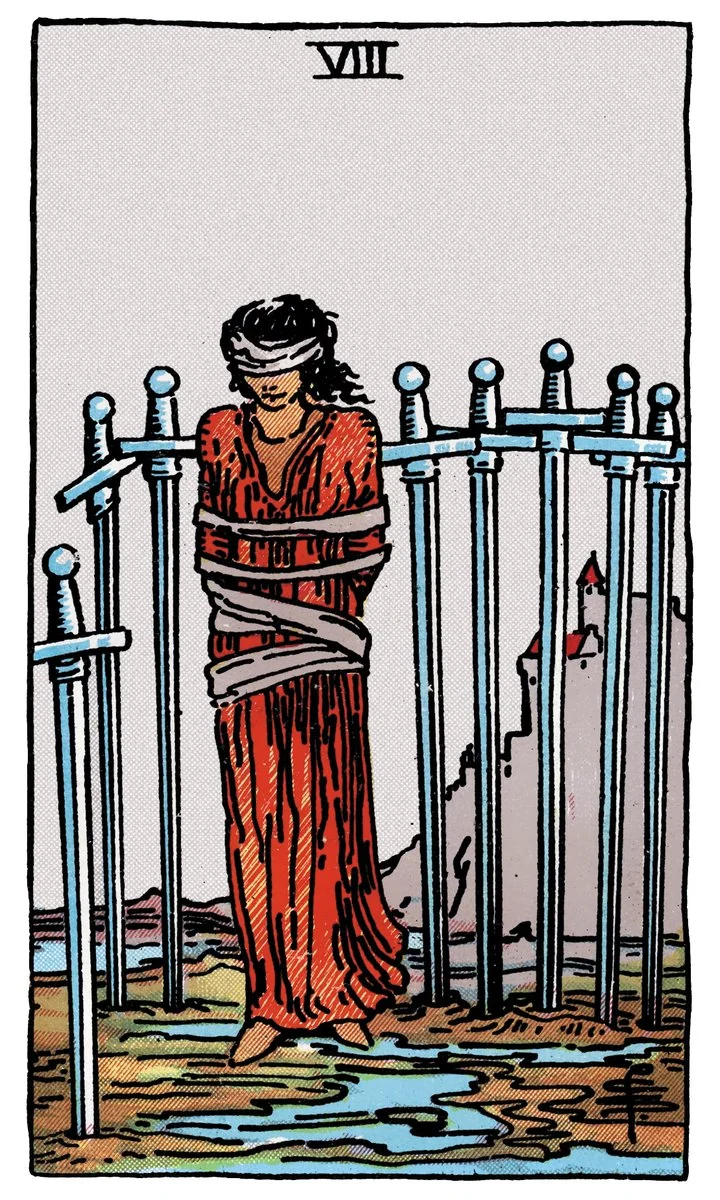
The Eight of Swords shows a woman standing blindfolded and bound, surrounded by swords planted in the ground. It describes the moments when you feel stuck. Real circumstances such as rules, money or obligations narrow your options, and fear tells you that any move will make things worse. It isn’t a card of no options. It’s a card of hesitation, when you can’t see enough to move safely.
Waite read the card as temporary confinement rather than permanent captivity. The swords don’t close into a wall, and the cords leave her legs free. Still, without her sight, that first step really is risky. The card asks you to take the pressure seriously without assuming it is total or will last forever.
- Upright keywords
- feeling trapped, real restrictions, fear of consequences, limited information, anxious overthinking, feeling powerless
- Reversed keywords
- clearer sight, loosening limits, a first step out, finding support, regaining choice, separating fact from fear
- Real limits
The swords stand around her like rules, legal duties or other people’s expectations, and the cords keep her arms close to her body so she can’t react freely. Together they describe limits with real consequences: crossing the line could cost you something. The confinement isn’t an iron cell, though. It’s a field of deterrents, and seeing that each barrier is a specific cost rather than an impossibility is the start of finding a way through.
- The blindfold
The blindfold shows how fear and missing information cloud practical judgment. When you can’t see, your mind fills the dark with threats. In the Swords suit, that means mental overload and imagining the worst. She stays still not only because the swords are there, but because she can’t see where her feet will land. Taking off a mental blindfold usually means checking rumors and looking carefully at the ground in front of you.
- Room to move
The swords don’t form a solid wall, and her legs aren’t tied to the ground. But the blindfold, the cords and the uneven footing are still real obstacles. A gap that someone outside can see isn’t a safe path for a person who can’t. That’s why the card holds constraint and possibility together: getting out may take support, reliable information and changed conditions, not just more courage.
Eight of Swords upright and reversed meaning
Eight of Swords upright meaning
Upright, the Eight of Swords means real limits and fear are working together to keep you stuck, so every option looks riskier than staying put.
When the limits are real
Obligations, workplace policies, money or the people who depend on you are narrowing your room to move. These pressures aren’t imaginary, and crossing certain lines would have real consequences. With key details still missing, stepping forward carries genuine risk. The card suggests pausing to get accurate information rather than forcing a reckless exit through firm barriers.
When fear does the rest
Fear adds to the helplessness when you expect any move to bring punishment or failure. You might not ask for basic things because speaking up seems sure to start a fight. That fear is a protective response to a hard situation, not a personal flaw. Noticing where you feel most exposed helps you sort out which limits come from your surroundings and which come from protecting yourself.
Eight of Swords reversed meaning
Reversed, the Eight of Swords usually means the blindfold is slipping: you can see more clearly, find a workable way out and start testing how much room you really have.
The blindfold slips
As the blindfold slips, you notice the swords leave an open path. You start telling apart the contracts and duties that truly bind you from assumptions you had accepted without question. The friction doesn’t disappear overnight, but your choices become specific. You try small actions to learn which barriers give way to calm persistence and which need a formal conversation to change.
Getting your agency back
Getting your agency back might mean naming a need, finding someone reliable to lean on or gaining one option you didn’t have before. It doesn’t require breaking free of every limit at once. If outside pressure is still there, moving slowly isn’t proof that you don’t want to change. The reversal means the most when it matches a real shift: new information, better access, more safety or the freedom to say what you want.
Is the Eight of Swords a yes or no card?
No. The Eight of Swords is a no for now, especially for bold moves, quick launches or commitments you’d make without the full picture. Real limits and fear are closing in at the same time, so pushing ahead blind carries real risk. Reversed, it leans toward a slow yes as the facts get clearer, and if your question is about pausing to gather information first, the card supports that.
Eight of Swords symbolism
Every detail sets physical confinement against small signs that a way out exists.
- The blindfold
A white cloth covers the standing figure’s eyes.
The blindfold blocks direct sight, so she has to rely on memory, imagination and caution. In Swords, the suit of thought and communication, covered eyes point to a lack of trustworthy information. Without clear vision, the surroundings feel more hostile and unpredictable than they may really be. Cut off from outside evidence, every imagined threat becomes a practical obstacle.
- The swords
Eight swords are planted upright in the ground around her.
The swords make an uneven enclosure, not a sealed cage. Fixed firmly in the soil, they stand for rules, unresolved disputes or social penalties that discourage you from moving. They don’t touch her, so their threat is deterrence: they don’t strike, but they promise pain if she rushes forward blindly. There are gaps between the blades wide enough to step through with care.
- The cords
Cords wrap her arms and upper body but leave her legs free.
The cords clearly limit movement and expression. Her free legs leave some possibility of motion, but they don’t prove the cords are easy to slip or that walking away would be safe. With the blindfold and the blades, this detail shows several limits working at once. Reversed, the useful question is which limit is actually changing, and what support would make a next step possible.
- Water and muddy ground
Shallow water pools on the stony ground at her feet, with a castle on a distant hill.
The shallow water mixes the mental world of Air with the emotional current of Water. Puddles on stony ground suggest leftover feelings, hesitation and unsteady footing. They slow her down and make every step deliberate. With the castle high on the hill far behind her, the low, wet ground shows her cut off for now from the community and the security it offers.
Watercolor deck
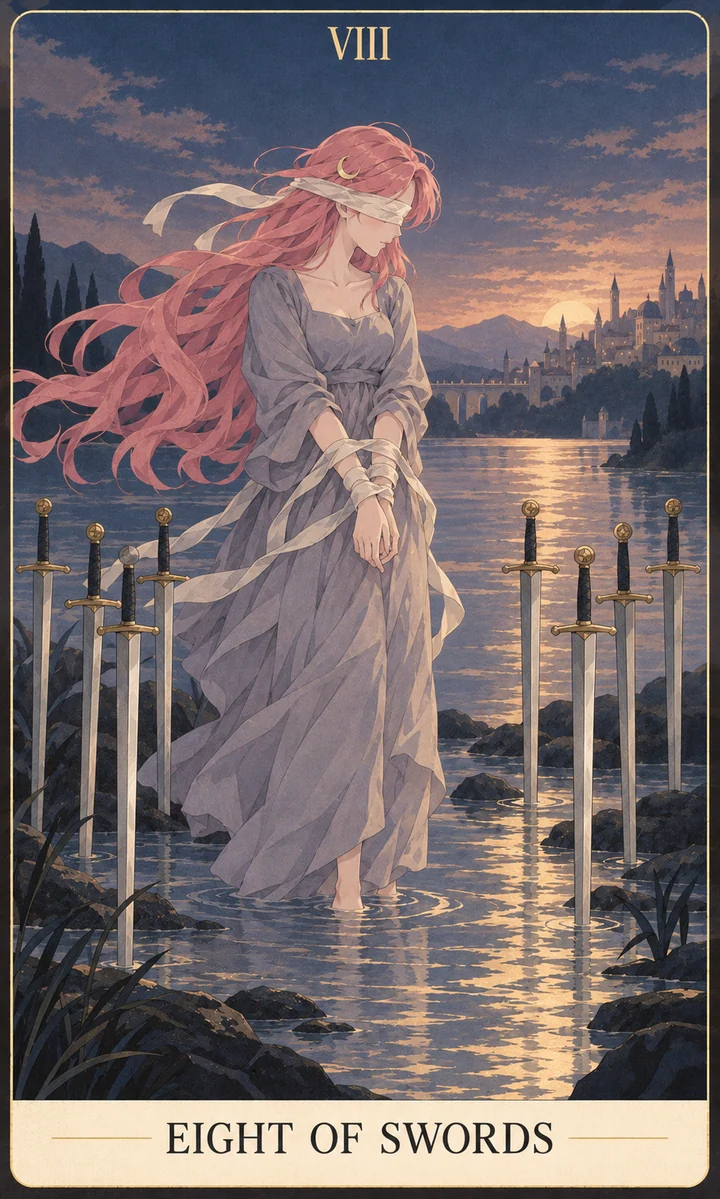
The watercolor puts her bound hands in front of her body, which reads as confinement she is aware of rather than total helplessness. The wet stones underfoot catch a muted light: the footing is slick, but the ground is solid enough to stand on. The castle sits far in the background, framing this struggle as a passage she has to cross outside the protection of the community.
Eight of Swords in love and relationships
In love, the Eight of Swords points to a connection where things have gone quiet, because of real constraints or because one of you fears the argument that speaking up could start.
Eight of Swords as feelings
Upright · They feel boxed in. There may be real affection, but they’re walking on eggshells, afraid that saying the wrong thing will lead to conflict or rejection. They feel cornered by the way things are and hesitate to speak plainly.
Reversed · The fear that kept them quiet starts to lift. They begin to say what they had held back, because an uncomfortable talk now feels better than more silent stalling. They want clarity more than a calm surface.
Where the relationship stands
Upright · The relationship feels frozen by rigid expectations, old grievances or rules nobody says out loud. Both of you may feel trapped by commitments or daily habits you don’t know how to change without causing hurt. Outside obligations, such as family demands, can also limit the freedom you have together.
Reversed · You start sorting the rules you actually need from habits you’ve put on yourselves. Admitting that some fears were overblown gives you room to agree on a healthier, more flexible way of being together.
Where it’s heading
Upright · The connection may stay restricted while the pressures and expectations around it go unspoken. Silence can come from uncertainty or a need to protect yourself, so on its own it doesn’t tell you whether someone cares or agrees.
Reversed · Things can move once it feels safer to speak and there are more real choices. Watch for concrete changes in how requests, boundaries and disagreements get handled, rather than expecting one brave conversation to clear every limit.
Eight of Swords career meaning
At work, the Eight of Swords means feeling stuck, partly because of real rules and contracts and partly because fear keeps you from testing the options you still have.
Feeling stuck in your role
Upright · Your confidence is dampened by red tape, a rigid job description or the fear of a costly mistake. You may feel your talents are being sidelined while real contracts or money worries keep you from leaving right away.
Reversed · You stop waiting for management to approve your ideas. You take an honest look at your skills, sort actual policy limits from imagined ones and look for small ways to put your experience to work.
Working with others
Upright · Teamwork suffers from poor transparency, siloed teams or defensive managers who treat criticism as insubordination. People hold back suggestions because speaking up seems to cost too much politically.
Reversed · Communication starts to open up as people question restrictive assumptions. Sharing data and clarifying procedures clears unnecessary bottlenecks, and practical cooperation replaces cautious, defensive routines.
Where your career is heading
Upright · Staying passive keeps you stuck in a role or project that isn’t rewarding you. The current setup keeps you basically secure, but it costs you independence.
Reversed · Real progress starts again. You might update your credentials, talk to a mentor outside your company or apply for an internal transfer. Once you see the exit isn’t fully blocked, small, careful steps can move you toward a more flexible job.
Eight of Swords money and finances
With money, the Eight of Swords points to feeling boxed in by obligations, tight budgets or missing information, and to how anxiety shapes the way you handle what you have.
Income
Upright · The theme is limited room to use or grow what you have. The limit might be access, timing or incomplete information; the card doesn’t point to a specific contract problem.
Reversed · That limit becomes clearer or starts to change. Having more freedom to act and actually earning more are separate questions, though.
Bills and obligations
Upright · Existing expenses and obligations may leave little flexibility, or not knowing exactly where you stand may feel confining.
Reversed · Ask whether the burden has actually changed or whether you simply understand the terms better now. The card is about room to move and control. It doesn’t recommend a particular way to handle debt, and it doesn’t assume every obligation can be dropped.
Financial security
Upright · Security feels limited by unclear choices or real restrictions.
Reversed · A more accurate picture of your resources and responsibilities can make practical options easier to see. Feeling more confident doesn’t mean the underlying risk is gone: understanding a situation better and the situation itself improving are two different things.
Eight of Swords in a tarot spread
Your question sets the topic, and the card’s place in the spread sets its job. Here’s how the Eight of Swords reads in the positions people use most.
- Present situation
- Upright: you’re dealing with strict rules and too little information. Moving carefully keeps you safe, but too much hesitation drags the problem out. Reversed: you’re starting to see which limits are real and where there’s room to move.
- Feelings
- Upright: anxiety and a sense of exposure, so that even ordinary decisions feel dangerous. Reversed: the fear is easing, and there’s a readiness to say what has been held back.
- Obstacle
- Upright: imagining the worst, on top of real institutional barriers, keeps you frozen and stops you from testing the open spaces. Reversed: expecting to be free of every limit at once, when one workable step is what’s available.
- Advice
- Upright: as advice, the Eight of Swords says don’t force a reckless confrontation. Take off the blindfold first by getting verified facts, then loosen the easiest commitments one at a time. Reversed: keep testing small steps, and ask for the support that makes the next one safe.
- Outcome
- Upright: staying passive keeps you confined. Reversed: sorting real limits from imagined ones lets you move steadily toward more independence.
Cards to compare with the Eight of Swords, and a guide to reading it in a spread: Two of Swords · Nine of Swords · The Devil · Tarot beginner’s guide.
Eight of Swords tarot card FAQ
What does the Eight of Swords mean?
The Eight of Swords means feeling trapped by a mix of real limits and fear. Upright, rules, obligations or money narrow your options, and worry about making things worse keeps you still. The blindfolded figure can’t see the gaps between the swords, so the card asks you to sort confirmed obstacles from worst-case worries and find the safest way to move.
What does the Eight of Swords reversed mean?
Reversed, the Eight of Swords means you’re starting to see a way out. The blindfold slips, restrictions loosen and you notice that some limits were more flexible than they looked. Freedom usually comes in steps: getting the facts, asking for support and testing one small choice at a time, rather than escaping everything at once.
What does the Eight of Swords mean as feelings?
As feelings, the Eight of Swords means the person feels cornered or frozen, often out of fear of conflict. They may care about you and about how things turn out, but feel unable to act freely. They’re afraid of crossing a line they can’t see, which can look like silence, hesitation or avoidance rather than a lack of interest.
What does the Eight of Swords mean in love?
In love, the Eight of Swords points to a relationship held in place by fear of rejection, rigid agreements or grievances nobody has addressed. Partners may walk on eggshells to keep the peace. Moving forward takes an honest talk about which limits are boundaries you both need and which are fears that have been holding you back.
Does the Eight of Swords reversed mean the relationship is over?
No. The Eight of Swords reversed means the silence and helplessness are breaking, not that the connection has to end. It opens the door to an honest conversation. Whether you use that clarity to renegotiate the relationship or to part respectfully depends on what both of you choose to do with it.
Is the Eight of Swords all in your head?
Not entirely. The Eight of Swords shows real limits, such as rules, obligations or someone else’s power, working together with fear about what happens if you move. Some barriers may turn out to be more flexible than they look, but the card doesn’t blame you for feeling stuck. Getting free often takes information and support, not just willpower.