
What does The Hermit mean in tarot?
The Hermit is about stepping away from the noise on purpose so you can see what’s actually true. Instead of rushing ahead or waiting for everyone to agree, the card asks what stands out once other people’s opinions fall away. It marks a stretch of time when your own observation and patient study count for more than applause or group momentum.
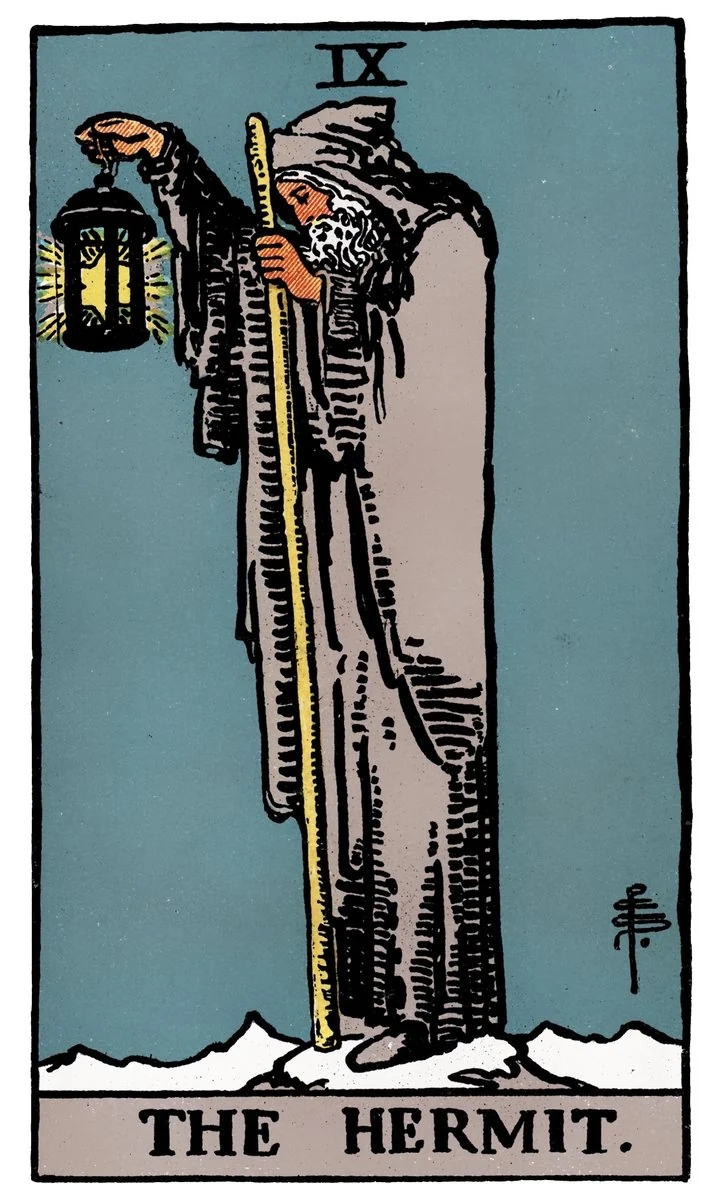
On a snowy peak, an old man holds up a lantern with a six-pointed star inside and leans on a plain staff. His light doesn’t reach the horizon; it shows only the ground for his next step. That’s the heart of the card: real clarity rarely comes in a crowd. It comes from honest reflection over time.
- Upright keywords
- soul-searching, introspection, solitude, inner guidance, careful study, patience, a wise mentor
- Reversed keywords
- isolation, loneliness, withdrawal, shutting people out, avoiding reflection, stubborn secrecy
- Chosen solitude: climbing the mountain
The Hermit stands alone on the summit, far from the crowds and chatter of the valley. Being there is a deliberate choice to find physical or mental space and see what’s real. In personal questions, it means turning down the volume on other people’s opinions long enough to hear your own reasoning and weigh your long-term priorities honestly.
- The lantern: light for the next step
Inside the lantern glows a six-pointed star, lighting a small circle around his feet. Wisdom doesn’t mean knowing everything that lies ahead. It means having enough clarity and presence of mind to put your next foot down on solid ground.
- The staff: support from experience
The Hermit leans on a long staff, the kind of support that practical experience and steady habits give you. He doesn’t float above reality in pure theory; he crosses icy rock with tested, measured steps. Rely on what you’ve proven you can do, and on patience, rather than on rushed leaps nobody has checked.
The Hermit upright and reversed meaning
The Hermit upright meaning
Upright, the Hermit means a useful pause: time alone, careful thought and checking things for yourself until you’re ready to act.
Slowing down to get it right
Things slow down, or the work needs focused, independent effort. Progress comes from careful research, patient drafting or advice from an experienced mentor, not from broad self-promotion. Narrow your attention to the task in front of you. Check the source documents, review the details and test your assumptions before you decide. When the advice you get conflicts, set aside the trendy takes and look at track records and clear standards.
Finding your own perspective
You feel a natural pull to step back from surface-level obligations and digest what has happened. Space helps you settle and tell your own priorities apart from what others expect of you, and solitude feels restoring rather than lonely. Set aside private time without screens: write things down unedited, study something deeply or take long walks alone. As advice, the Hermit says to trust your own judgment instead of asking several people for permission to think what you already know.
The Hermit reversed meaning
Reversed, the Hermit usually means your relationship with solitude is off balance: either time alone has hardened into isolation, or you’re avoiding it with constant noise and company.
Walling yourself off
Healthy retreat hardens into defensiveness, secrecy or cynicism. You, or someone else, may cut off contact out of pride, shame or fear of being misunderstood. Independence becomes an excuse to turn down help, guidance or basic emotional accountability. Ask whether your retreat is solving anything or just shielding you from uncomfortable conversations. A useful retreat gives you insights you can eventually share; stonewalling only builds resentment and distance.
Running from your own thoughts
Here the problem is fear of being alone with your thoughts. You fill your calendar, look for constant reassurance or scroll endlessly to drown out something unresolved. Skipping reflection this way means the real problem never gets looked at. Ask what fear or hard truth you’re trying to outrun. Cut the inputs for a day and let the surface anxiety settle, then write down the facts you’ve been choosing not to see.
Is The Hermit a yes or no card?
Maybe. The Hermit is a maybe that leans toward “not yet”: it asks you to slow down and get clear before you act. It leans yes for questions about study, research, time alone or rethinking a plan, and no for anything that needs a fast decision, a joint push or a big social step. Reversed, it suggests that withdrawing, or avoiding the question altogether, is part of what’s holding things up.
The Hermit symbolism
The classic Hermit uses just a few plain details to set inner wisdom against careful footing on an icy summit.
- The glowing lantern
He holds up a lantern with a shining six-pointed star inside.
The lantern lights the ground at his feet, not the whole journey. Wisdom handles the next practical step instead of demanding to see the end.
- The staff
A tall staff is gripped firmly in his left hand.
The staff stands for support, a deliberate pace and hard-earned experience. It keeps him steady on risky ground and stops him from stepping carelessly.
- The snowy peak
The Hermit stands alone at the top of a bare, snow-covered mountain.
The height suggests a wider view earned through sustained effort. The ice and bare rock suggest simplicity, focus and freedom from social entanglements.
- The gray hooded cloak
A heavy gray cloak covers his whole body, with the hood drawn up.
The cloak suggests modesty and discretion. It shelters the inner flame from harsh wind and keeps reflection safe from passing distractions.
Watercolor deck
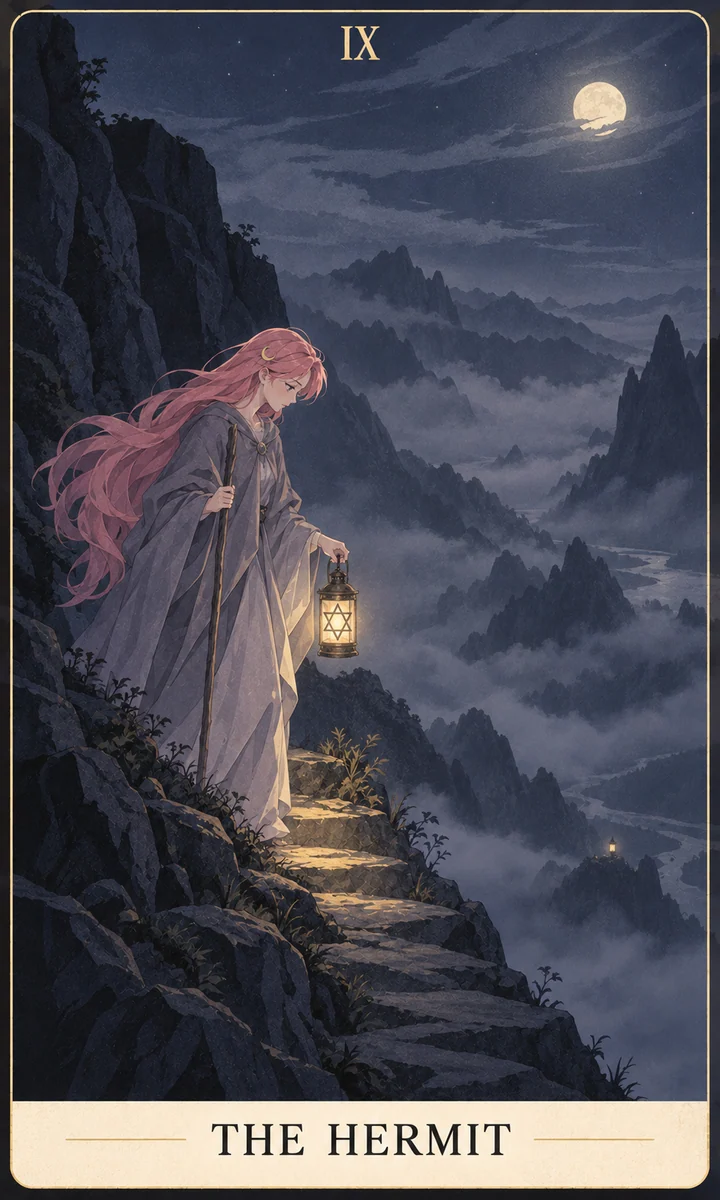
In our watercolor Hermit, a robed woman carries a softly glowing lantern along a narrow stone stairway cut into the mountainside. Pale mist drifts across the silent ridges under a calm moon. Her lantern lights only the next few steps: inner clarity doesn’t require seeing the whole road at once, just the patience to take one honest step at a time.
The Hermit in love and relationships
In love, the Hermit usually means a need for space, reflection or time to know yourself, and it asks whether each person knows who they are outside the relationship.
The Hermit as feelings
Upright · The Hermit as feelings suggests someone who is reflecting and wants some personal space, possibly before they’re ready to say what they feel. It confirms neither love nor its absence. Reserve isn’t the same as indifference: if their quiet comes with reliable follow-through and honest answers when you ask, they’re thinking it through.
Reversed · Feelings may be frozen behind defenses, stubborn sulking or deep isolation. They may feel detached, misunderstood or scared of opening up. Or they may cling because they can’t stand being alone, making their partner responsible for their happiness. Evasiveness and cold avoidance point to defensive withdrawal rather than thoughtful distance.
Closeness with room to breathe
Upright · Right now the relationship works best when you both respect each other’s interests, routines and quiet evenings. If you’re single, it’s a good time for self-discovery, and being on your own feels better than settling for shallow company. Time apart should leave you both glad to reconnect.
Reversed · Distance has turned into a cold divide. You may be living parallel lives like roommates, not sharing vulnerability or worries. If you’re single, it can point to self-imposed loneliness, social anxiety or standards that push good people away. If time alone keeps breeding resentment or relief, the relationship needs an honest conversation.
A slow pace that values substance
Upright · Things may need more time for reflection and thoughtful conversation. What matters is whether the space leads to clearer understanding and renewed contact; a slow pace alone doesn’t say whether a lasting commitment is coming. Say clearly what a pause is for, rest or reflection, and agree on when you’ll talk again.
Reversed · A standoff blocks the way forward. Without honest talk, one person may suddenly retreat into their shell while the other panics and chases, and the cycle wears you both out. At worst, mutual stubbornness turns into long silent treatments that slowly drain goodwill. Silence used as a weapon damages the bond; space you’ve agreed on protects it.
The Hermit career meaning
At work, the Hermit means deep research, specialized craft and solving problems on your own, valuing solid expertise over office politics and loud self-promotion.
Deep, focused work
Upright · Your work calls for independent study, careful documentation or solving problems on your own. You do well by mastering complex tools, writing detailed procedures or catching errors others miss. Visibility and promotional meetings take a back seat to careful, high-quality work.
Reversed · Working in a silo has stopped helping. You may be holding on to information, refusing input or putting colleagues off with intellectual arrogance. Or the opposite: chaotic team demands and endless meetings leave you no uninterrupted time to do good work. If teammates can’t use or follow your work, set up clear handoffs while still protecting your focus hours.
Specialists, mentors and research
Upright · Good openings lie in research, advisory or consulting work, academia or a solo practice. Instead of competing for flashy titles, your edge grows by building rare, specialized knowledge. An experienced mentor may turn up, or you may be asked to quietly guide newer colleagues.
Reversed · You may pass on good opportunities because you dread interviews, networking or presenting your results. Or you may follow bad advice from self-styled gurus without checking their credentials, mistaking untested theory for proven practice. Favor mentors who can show real results, and put your energy into skills and a portfolio rather than surface networking.
A career that fits your values
Upright · A career change works best when it’s driven by meaning rather than salary wars or status. You might consider downshifting, going freelance or choosing an ethical niche that respects your integrity. A slower path that protects your peace of mind can feel far more rewarding than empty advancement.
Reversed · Disillusionment with office politics may push you toward a rash exit. Leaving without savings or a clear plan can turn a principled retreat into financial hardship. Or you stay stuck in an uninspiring job because you’re too checked out to look elsewhere. Draft a realistic timeline that covers living costs and any training you need, and make sure you’re moving toward something, not just away from discomfort.
The Hermit money and finances
With money, the Hermit means careful budgeting, checking the facts yourself and keeping things simple, valuing long-term security and independence over showy spending and risky bets.
Income built on expertise
Upright · The Hermit turns your attention to how your expertise creates value, and to what justifies your fee or the return you expect. It favors study and checking the facts. It doesn’t mean your income has to be slow or earned alone.
Reversed · Your income may suffer because you’re too shy to market your services or charge fair rates. On the flip side, trusting murky get-rich-quick tips in isolation can lead to avoidable losses, and late invoices or neglected billing hold up payments. Review your rates and contracts without embarrassment, and ask whether modesty is hiding the price you should be charging.
Simplicity over display
Upright · Spending is a chance to separate what you really need from costs you take on to keep up with others. Simplifying should support your actual life and priorities; it doesn’t mean treating every pleasure or social plan as unnecessary.
Reversed · Thrift can turn into anxious hoarding, where you deny yourself basic comforts, medical care or the tools you need out of fear. Or you spend in secret to numb loneliness and quietly build up debt. Go through your recurring statements and remember that money is a tool for a decent, working life, not a score to keep. Spend on your health, good food and reliable equipment without guilt.
Self-reliance built on clear facts
Upright · Security comes from understanding where you stand now and why you’re making each decision. Reviewing things yourself is useful, and unfamiliar questions may call for expert advice. Being independent doesn’t mean carrying every money worry alone.
Reversed · Ignoring bank accounts, unpaid taxes or complicated contract terms leaves you exposed. Burying your head in the sand won’t make debt disappear, and refusing qualified advice leaves you open to simple mistakes. List every balance, interest rate and fixed monthly cost, unpleasant numbers included; the dread fades once the math is on paper.
The Hermit in a tarot spread
Where the Hermit lands in a spread changes what it describes. Your question sets the topic; the position tells you what part the card plays in the answer.
- Present situation
- Upright: a natural time to step back, do deep individual work or wait for the facts to settle. Reversed: you’re either hiding from contact you need or staying busy to avoid quiet reflection.
- Obstacle
- Upright: overthinking, perfectionism that causes delays, or cutting yourself off from people who could help. Reversed: refusing to reflect, loneliness disguised as pride, or ignoring proven advice.
- Advice
- Upright: as advice, the Hermit says to pause, consult trustworthy sources and light only the next practical step. Reversed: end the isolation that isn’t helping, say clearly what you need and admit where you could use qualified help.
- Outcome
- Upright: deep personal clarity, sharper expertise and a calm independence earned through careful judgment. Reversed: lasting distance, misunderstandings left unresolved, or insisting on facing a hard problem completely alone.
To read the Hermit alongside the other cards in a spread, start with our Tarot beginner’s guide.
The Hermit tarot card FAQ
What does the Hermit mean in tarot?
The Hermit, card IX of the Major Arcana, means stepping back from the noise to think for yourself. Upright, it stands for introspection, careful study, inner guidance and trusting what experience has taught you. Its lantern lights only the next step, a reminder that you can move through uncertainty without knowing the whole future. Reversed, it points to isolation or avoiding reflection.
What does the Hermit reversed mean?
The Hermit reversed means solitude has gone wrong in one of two ways. Either time alone has hardened into isolation, secrecy and shutting helpful people out, or fear of being alone sends you chasing distractions so you never face the real problem. Either way, the fix starts with telling protective solitude apart from defensive withdrawal, then reconnecting or reflecting as needed.
How does someone feel about you if you pull the Hermit?
The Hermit as feelings usually means someone is taking their feelings seriously and thinking them through privately rather than showing them quickly. They may need some space before they can say what they want. Reversed, it can point to emotional coldness, stonewalling or silence used as a weapon. The card describes careful reserve, not a promise of passion, so watch what they do after the quiet.
Does the Hermit mean someone has lost interest or wants to break up?
Not automatically. The Hermit mainly means someone needs space to process and reflect. Upright, wanting space can actually protect a relationship from burnout. Reversed, and paired with a long refusal to talk, it can point to emotional withdrawal. The clearest sign is how they handle the space: whether they stay respectful and tell you what they need, or simply disappear.
What does the Hermit mean for your career?
In a career reading, the Hermit points to deep, focused work: research, specialized skills, careful problem-solving and learning from a mentor or becoming one. It favors expertise over office politics and self-promotion, and often a slower path that fits your values. Reversed, it can mean working in a silo, avoiding networking or interviews, or quitting in frustration without a plan.
What is the difference between the Hermit’s solitude and loneliness?
Upright solitude is a choice that feeds you: it brings clear insights, restored energy and a steady independence you can eventually share. Reversed loneliness is a state you fall into or hide in, marked by feeling cut off, bitter and defensive. Solitude builds inner strength and calm focus. Isolation breeds friction, anxiety and rigid emotional walls.