

What does Judgement mean in tarot?
Judgement marks a turning point: you finally make sense of your past so a new chapter can begin. It isn’t a judge handing down punishment. It’s a moment of waking up, when you see things as they really are, own your history without denial and understand the step forward your situation is asking for.
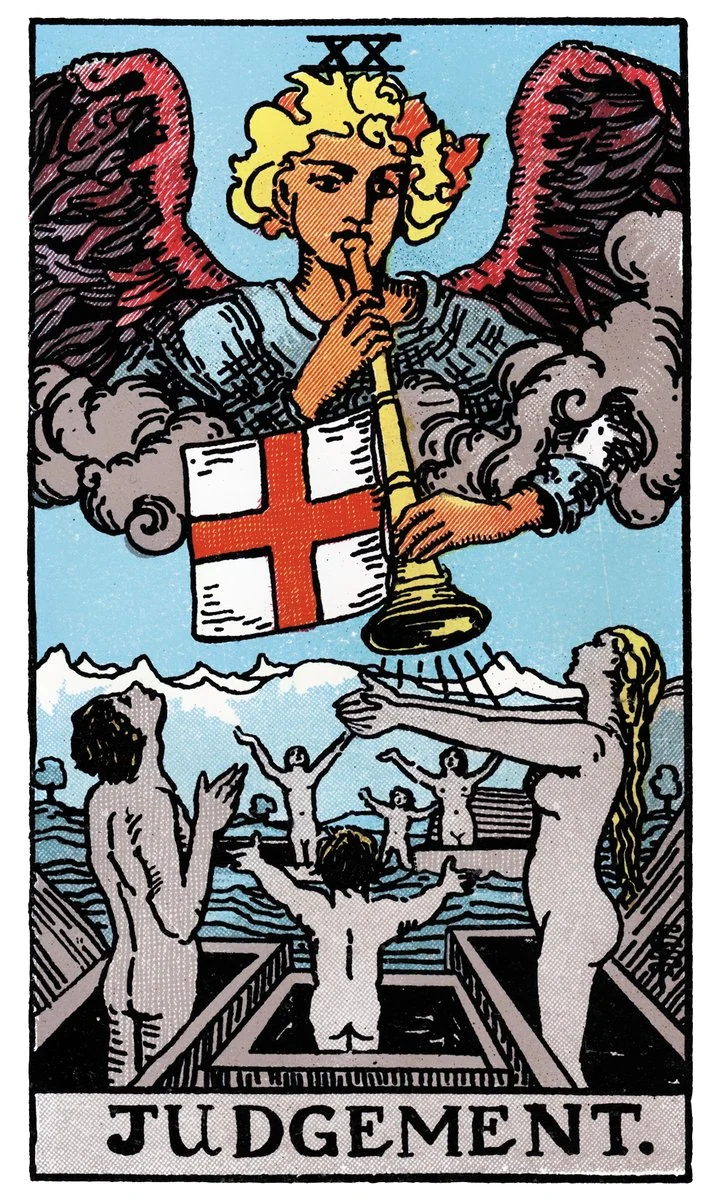
A winged angel blows a bannered trumpet from the clouds, and people rise from floating stone coffins with their arms raised. The sound breaks through habit and inertia, the open coffins show old limits being left behind, and the snowy mountains in the distance suggest a wider view. Together they show how an honest look at yourself can dissolve old patterns and lead to a clear, deliberate fresh start.
- Upright keywords
- awakening, reckoning, renewal, answering a calling, forgiveness, a clear decision, rebirth
- Reversed keywords
- harsh self-criticism, guilt, self-doubt, avoiding a decision, ignoring the call, fear of change, stuck at a crossroads
- Awakening and calling: the trumpet above the figures
The trumpet calls the people below to respond, which ties Judgement to recognizing something important: a new understanding of your past, or a purpose that deserves your attention. Make sure it’s a lasting insight and not a passing burst of enthusiasm. What exactly has become clear, and why should it change your next decision?
- Review and renewal: rising from the coffins
The figures climb out of closed boxes, which gives renewal a visible form. In a reading, look at a whole stretch of your life at once: keep what you learned, accept the responsibilities that are really yours, and don’t reduce anyone, yourself included, to past mistakes. Renewal doesn’t erase history; it changes what you do with it.
- Response and action: the outstretched arms
The people don’t just hear the call; they stand up and answer it. So Judgement links insight to action: a decision, a conversation or a practical change. Upright, you’re willing to respond. Reversed, ask what’s really slowing you down, because missing information, fear of change, self-doubt and endless self-criticism each need a different response.
Judgement upright and reversed meaning
Judgement upright meaning
Upright, Judgement means a moment of clarity when your past choices add up to a clear direction, and you’re ready to take responsibility, accept what you’ve learned and move on without second-guessing.
A turning point that clears things up
Something reaches a decisive point that clears up past confusion. Long effort gets a formal evaluation, a legal or organizational matter is resolved, or circumstances ask for a choice that will change your path for good. Look at the facts that have come out and accept them as they are. If a chapter is closing, make your position clear and finish what you owe so you can move on cleanly.
Waking up to what really matters
A rush of self-awareness cuts through old doubts. You forgive past mistakes as lessons you needed, see what truly matters and start living in line with your values. Trust that realization instead of waiting for someone’s permission to change. Notice which outgrown version of yourself you’re ready to let go of, and act like the person you’ve become.
Judgement reversed meaning
Reversed, Judgement usually means you’re stuck at an important crossroads, held back by harsh self-criticism, avoiding closure or refusing to act on what you already know is true.
Putting yourself on trial again and again
Looking back turns into constant guilt and second-guessing. Instead of taking practical lessons from past mistakes, you keep putting yourself on trial, which drains your energy and hides what’s possible now. Real accountability is different from punishing yourself. Accept what can’t be undone, fix what you still can, and close the case on matters that are settled.
Hearing the call but not answering
You know what needs to happen, but fear of change keeps you in a situation you’ve outgrown. Putting things off replaces commitment, and an uncomfortable status quo survives because taking a stand feels intimidating. Name the consequence you’re afraid of. Not deciding is also a choice, with costs that pile up, so take the first concrete step your own truth calls for.
Is Judgement a yes or no card?
Yes. Judgement is a yes, especially for questions about making a big decision, resolving a long-standing issue or following a calling. It marks a moment of clarity when you know what needs to happen, though it asks you to be honest, own your part and stop looking back at old habits. Reversed, it leans toward “not yet”: there’s reflection or responsibility you haven’t faced, and the answer can change once you do.
Judgement symbolism
The classic Rider–Waite–Smith imagery turns a spiritual awakening into physical gestures of hearing and rising, setting heavy stone coffins against open sky and water.
- The angel and bannered trumpet
A winged angel appears from a bank of clouds, blowing a golden trumpet hung with a red-cross banner.
The trumpet is a wake-up call you can’t ignore. It marks the shift from going through the motions to being fully aware, and it asks for your attention and a clear response.
- The rising figures in open graves
A man, a woman and a child stand up in gray floating coffins, backs arched and arms outstretched in wonder.
The open coffins show release from old limits and dead habits. Rising together, the figures look ready to take full part in a new stage of life.
- The sea and waterways
Calm blue-gray water surrounds the floating coffins and stretches to the foot of tall mountains.
Water stands for the flow of awareness and feeling. It’s a reminder that rebirth doesn’t wipe out your memories; you carry what you’ve lived into the new landscape.
- The distant snow-capped mountains
A jagged ridge of blue and white peaks lines the horizon under a clear, bright sky.
The peaks suggest a higher view, lasting truth and the challenges ahead. Rising out of the coffin opens up that wider view, trading short-term worries for long-term purpose.
Watercolor deck
The watercolor Judgement keeps the trumpet, the rising figures and the coffins on the water, and sets them in bright dawn light. The call from above and the hands reaching up make renewal a two-way exchange rather than something that just happens to you: hear the message, look honestly at the past and decide how you’ll step into the next phase.
Judgement in love and relationships
In love, Judgement means a moment of truth: you see the relationship clearly, own your part and move from something vague toward a conscious commitment or a clean goodbye.
Judgement as feelings
Upright · They’re taking an honest look at the connection and deciding whether to respond to you clearly. They may want to try again, but reconciliation is only one possibility. Watch for real changes in how they understand things and how they act, with feelings expressed directly and about the present, not just nostalgia.
Reversed · Their feelings are clouded by old resentment, fault-finding or fear of being vulnerable. They may dwell on past slights, or downplay how much they care to protect themselves from rejection. Defensive distance or lingering blame is not the same as being ready to build something together.
A relationship facing a moment of truth
Upright · The relationship reaches a point where your patterns get an open review. Couples settle long-running friction by being honest with each other, and newer connections move past flirting into a clear understanding. You’ll know it’s working when talks end in concrete agreements about how you’ll treat each other from here.
Reversed · The relationship is stuck in a loop of blame that never resolves. You both know a frank conversation is overdue, but fear of a breakup or of change keeps the real issues off the table. Talks circle through the same complaints; naming the problem plainly is the way out.
A new chapter for the relationship
Upright · A breakthrough changes how you relate for good. That might be renewed faithfulness, a formal commitment or a clean, respectful parting, but either way, uncertainty gives way to clarity you both share.
Reversed · Things stall because neither of you makes the call. One of you may keep threatening to leave without going, while the other offers surface compromises that leave the real problems untouched. What’s needed is an end to the limbo, either by setting workable boundaries together or by admitting the connection has run its course.
Judgement career meaning
At work, Judgement means a formal review, a clearer sense of your true calling, or a major move based on everything you’ve learned so far.
Your work under review
Upright · Your track record gets an objective look: a performance review, a credential check or decisive feedback. The quality of your accumulated work sets your standing and opens new paths. Keep your attention on measurable results and documented contributions.
Reversed · Criticism makes you defensive, or a review keeps getting delayed. You may feel unfairly judged by colleagues while missing real blind spots in how you work or communicate. Keep the formal process apart from your emotional reaction, and look for the specific areas you can develop.
Answering a professional calling
Upright · A role or project comes along that fits both your hard-won skills and your values. It’s an invitation to step out of a familiar supporting role and take more ownership. Judge it by how well it uses your experience, not by how comfortable it feels.
Reversed · Self-doubt or reluctance to take on more responsibility can make you let a good opening pass, simply because it means leaving a safe but stale routine. Ask whether your hesitation comes from a real skills gap or from fear of being seen.
Moving toward work that means something
Upright · A strategic career change becomes necessary. Your past experience comes together into a clear sense of vocation, and you leave a field or role that no longer fits your integrity or ambition. Map out the qualifications, timeline and resources you need to make the move on purpose.
Reversed · You stay in an unfulfilling job out of habit, ignoring steady signs that you’ve gone as far as you can there. Complaining about work replaces planning your exit. Compare where your career is heading with what you’re actually good at, and start taking concrete steps.
Judgement money and finances
With money, Judgement means taking an honest look at your finances, facing past spending and building habits that support long-term security.
What your effort has actually earned
Upright · Judgement puts your income inside a bigger review: which efforts created value, which expectations need adjusting and whether to keep the same approach. It’s about evaluating and choosing, not a guarantee of bonuses or overdue rewards. Base your expectations on signed contracts and money actually received.
Reversed · Expected payments or settlements get stuck in red tape, or past neglect cuts into what comes in. Unrealistic income assumptions run into the actual terms of a contract. Go carefully through billable hours, unpaid invoices and running costs.
Facing old debts and obligations
Upright · Your spending is about responsibilities left by earlier decisions, ones that need finishing, changing or closing. Taking responsibility means working from facts; spending out of guilt may not fix the original problem. List every debt and required payment so you know where you stand.
Reversed · Bills get avoided while penalties, interest and stress pile up. Or impulse spending becomes a way to distract yourself from money worries. Put structured repayment ahead of extras to give yourself a clean foundation.
Building better money habits
Upright · Security comes from turning experience into new decisions. Before you assume a new phase has begun, check which habits have actually changed and which obligations are still open. Realizing what went wrong doesn’t restore your finances by itself.
Reversed · Disorganization keeps causing money crises, yet the habits stay the same. You may swing between strict self-denial and careless splurging, avoiding the steady discipline real stability needs. Swap guesses for actual statements and a budget, and let your spending follow the reserves you can document.
Judgement in a tarot spread
Your question sets the topic; the position in the spread sets the card’s job. Upright or reversed tells you whether the call is being answered, and the position tells you whether Judgement describes the present, a block, advice or where things are heading.
- Present situation
- Upright: you’ve reached a major turning point where past choices have added up to a reality that calls for a clear decision. Reversed: things are bogged down by mistakes no one has dealt with, unresolved complaints or a shared reluctance to admit an old phase is over.
- Obstacle
- Upright: moralizing, self-righteousness or demanding instant perfection from others can stall progress. Reversed: harsh self-criticism and fear of accountability freeze your judgment, keeping you in patterns you outgrew long ago.
- Advice
- Upright: as advice, Judgement says to face the facts, forgive past missteps and answer the call to step forward with full ownership. Reversed: stop the cycle of self-blame, fix what you can today and make the decision you’ve been putting off.
- Outcome
- Upright: things become clear, with a clean break from old entanglements and a fresh start. Reversed: putting off the decision keeps the same frustrations coming back, and things resolve only once you face reality and make the change.
To see how Judgement reads alongside other cards in a spread, start with our Tarot beginner’s guide.
Judgement tarot card FAQ
What does the Judgement card mean in tarot?
The Judgement card means awakening, an honest reckoning and moving into a new stage of life. It shows a chapter closing and asks you to take what you’ve learned and answer a call you can’t ignore. It isn’t about punishment from outside; it’s an honest look at yourself that frees you from habits you’ve outgrown.
What does Judgement reversed mean?
Judgement reversed usually means you’re avoiding a reckoning you need, being too hard on yourself or hesitating at an important crossroads. You may be stuck in guilt, or denying facts you already see. The way forward is to move from regret to responsibility and make the decision you’ve been putting off.
What does the Judgement card mean in love?
In love, Judgement means a moment of truth when a relationship gets an honest evaluation. Upright, it supports honest talk, forgiving old hurts and moving into a clear commitment or a clean parting. Reversed, it points to constant fault-finding, the same old arguments or refusing to talk about the obvious problem. As feelings, it shows someone deciding how they really feel about you.
Does Judgement mean reconciliation with an ex?
Judgement can point to reconciliation, but it doesn’t promise it. The card is about reviewing the relationship and deciding how to respond to what you now understand. Getting back together takes both people wanting it, the old problems addressed and changed behavior. The same review may also tell you it’s time to move on.
What is the difference between Judgement and Justice?
Justice is about a fair decision; Judgement is about awakening and renewal. Justice asks what evidence and standards should guide a choice and how responsibility should be shared. Judgement asks what a look back over a whole chapter shows you, and how you’ll respond to it. Both cards can guide everyday decisions.
What number is the Judgement card in tarot?
Judgement is card XX, number 20, of the Major Arcana. It comes after the Sun (XIX) and just before the World (XXI), the final card. That near-final place fits its meaning: Judgement is the look back over a whole chapter and the call to rise into the next stage, while the World marks the completion that follows.