What does The Emperor mean in tarot?
The Emperor is the card of structure and responsible authority. When a situation is loose, chaotic or full of unknowns, he doesn’t rely on bursts of enthusiasm. He sets clear rules, divides up responsibilities and gets things running in order. Rather than producing new ideas, he builds the framework that protects and sustains them. Whether you’re asking about a goal or a relationship, the card turns your attention to who is responsible, how decisions get carried out and whether the arrangement gives real stability.
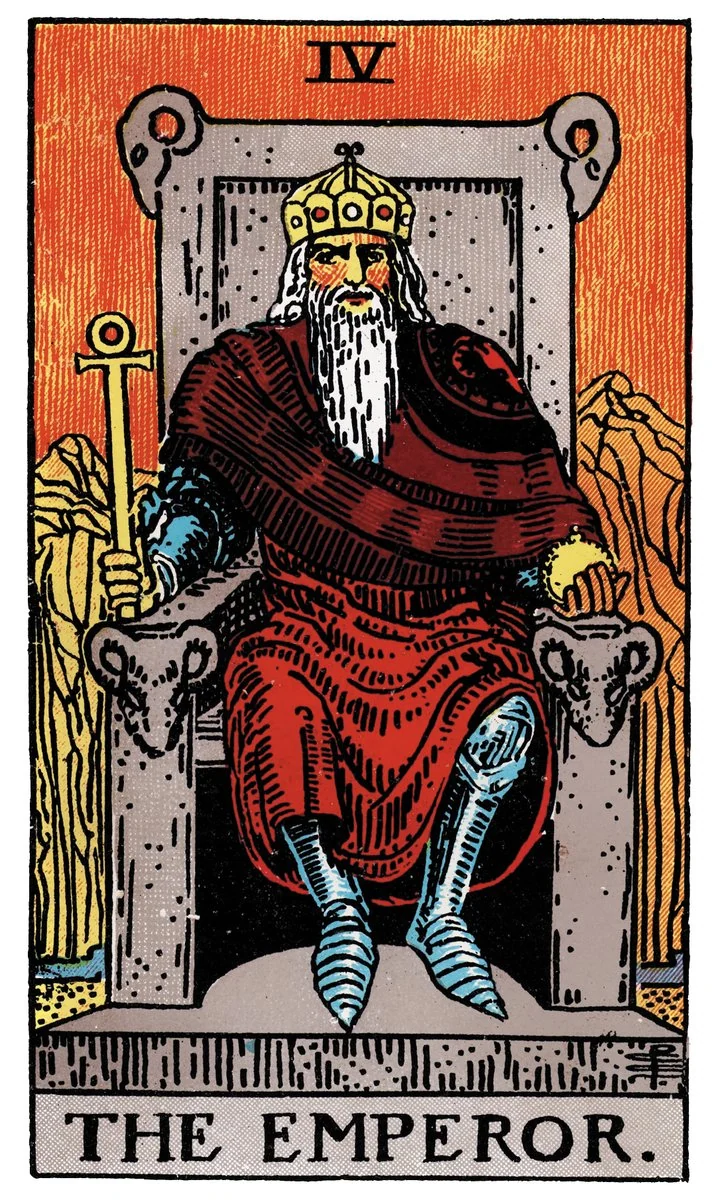
On the Rider–Waite–Smith card, the ruler sits on a hard stone throne carved with ram heads, wearing armor under a red robe and holding an ankh-shaped scepter and a golden orb. The stone and armor stand for steady protection against outside chaos; the scepter and orb stand for the everyday duty of governing. This authority isn’t about getting your own way. It exists to hold safe boundaries and look after people. Upright, that order brings security and progress; reversed, ask whether control has become too harsh, or whether the person who should be in charge isn’t doing the job.
- Upright keywords
- structure, stability, authority, leadership, discipline, clear boundaries, protection
- Reversed keywords
- rigid control, micromanagement, power struggles, lack of discipline, avoiding responsibility, stubbornness
- Order and boundaries
The heavy stone throne has no soft cushions, a sign that stability rests on firm principles rather than shifting moods. In a reading, that means explicit boundaries and consistent rules. A good boundary makes clear who is responsible for what and protects your energy from confusion. When this card appears, ask whether your current agreements are clear and workable, or whether vague expectations are inviting conflict.
- Authority and responsibility
Holding an ankh scepter and an orb, the Emperor accepts the weight of being in charge. Real authority comes with accountability, not just power over others. The card asks whether you’re willing to stand behind your decisions and protect the people who depend on you. In practical questions, it asks who carries final responsibility for the outcome, and whether that leadership is backed by real ability.
- Discipline and follow-through
The armor under his red robe means he’s ready to defend his ground and carry out plans even when it’s uncomfortable. The Emperor turns ideas into procedures and steady habits. This is the quality of daily discipline, systematic effort and staying calm under pressure. It favors holding your course through consistent work rather than waiting for bursts of inspiration.
The Emperor upright and reversed meaning
The Emperor upright meaning
Upright, the Emperor means stability built on clear rules and responsible leadership: you set firm boundaries, take ownership of what’s yours and follow through with discipline.
Clear rules and reliable agreements
Things run smoothly because the rules are clear and actually followed. Around you, that can look like a stable organization, fair management and commitments people keep. Projects move forward through methodical planning, clear roles and agreed standards rather than guesswork. Put your agreements into clear words, in writing if needed. Know who makes the decisions and what concrete steps will bring stability, and rely on consistent routines instead of waiting for things to organize themselves.
Self-discipline and calm control
Inside, the Emperor means self-command and a clear, practical focus. You feel able to manage your emotions and point your willpower at concrete goals. You hold your boundaries calmly, without hostility, because your sense of authority comes from self-respect rather than a need to prove anything. Concentrate on what’s within your control and own your choices. Under stress, lean on routines that steady you, and practice saying a clear no to demands that cross your values or your limits.
The Emperor reversed meaning
Reversed, the Emperor usually means power is out of balance: either rigid control and micromanagement, or a collapse of leadership, discipline and accountability.
Too much control or none at all
Authority goes wrong in two ways. When power overreaches, you see stubborn authoritarianism, micromanaging and a refusal to hear feedback. When authority collapses, you see chaos, missed deadlines, passive avoidance and nobody willing to lead. Ask which one you’re dealing with. If the rules are choking progress, drop the restrictions that don’t matter and hand over some control. If things are in disorder, make ownership clear, set minimum standards and hold people to what they agreed to.
Resetting boundaries and responsibilities
The reversed Emperor shows that the current arrangement no longer protects anyone. Your boundaries may keep getting crossed by someone overbearing, or you may be enabling chaos by rescuing someone who won’t carry their share. Stop making up for other people’s lack of discipline, and don’t impose decisions on people who are your equals. Make sure authority and accountability sit with the same person, and be clear about where your responsibility ends and someone else’s begins.
Is The Emperor a yes or no card?
Yes. The Emperor is a yes, especially for questions about whether a plan can go ahead, whether you can set up clear rules or whether an agreement will hold. Its yes comes with conditions: discipline, clear roles and doing things by the book, so it helps less with questions that call for flexibility or an unconventional approach. Reversed, it leans toward no for now, because the framework has gaps, responsibilities are unclear or someone is blocking progress; sort out who’s in charge before you act.
The Emperor symbolism
The Rider–Waite–Smith Emperor uses stone, armor and royal regalia to ground leadership in the real world and in steady resolve.
- The stone throne and ram heads
He sits on a plain, square stone throne with ram heads carved into it.
Stone stands for permanence and foundational law, and the rams for drive and determination. Together they show authority that rests on lasting structures rather than passing moods.
- Armor under a red robe
Armor shows on his limbs beneath a heavy red robe.
The armor shows readiness to defend and the ability to keep emotions in check, while the red robe stands for active willpower. Protecting anything takes practical resilience and the strength to hold firm under pressure.
- The ankh scepter and the orb
His right hand holds a scepter shaped like an ankh, and his left holds a small golden orb.
The ankh stands for life and care, and the orb for the world he’s responsible for. Authority here means looking after resources, balancing care with firm decisions.
- The bare mountains
Rugged, jagged mountains rise behind the throne against an orange sky.
The harsh landscape shows that order has to be built in a world that won’t do it for you. Security isn’t a happy accident. It’s something you build on purpose to withstand hard conditions.
Watercolor deck
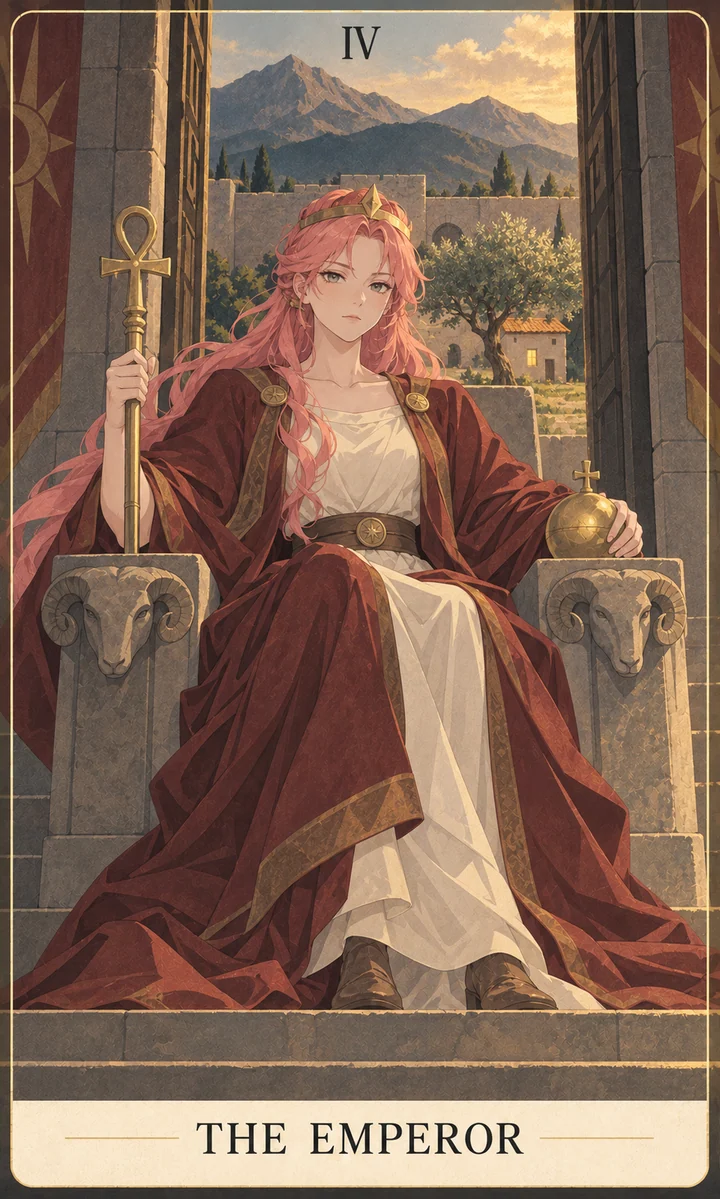
In our watercolor Emperor, a commanding woman in red robes sits on a raised stone throne holding a vertical scepter. Behind her stand a solid stone gate and a quiet town, with cold, rugged mountains beyond. The scene ties authority to concrete protection: real power isn’t measured by how intimidating it is, but by how well its boundaries keep the community inside them safe enough to build their lives.
The Emperor in love and relationships
In love, the Emperor means commitment, dependability and clear boundaries, and the question is whether protection supports mutual respect or turns into one-sided control.
The Emperor as feelings
Upright · If you pulled the Emperor for someone’s feelings, they likely take you seriously and want a clearly defined relationship. They may see you as part of their long-term plans and show they care through practical support and a protective streak. That care can come with a wish to take charge, so watch whether they keep their promises and respect your decisions. Seriousness isn’t the same as coldness.
Reversed · Their feelings may come mixed with a strong need for control: wanting everything their way, even trying to reshape you to fit their standards. Or they may feel pressured by the responsibility a committed relationship brings and back away. If you feel stifled, notice whether they’re trying to run your life or dodging the conversation when it’s time to commit. Protectiveness never justifies taking away your choices.
Clear roles and fair rules
Upright · The relationship runs on mutual respect, clear boundaries and agreements you both keep. You each know where you stand and what’s expected, which makes it a secure place to build long-term plans. Care often shows up as solving practical problems and providing stability more than grand romance.
Reversed · Power struggles, one-sided decisions or an uneven share of emotional work strain the connection. One partner may dominate in the name of protection, or neither takes responsibility for fixing recurring conflicts, and the relationship starts to feel like a contract. Look at how daily decisions and compromises actually get made, and reset boundaries so both voices count.
Making it official
Upright · The relationship is moving toward more definition, formal commitments and shared practical goals. Conversations turn naturally to living arrangements, shared responsibilities and long-term security, and the bond shifts from casual to solid.
Reversed · Progress stalls over stubbornness, clashing ideas about who’s in charge, or an unwillingness to commit. Pushing for a label before basic trust and shared standards exist will meet resistance. Name the next concrete step, such as exclusivity or how you’ll split household costs, and look for agreements you both choose freely rather than grudging compliance or ultimatums.
The Emperor career meaning
At work, the Emperor means clear structure, leadership responsibility and steady, methodical progress, with a close look at how authority is used and how systems are kept running.
Clear structure at work
Upright · Work runs on established procedures, clear reporting lines and predictable expectations. You or your organization have the discipline to oversee complex projects and keep standards consistent. Knowing who decides and how performance is measured lets you work confidently inside those boundaries.
Reversed · Things get bogged down by micromanagement, heavy-handed leadership or plain disorganization. Responsibilities may be poorly assigned, so people are frustrated by rules that change on a whim or leaders who dodge blame when things go wrong. Find out who actually holds decision-making power and whether the standards are written down anywhere.
Stepping up to lead
Upright · Advancement comes from showing you can organize, be relied on and lead others. Opportunities favor people who can bring order to a messy situation and deliver results that are measurable and repeatable. Present your track record with concrete numbers and finished projects.
Reversed · A promotion or new venture may be held up by rigid policies, bureaucratic gatekeeping or an unwillingness to take ownership. Don’t promise control you don’t have the backing to enforce. Make sure any extra responsibility comes with formal authority, rather than hoping informal influence will be enough.
Building a career that lasts
Upright · Your career may grow through established industries, leadership roles or a business of your own with solid systems behind it. Success depends on strategic patience, knowing how institutions work and planning for the long term.
Reversed · A career may feel stifling because of rigid hierarchies, or a business may struggle for lack of discipline and financial controls. Ask whether you’re resisting structure you actually need or putting up with pointless control. Look for paths with clear milestones, where taking responsibility is rewarded rather than exploited.
The Emperor money and finances
With money, the Emperor means budgeting discipline, protecting what you have and planning for the long term, rather than chaotic spending or tightfisted control.
Income on a solid footing
Upright · The Emperor is about how earnings are organized: who’s responsible, the rates, the payment dates and who answers for problems. Income is dependable when the arrangement can be checked and carried out, not just because someone has a title or makes an authoritative promise. For each agreement, confirm the amount, the due date, who pays and how disputes get resolved.
Reversed · The problem is either weak administration or too much control. Missing payment records and unclear responsibility need better oversight. Restrictive terms, or one person controlling all access to the money, raise a different question about power. Compare what was agreed with what’s actually been paid before you count on that income.
A budget with clear rules
Upright · Spending here is about plans, authority and responsibility. Be clear about who decides, who pays and how exceptions get discussed. Good rules help, but they shouldn’t give one person unchecked control over everyone else’s needs.
Reversed · Control over money breaks down into reckless overspending, or swings the other way into a tightfistedness that blocks necessary investment. Cash flow problems often trace back to poor record-keeping or emotional purchases. Set clear spending limits, separate needs from wants, and review subscriptions and debts to plug the leaks.
Building reserves that protect you
Upright · Security rests on clear responsibilities and arrangements that actually work. Ask how much depends on a single decision-maker, and whether you’d still have access to the money and information you need if things changed.
Reversed · A false sense of security hides weak spots, or anxiety about money gets in the way of sound decisions. Trouble comes when finances are neglected or badly miscalculated. Compare your cash reserves with your monthly obligations, and focus on paying down debt and building an emergency fund before taking speculative risks.
The Emperor in a tarot spread
Your question sets the topic, and the position in the spread tells you what job the Emperor is doing. Upright or reversed shows the state of his themes; the position decides whether they describe where you are, what’s in the way, what to do or where things are heading.
- Present situation
- Upright: a stable framework, established authority or a setting with clear rules; notice who holds responsibility and which boundaries are in force. Reversed: disorganization, a power struggle, or someone in authority overstepping their role.
- Obstacle
- Upright: too much rigidity, emotional inflexibility or bureaucratic resistance that blocks creative change. Reversed: a complete lack of structure, leaders who won’t lead, or avoidance of necessary discipline, leaving everyone without clear direction.
- Advice
- Upright: as advice, the Emperor says to take charge: set clear boundaries, organize your resources and keep your commitments. Reversed: stop micromanaging, or stop putting up with someone else’s irresponsibility; decide whether you need to hand over control or step up and take ownership.
- Outcome
- Upright: points to lasting stability, orderly agreements and security built on disciplined effort. Reversed: unresolved power clashes, broken agreements or instability that comes from not setting firm ground rules early on.
To read the Emperor alongside the other cards in a spread, start with our Tarot beginner’s guide.
The Emperor tarot card FAQ
What does the Emperor tarot card mean?
The Emperor means structure, stability, authority and disciplined follow-through. It’s card IV of the Major Arcana. Upright, it encourages you to take responsibility, set clear boundaries and build arrangements people can rely on. Reversed, it points to power out of balance: either heavy-handed control and micromanagement, or someone avoiding the responsibility that comes with being in charge.
What does the Emperor reversed mean?
The Emperor reversed means power isn’t being used in a balanced way, and it can tip toward control or toward a lack of accountability. Control looks like someone overstepping, meddling in every detail and refusing to hear other views. A lack of accountability looks like rules falling apart and everyone passing the blame. Look at who actually holds power in your situation, and whether it’s being abused or neglected.
How does someone feel about you if you pull the Emperor?
Upright, the Emperor usually means they take you seriously. They see you as a partner worth committing to, may include you in their long-term plans, and tend to show care through protection and taking the lead. Reversed, they may try to reshape you to fit their standards, which can feel controlling, or they may shy away from the responsibility a committed relationship brings.
What does the Emperor mean in love?
In love, the Emperor means a practical, committed relationship built on reliability and clear roles. Care tends to show up as solving problems and providing stability rather than grand romantic gestures, and when it works, it feels very secure. Reversed, it warns of power struggles, possessiveness or emotional coldness, or a relationship that runs like a contract with little real connection.
Does the Emperor card always represent a man?
No, the Emperor doesn’t have to be a man or an older boss. Tarot figures stand for qualities, not a fixed gender or age. The Emperor is the role of setting rules, providing stability and making the final call. In real life, it can describe a mother, a female manager, the steady person on a team, or your own capacity for order and self-discipline.
What is the Emperor holding in tarot?
The Emperor holds an ankh-shaped scepter in his right hand and a golden orb in his left. The ankh stands for life and care, and the orb for the world he’s responsible for. Together they show authority as stewardship: managing resources and making firm decisions while still protecting what’s alive. His armor and stone throne add the steady, defensive side of that role.