What does the Ten of Wands mean in tarot?
The Ten of Wands is the end of the Wands suit, where drive, creative fire and ambition reach their limit. What started as a single spark has grown, card by card, into ten full wands, and one person is now carrying all of them. The card shows real endurance, and the obvious strain of refusing to let anything drop.
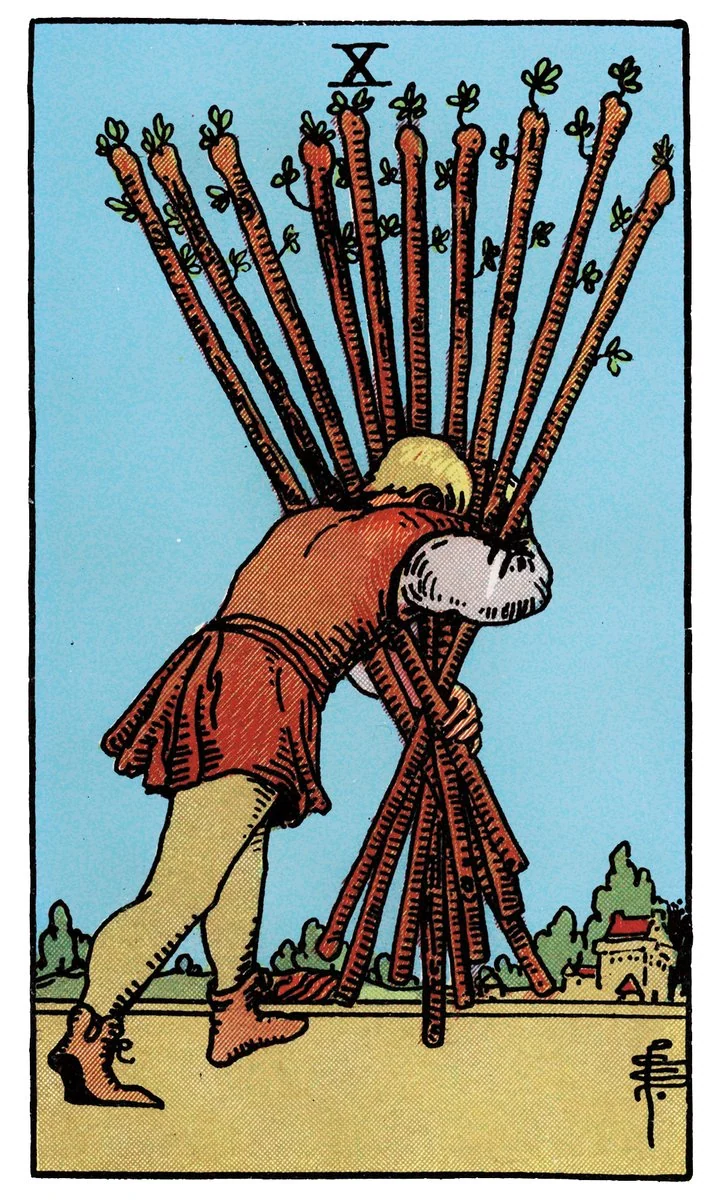
In the classic image, a bent figure trudges toward a distant house, their face hidden behind the bundle in their arms. The destination is in sight, so the hard work is nearly over. But success comes with its own upkeep, and reaching the goal means little if you collapse right at the door.
- Upright keywords
- burden, overwork, too much responsibility, carrying it alone, near the finish, hard work
- Reversed keywords
- delegating, letting go, putting the load down, asking for help, burnout, dropped balls
- Too much at once: ten wands in one bundle
All ten wands are here, which means the effort has reached its limit. No single wand is too heavy, but together their weight tests what one body can carry. That’s how small, well-meant commitments pile up over time, until the bundle takes up all of your attention.
- Head down: the hunched posture
The figure’s bent back and lowered head show how overwork narrows your view. When getting through the day takes every bit of energy, you lose the bigger picture. You see only the ground in front of your feet, not the people who could help or an easier way around. Pushing on becomes automatic, and you can’t even tell how close the end is.
- The cost of success: the house ahead
The house on the horizon stands for finished ambition, shelter and reward. It shows the journey isn’t pointless. But dragging too much into that house can spoil the peace you were working toward. Real success means arriving with enough energy left to enjoy what you built.
Ten of Wands upright and reversed meaning
Ten of Wands upright meaning
Upright, the Ten of Wands means you’re carrying too much responsibility on your own and need grit to get it over the finish line.
Everything due at once
Every task, duty and promise you agreed to has come due at the same time. You can carry this load across the line, but the sheer amount of work blocks your view. Sort what truly has to be done now from what you carry out of habit. To finish, head straight for the end and don’t pick up anything new on the way.
Needing to carry it all
You may tie your worth or competence to how much pressure you can take without complaining. Keeping total control of a project feels safer, but it wears you down and breeds quiet resentment toward people who seem to have it easy. Notice your physical limits before exhaustion forces you to stop. Finishing well includes admitting when a job has grown too big for one person.
Ten of Wands reversed meaning
Reversed, the Ten of Wands usually means the load has become unsustainable: either you hand some of it off, or it falls apart under you.
Putting it down, or dropping it
The reversed card points down one of two paths: setting the load down on purpose or watching it fall. If you speak up and hand specific tasks to others, the reversal means relief, smart delegation and getting your balance back. If you stay quiet and keep absorbing pressure until your stamina gives out, it shows up as dropped balls, missed deadlines, getting sick and being forced to abandon goals that mattered.
Letting go of control
Relief means facing your fear of what happens when you put the bundle down. You may worry that others will do the work badly, or that you’ll stop being the one everyone needs. Stepping back works best as a practical handover, not a dramatic exit. Spell out who owns what, explain the standard you need and let others carry their fair share.
Is the Ten of Wands a yes or no card?
No. The Ten of Wands leans no, especially if you’re asking whether to take on a new commitment, project or partnership while you’re already overloaded. If the question is whether you can finish what you’ve started, it’s a tired yes: you’ll get there, but at a real cost. Reversed, it says hand off or put down part of the load before you agree to anything else.
Ten of Wands symbolism
The bundle of wands, the bent back and the house ahead together show what effort costs when nobody shares it.
- The ten wands
Ten heavy wooden wands are gathered into one awkward, fanned-out bundle.
In the Wands suit, each wand stands for a creative impulse, a project or an ambition. Gathering all ten together piles every earlier effort into one mass. The bundle is too bulky to hold comfortably, which shows the difficulty isn’t just weight. It’s juggling too many separate commitments at the same time.
- The bent back
The figure leans sharply forward, head tucked down behind the wands.
The deep bend in the spine shows the physical toll of overdoing it for too long. Tucking the head down protects the face from the wands, but it also blocks the view ahead, so the carrier sees only the ground beneath their feet. That’s what a crushing workload does: it pushes you into survival mode, with no room for perspective or planning.
- The house in the distance
A cluster of roofs and trees sits in the background on the right, under a clear sky.
The house is the destination: home, finished work and security. It shows the carrier isn’t wandering but coming to the end of a hard journey. Because the bundle blocks the view, though, the figure can’t see how close shelter is. The question is whether they can keep going just long enough to get there.
- The open path
The ground under the figure is an open, gently rising field with no traps or barriers.
There are no cliffs, enemies or hidden snares on this path. The only thing slowing the traveler down is the load they chose to pick up. So the pressure isn’t coming from someone attacking you. It comes from taking on too much, letting duties pile up and refusing to leave extra baggage behind.
Watercolor deck
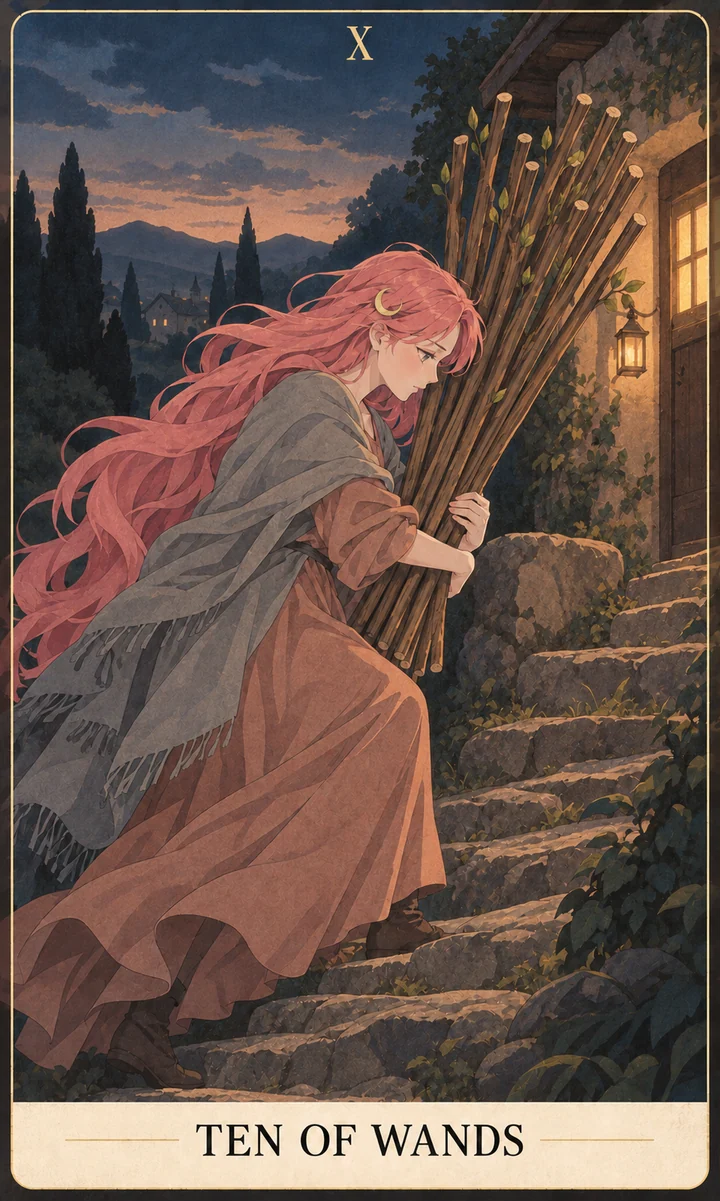
The watercolor version shows the traveler climbing steep stone steps toward a nearby building, clutching the heavy wands tight against their chest. Because the building is so close, the journey reads as its final, steepest climb. Every step takes conscious effort, a reminder that finishing well depends on a steady pace, not a sudden frantic push.
Ten of Wands in love and relationships
In love, the Ten of Wands asks whether the emotional work, chores and everyday upkeep of the relationship are shared, or carried by one person.
Ten of Wands as feelings
Upright · They’re deeply committed but weighed down by what the relationship demands, practically or emotionally. The affection is real, yet fatigue leaves little room for romance, fun or spontaneous warmth.
Reversed · They’ve hit their limit. They may want an honest talk about rebalancing the effort, or they may quietly pull away because the relationship feels like an unpaid second job that nobody thanks them for.
How the relationship works now
Upright · Responsibility is lopsided. One partner handles the scheduling, smooths over conflicts or does most of the housework while the other stays passive. The relationship keeps moving, but only because one person is straining to pull it along.
Reversed · That imbalance snaps. If you renegotiate roles and split tasks differently, closeness can recover. If the overloaded partner just walks away in silence, resentment breaks the connection.
Where it’s heading
Upright · You’re approaching a demanding milestone together, such as a move, caring for a family member or another big transition, that calls for shared grit for a while. A clear timeline keeps it from turning into permanent exhaustion.
Reversed · The relationship can only grow if the balance is properly reset. Getting back together or deepening your commitment works only if the less involved partner takes on concrete, visible tasks, not just sympathetic apologies with no change in behavior.
Ten of Wands career meaning
At work, the Ten of Wands means a heavy workload, tight deadlines and doing too much yourself; reversed, it’s time to delegate or risk burning out.
Your workload
Upright · You’re committed to delivering and willingly take on extra assignments to get the project done. Pride in your stamina keeps you going, but tunnel vision gets in the way of thinking ahead.
Reversed · You either see that solo heroics can’t last and start turning down nonessential requests, or you burn out, miss errors and can’t keep the quality up.
Working with others
Upright · Because you don’t delegate, everything bottlenecks through you. Colleagues may lean on your reliability and leave you the hardest tasks while they do less.
Reversed · The setup needs a real restructure. Teamwork works again when you break the bundle apart: clear handoffs, shared ownership and trust that people will handle what’s assigned to them.
Where your career is heading
Upright · A major project is close to its delivery date. Finishing means working through the final tasks steadily and refusing any scope creep.
Reversed · Moving up depends on letting go of micromanagement. Senior leadership means coordinating people, not doing every detail yourself. Drop the responsibilities you’ve outgrown to make room for bigger work.
Ten of Wands money and finances
With money, the Ten of Wands means heavy obligations such as debt, high overheads or supporting others; reversed, it’s time to restructure.
Income
Upright · Your income is steady but takes grueling hours to keep up. You’re trading time directly for money.
Reversed · Keeping up this pace could cost your health more than the income is worth. Look for more efficient ways to earn, renegotiate your rates or cut work that pays too little.
Bills and debt
Upright · Expenses, debt or financial support for family take almost everything that comes in, leaving little margin for error.
Reversed · The pressure forces a restructure. Consolidate high-interest loans, cancel subscriptions you don’t need and talk openly about money with the people you share a household with.
Long-term stability
Upright · You’re on track to clear a major obligation if you stay disciplined through the final payments.
Reversed · Holding on to things that cost too much to maintain puts your stability at risk. Consider selling or downsizing anything that drains your savings without giving you equal value back.
Ten of Wands in a tarot spread
Your question sets the topic, and the spread position tells you what job the Ten of Wands is doing: describing where you stand, naming what’s in the way or suggesting what to do next.
- Present situation
- Upright: you’re carrying your heaviest load just as a project nears completion, and the push is to see it through. Reversed: it’s time to hand some of it off now.
- Feelings
- Upright: burdened, drained and alone under pressure, with a stubborn pride in carrying it all. Reversed: ready to put the load down.
- Obstacle
- Upright: refusing to delegate or ask for help hides simpler solutions and turns you into the bottleneck. Reversed: dropping things without a proper handover leaves loose ends that come back later.
- Advice
- Upright: as advice, the Ten of Wands says cut your schedule down to the essentials and make no new promises until this load is delivered. Reversed: hand off what others can carry, and do it with a clear handover.
- Outcome
- Upright: the end of the hard stretch is near, and the work gets delivered. Reversed: if nobody shares the load, duties start to slip or get dropped.
To read the Ten of Wands alongside related cards, see Nine of Wands · Two of Pentacles · The Devil · Tarot beginner’s guide.
Ten of Wands tarot card FAQ
What does the Ten of Wands mean?
The Ten of Wands means burden, overwork and responsibility that has piled up close to the finish. Success or ambition has created a heavy load, and one person is carrying all of it. Getting it over the line takes grit. The card also warns against taking on anything new alone until this load is delivered or shared.
What does the Ten of Wands reversed mean?
Reversed, the Ten of Wands means the load can’t go on as it is, and something has to change. In the best case, that’s relief: you delegate, drop what isn’t needed and share the work. In the worst case, burnout forces a sudden, messy collapse where responsibilities simply get dropped. Which one you get often depends on whether you speak up first.
How does someone feel about you if you pull the Ten of Wands?
As feelings, the Ten of Wands means someone feels exhausted, duty-bound and overwhelmed by expectations. They may care deeply about you, but keeping things going, emotionally or practically, feels heavy right now. What they want is rest and appreciation, not more complications. Reversed, they’ve reached their limit and may either ask to rebalance things or quietly pull back.
What does the Ten of Wands mean in love?
In love, the Ten of Wands means unequal effort, with one partner carrying most of the emotional or household work. Upright, the relationship gets through a stressful season on endurance alone. To stay healthy, you both need to see the imbalance and actually share the day-to-day responsibilities differently, not just talk about it.
Does the Ten of Wands reversed mean a breakup?
Not necessarily. Many people read the Ten of Wands reversed in love as an immediate, bitter breakup, but it often means one partner has finally stopped doing everything. That shift can be healthy. If you both talk honestly and rebalance the effort, the relationship can come out stronger. If the tired partner walks away in silence instead, resentment can end it.
Is the Ten of Wands about burnout?
It can be. Upright, the Ten of Wands shows the conditions that lead to burnout: too many responsibilities, no help and no break in sight. Reversed, it can mean burnout has arrived, with dropped tasks or a forced stop, or that you’re finally setting part of the load down before it gets that far. Either way, the card asks what you can share or let go.