
What does The Tower mean in tarot?
The Tower is the card of sudden disruption. Lightning hits the top of the tower, the crown falls and the figures lose their footing. It captures the moment when something you relied on changes, whether through an event, important news or a sharp realization.
Upright, the disruption is usually out in the open. Reversed, the change may be internal, delayed or partly handled through early adjustments. Either way, work out which assumption has changed, how far the impact reaches and what support you still have before you decide how to respond.
- Upright keywords
- sudden change, upheaval, revelation, a shaky foundation, shock, awakening
- Reversed keywords
- delayed upheaval, resisting change, inner turmoil, dismantling things gradually, tension that keeps building, averting a crisis
- Sudden change and revelation
The lightning breaks into the scene without warning, which links the Tower to unexpected events, important news or a sharp change in understanding. The trigger may come from outside or from a realization of your own. Ask which assumption no longer holds. The card doesn’t prove anyone deceived you, and not every upheaval comes from fooling yourself.
- A tower that looked solid
The tower looks imposing, yet its crown is knocked away. That contrast makes the card useful for asking what an arrangement rests on: a shared assumption, a key resource or an authority you can no longer count on. When one support fails it can shake the whole structure, but some parts may still be sound. Sort what is damaged from what you can keep.
- Falling, then rebuilding
The falling figures show the shock and vulnerability of losing familiar support. The first job is to acknowledge the impact, not to insist it’s secretly good for you. In an advice position, secure your safety, the facts and your urgent needs before deciding what to repair, replace or leave. New understanding may follow, but that doesn’t make the harm necessary or deserved.
The Tower upright and reversed meaning
The Tower upright meaning
Upright, the Tower means a sudden event, honest disclosure or realization that brings down a situation that couldn’t last, and it asks you to face the facts without your usual defenses.
When events overturn the plan
Something from outside breaks through your routine and drags hidden instability into plain view. An organization changes overnight, news arrives without warning or an arrangement ends because its terms couldn’t hold. You can no longer pretend everything is working. Find the assumption the events have disproved, and gather facts rather than rushing to put the pieces back together. Accepting the loss of comfort lets you protect what’s essential and see what is still standing.
When a story about yourself collapses
A shift inside you shatters a story you believed about your security, status or identity. You suddenly see that you’ve outgrown a role, or that you’ve accepted compromises that chipped away at your integrity. It’s disorienting, but the shock strips away excuses and puts you back in touch with what you value. Let the old expectations fall away without rushing to build a new identity, and notice where pride or fear kept you in defensive habits. Sticking to plain facts makes the transition less frightening.
The Tower reversed meaning
Reversed, the Tower usually means a crisis that is happening on the inside, being put off or being defused by taking things apart before they fall.
Putting off the reckoning
You can feel the pressure to change, but anxiety or pride keeps you from acting. It’s tempting to patch the cracks instead of facing the deeper failure. Holding the crisis down doesn’t solve it; it stretches out the tension and makes the eventual reckoning more exhausting. Notice where you’re spending a lot of energy keeping an unworkable setup alive, and name the outcome you fear most if it collapses. Admitting the current arrangement has an end date lets you plan an orderly exit.
Taking it down before it falls
When you’ve heeded the early warnings, the reversed Tower shows a controlled dismantling rather than a violent collapse. You wind down commitments that can’t last, step by step, and limit the damage around them. The core change still happens, but you take part in it instead of being flattened by it. Decide which agreements, expenses or roles you can formally end now, and share hard decisions openly before circumstances force an emergency.
Is The Tower a yes or no card?
No. The Tower is a no, especially if you’re asking whether things will stay calm, stay the same or go smoothly. The card shows a sudden shake-up that exposes a weak foundation, so plans resting on that foundation are unlikely to hold. If you’re asking whether a hidden truth will come out or whether to leave a situation that isn’t working, it leans yes; reversed, the shake-up is delayed or softened, so the answer is closer to “not yet.”
The Tower symbolism
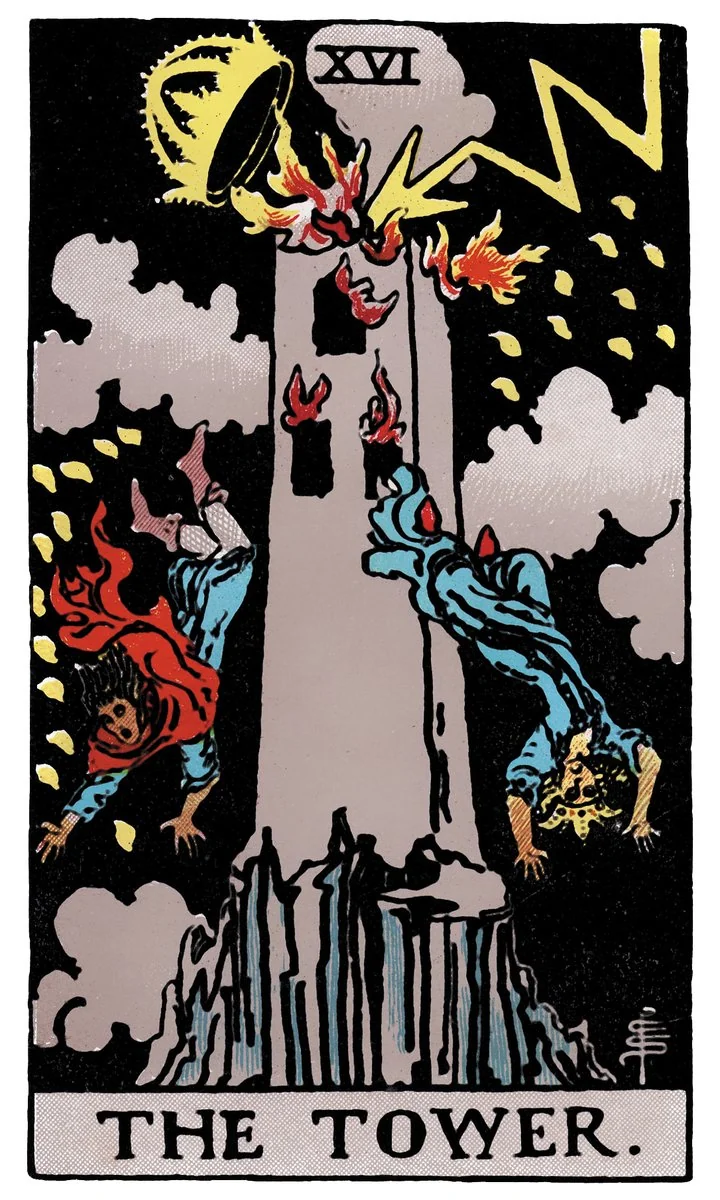
In the classic Rider–Waite–Smith Tower, every detail shows human defenses giving way to the truth, turning a sudden ruin into a kind of release.
- The lightning bolt
A jagged bolt of lightning strikes the top of the tower out of a dark sky.
Lightning stands for sudden insight or events beyond your control. It cuts through mental defenses and exposes weak points in an instant, and it is what knocks the crown loose.
- The falling crown
A large golden crown is knocked off the top of the tower into empty air.
The crown can stand for authority, status or confidence that you’re in control. When it falls, you get a fresh look at what really holds an arrangement up once those apparent safeguards are tested.
- The falling figures
Two clothed people fall headfirst from the tower.
The figures show that when a structure fails, real people feel it right away. Their fall stands for the sudden loss of a position that seemed secure, bringing both of them back down to the ground.
- The flames in the windows
Bright flames burst out of the tower’s three windows.
The flames show the disruption inside the structure itself, not just at the top. That calls for a careful look at what is still usable and what needs replacing.
Watercolor deck
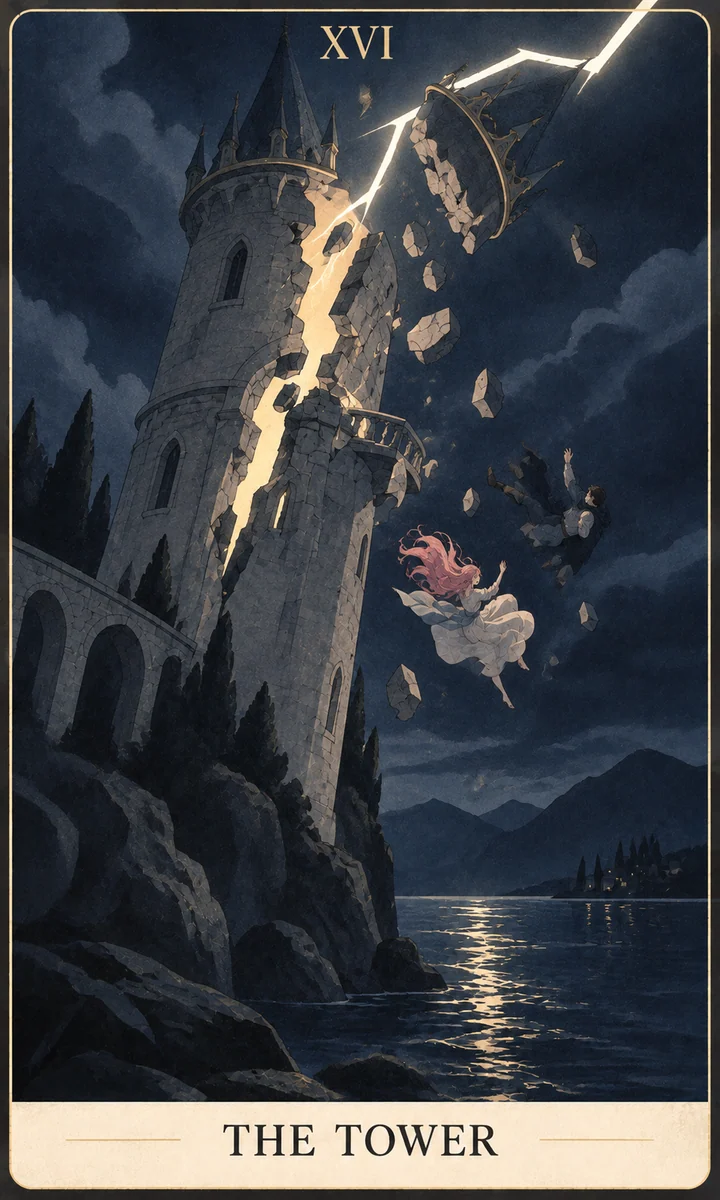
Our watercolor Tower keeps the lightning, the broken stone, the falling crown and the falling figures. The bright opening against the dark sky captures the moment familiar support gives way. To read it, find where the impact actually landed, sort what is still usable from what isn’t and work out what you need in order to rebuild.
The Tower in love and relationships
In love, the Tower points to a sudden revelation, a long standoff breaking open or a false sense of harmony collapsing, which clears away pretense so you can relate honestly.
The Tower as feelings
Upright · If you pulled the Tower for someone’s feelings, they may be surprised, disappointed or seeing the connection very differently all of a sudden. The card shows that their view has been shaken, not exactly why, and on its own it doesn’t prove betrayal, a breakup or sudden love. Ask whether the shock is about one incident or about something more basic in what you expected from each other.
Reversed · The discontent comes out as quiet dread or slow emotional withdrawal. They sense that something basic is broken but hide their alarm to avoid a confrontation, and the distress builds until their private doubts can’t be ignored.
When things can’t stay polite
Upright · An argument, a disclosure or an outside event shatters the old routine. Couples can no longer keep a polite silence about money, feelings or home life. If you’re single, it can mark the sudden realization that someone you’ve been pursuing offers nothing real to build on. Healing means letting go of the old template instead of trying to restore yesterday’s fragile arrangement.
Reversed · The relationship lives in an uneasy truce, with both of you stepping around known cracks. Or you’re quietly renegotiating boundaries before a bigger conflict breaks out. What happens next depends on whether you address the issues directly and can talk without getting defensive once the shock passes.
Clearing the ground
Upright · The relationship reaches a decisive turning point that ends old patterns. It hurts, but the break also ends codependency and long-standing confusion. Anything you rebuild afterward has to rest on honesty and realistic shared expectations.
Reversed · A formal separation may be put off, or the emotional fallout of an earlier breakup is finally being worked through. The risk is clinging to an empty shell out of habit. Don’t rush to define the future while the dust settles, and check whether rebuilding respects both of you or recreates the pressure points that caused the break.
The Tower career meaning
At work, the Tower points to sudden shake-ups, canceled projects or the realization that a role can’t last, breaking up stagnation through disruption.
A sudden shake-up at work
Upright · Sudden leadership changes, budget cuts or exposed operational problems throw off your daily work. A plan you were counting on may be canceled without anyone asking you. The shock ends complacency and shows where your workplace is really vulnerable. Rely on confirmed announcements, not office rumors.
Reversed · Instability builds slowly through internal reorganizations, hiring freezes or quiet warnings. Or you act first, resigning before a crisis breaks. The underlying strain is the same as with the upright card. Check which of your responsibilities are legally binding, and where your dependence on one boss or plan leaves you exposed to turmoil at the top.
A setback that opens a new path
Upright · A sudden setback frees you from a path you were too comfortable to leave on your own. The disruption pushes you onto the job market and can open unexpected doors in other industries or in specialized roles on firmer footing. List the skills and relationships you keep no matter what happens to your employer, and put your energy into reaching out rather than mourning a company whose stability was an illusion.
Reversed · A looming crisis pushes you to update your credentials and quietly line up backup options. By building a transition plan before things collapse, you avoid the worst. Acting in time turns a weak position into practical leverage.
Rebuilding on firmer ground
Upright · Your whole approach to work gets an overhaul. You drop the prestige chasing that drained you in favor of work that is clearly useful. Letting go of career vanity helps you build real, lasting skill.
Reversed · You may resist changing careers despite clear signs your field is shrinking, or you may start retraining to keep up with structural shifts. Progress depends on matching your ambitions to economic and personal reality. Weigh pay, hours and the long-term health of your field against your own stamina, and choose lasting independence over an impressive title that hides burnout.
The Tower money and finances
With money, the Tower points to unexpected expenses, sudden changes to contracts or the collapse of a risky assumption, and calls for finances built on solid ground.
When expected income suddenly changes
Upright · The Tower means an income you expected, or the arrangement behind it, is suddenly in question. Work out which part has actually changed and which still holds, and keep confirmed facts apart from the scariest possible outcome. Plan the next three months on money that has actually arrived, not on pending promises.
Reversed · A loss of income is cushioned by severance, other contracts or quick side work. It can also point to a chronic cash shortfall you keep patching with short-term credit. Real stability means closing the gap underneath.
Absorbing a surprise expense
Upright · Urgent costs that follow a change land on top of your existing bills. Sort what needs attention now from what can be discussed or rescheduled, rather than treating everything as equally urgent. Split costs into essential living expenses and wants that can wait, and pause discretionary spending until the emergency bills are paid.
Reversed · An emergency fund or timely insurance helps you avoid a financial disaster. It can also warn against ignoring rising maintenance costs that will turn into a bigger breakdown if you leave them. Spending a little early protects you.
Restructuring what isn’t working
Upright · When your security is shaken, take stock of the resources and support you still have before you judge the damaged setup. The Tower asks what an arrangement rests on; it doesn’t mean every reserve is gone or that you must abandon everything. List all your debts, including small loans and interest charges, and build a steady repayment plan around what you actually earn.
Reversed · You narrowly avoid insolvency by renegotiating loan schedules or selling assets that aren’t paying off. Or fear of financial failure leaves you frozen and unable to rebalance sensibly. Clear accounting brings back control much faster than avoidance.
The Tower in a tarot spread
Your question sets the topic, and the position in the spread tells you what job the Tower is doing. Upright or reversed shows the state of its themes; the position decides whether they describe where you are, what’s in the way, what to do or where things are heading.
- Present situation
- Upright: an unexpected event, truth or disruption has broken an unstable arrangement, and there’s no room left for denial. Reversed: you’re in deep inner turmoil over a coming shift, or trying hard to hold off a breakdown that can’t be avoided.
- Obstacle
- Upright: pride, clinging to a failing plan or refusing to accept clear facts is blocking recovery. Reversed: putting off necessary changes out of fear only prolongs your exposure and drains the resources you have left.
- Advice
- Upright: as advice, the Tower says to let assumptions that don’t work collapse instead of fighting reality; make sure you’re safe, and tell the truth. Reversed: take apart compromised agreements step by step before outside pressure turns things into an emergency.
- Outcome
- Upright: false security is cleared away completely, leaving a clean slate for something built on solid ground. Reversed: either a softer transition thanks to timely action, or drawn-out inner friction from refusing to let go.
To read the Tower alongside the other cards in a spread, start with our Tarot beginner’s guide.
The Tower tarot card FAQ
What does the Tower tarot card mean?
The Tower means sudden change, revelation and the disruption of a structure or belief you relied on. Upright, the change is usually out in the open. Reversed, it may be internal, resisted, delayed or partly managed through early adjustments. The Tower is card XVI of the Major Arcana; read it as a prompt to find what has changed, not as a fixed prediction of disaster.
What does the Tower reversed mean?
The Tower reversed means the upheaval is delayed, happening on the inside or being handled before it becomes a crisis. You may sense that something has to change but keep patching the cracks out of fear or pride, which only drags out the tension. At its best, it shows you taking an unworkable setup apart step by step before it collapses.
Is the Tower card always bad?
No, the Tower isn’t always a disaster, though its effects can be hard. It describes a disruption to an event, a relationship pattern or an assumption, and there’s no need to recast every loss as a hidden blessing. A useful reading asks what has changed, what support remains and what you can now deal with more realistically.
What is a “Tower moment” in tarot?
A Tower moment is a sudden event that upends your routine and shatters something you took for granted. It could be an unexpected job loss, an abrupt breakup or a realization that changes how you see your life. It marks the point where denial stops working and change can no longer be put off.
What does the Tower mean in love?
In love, the upright Tower means hidden grievances or deep incompatibilities can no longer stay out of sight. It often marks a breakup, but it can also describe an intense argument that finally clears away false harmony so honest communication can begin. Reversed, it suggests lingering dissatisfaction, or necessary conversations avoided out of fear.
How is the Tower different from Death in tarot?
Death is about an ending, letting go of an old form and moving through a transition; the Tower is about a sudden interruption that shakes an arrangement or belief. The difference lies in the process each card stresses, not in a rule that Death is always gradual or the Tower always comes from outside. One situation can involve both a disruption and the ending that follows.