
What does The Fool mean in tarot?
The Fool is the card of beginnings. You stand at the start of something with no map, but you’re willing to go anyway and learn as you move. The card doesn’t promise a smooth trip. It points to the qualities that help most when you face the unknown: an open mind, a light load and a willingness to learn from what actually happens.
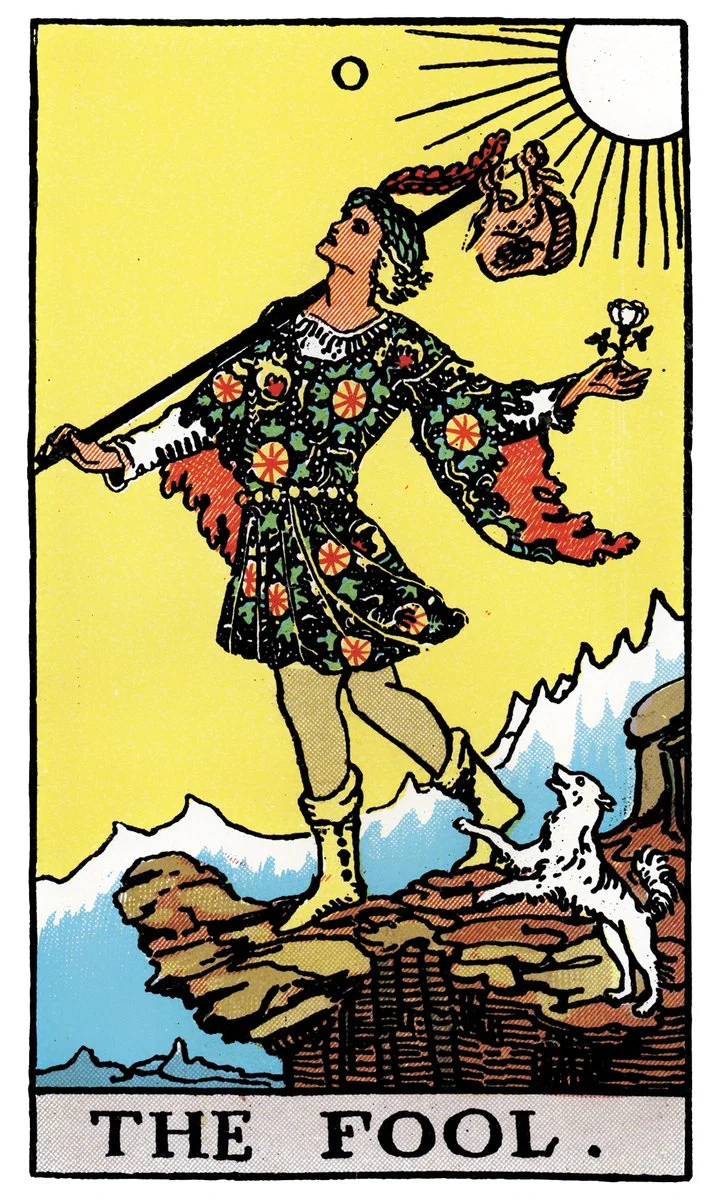
On the Rider–Waite–Smith card, a young traveler pauses at the edge of a cliff under a bright sun, face turned to the sky rather than the drop below. He carries only a white rose and a small bundle on a staff, and a white dog leaps at his heels. The cliff shows how much he doesn’t know yet; the dog stands for instinct and the warnings your surroundings give you. So the Fool’s journey is spontaneous, but it still asks you to stay awake along the way.
- Upright keywords
- new beginnings, curiosity, a leap of faith, spontaneity, traveling light, beginner’s mind
- Reversed keywords
- recklessness, ignored warning signs, fear of the unknown, hesitation, overthinking, fear of looking foolish
- Openness and new beginnings
The traveler stands at the edge of a cliff, eyes on the horizon, with no clear path under his feet. The picture pairs starting with not knowing: when you decide to go, you rarely see the whole route. The Fool asks you to try something as a beginner, let understanding come once you’re involved, and admit there are things you don’t know yet.
- Traveling light
The white rose and the small bundle keep the traveler light; he carries no heavy gear. Read this as a simple, sincere wish and a willingness to set down old roles and assumptions for a while. It helps to sort your worries into real preparation and leftover limits from past experience. Traveling light doesn’t mean skipping preparation. It means leaving room for something new.
- Learning as you go
The dog leaps at the traveler’s feet while the cliff keeps the real limits in view. Company, instinct and feedback from your surroundings all help you see the next step. As advice, the Fool favors small attempts that give you feedback quickly, so each move adds a little to what you know. Trust here never means ignoring consequences.
The Fool upright and reversed meaning
The Fool upright meaning
Upright, the Fool means a fresh start taken with an open mind: you’re willing to begin before everything is guaranteed and to learn along the way.
A new start with no map
Work, a plan or a relationship is moving into territory you haven’t been in before. There’s no precedent to follow, but there is room to explore. Let yourself come in as a beginner, and treat surprises as signals to adjust course rather than reasons to stop. Find the most basic first step and take it without waiting for every risk to disappear. Keep early experiments small enough to absorb mistakes, and let the situation show you its direction as you go.
Curiosity without the old baggage
Inside, you’ve let go of old wins and losses and of other people’s judgment, and what comes through is curiosity and spontaneity. You have energy for something new and don’t need to label the outcome yet. If you’re still carrying worries that don’t belong to this moment, the Fool suggests putting them down. In an advice position, it encourages you to drop extra defenses, follow what you genuinely want and leave some room for improvising.
The Fool reversed meaning
Reversed, the Fool usually means your actions and your sense of risk are out of step: either you’re rushing ahead without looking, or fear of the unknown keeps you from starting at all.
A reckless leap or frozen at the edge
The reversed Fool can tip two ways. In one, you’ve already jumped: warnings get ignored and recklessness passes for courage. In the other, you’re so worried about what could go wrong that you keep pacing the cliff edge, waiting for a guarantee that never comes. Your actual behavior tells you which one applies. If you’re in the middle of a risky move and the warning signs keep piling up, it’s recklessness. If you’ve been planning for months and keep finding reasons to delay, it’s fear.
Getting the pace right again
The fix depends on which way you’ve tipped. If you’re rushing, pull back and check what’s actually supporting you: write down the limits you can’t cross and the resources you really have, and pause any decision you can’t undo. If you’re stuck, let go of the idea that the first step has to be perfect. Pick a small move you can always walk back, and use it to break the anxiety of doing nothing.
Is The Fool a yes or no card?
Yes. The Fool is a yes, especially for questions about starting something new or trying a different path, because the card is about stepping forward before every answer is in. It’s a weaker yes if you’re asking whether something is already settled or guaranteed, since it describes a beginning, not a finished result. Reversed, it leans toward not yet: slow down if you’re rushing past warning signs, or take one small, reversible step if fear is what’s holding you back.
The Fool symbolism
Four details on the Rider–Waite–Smith Fool explain why openness, spontaneity and real risk all show up in the same card.
- The cliff and the open sky
The young traveler stops at the edge of a cliff high in the mountains, looking up into a wide, bright sky.
The cliff marks where experience runs out and the path disappears, so the risk is real. The upturned face shows a pull toward everything that’s possible. Together they ask you to see the open sky without pretending the drop isn’t there.
- The small bundle on a staff
A small, decorated bag hangs from the end of a staff resting on his shoulder.
The bag is small because he hasn’t packed years of habits and assumptions, which is the freedom of traveling light. It also means his supplies are limited, so this isn’t the moment to waste what you have.
- The white rose
In his left hand he holds an open white rose, loosely and calmly.
The white rose stands for a simple, sincere wish and motives not yet shaped by calculation. The step he’s about to take comes from a real inner pull rather than a careful weighing of advantages.
- The leaping white dog
A small white dog jumps at his feet, keeping pace with him at the cliff edge.
The dog stands for instinct, the body’s senses and the warnings your surroundings give. It isn’t there to stop him. Next to the cliff, it reminds you to trust your instincts and still listen when something around you says “careful.”
Watercolor deck
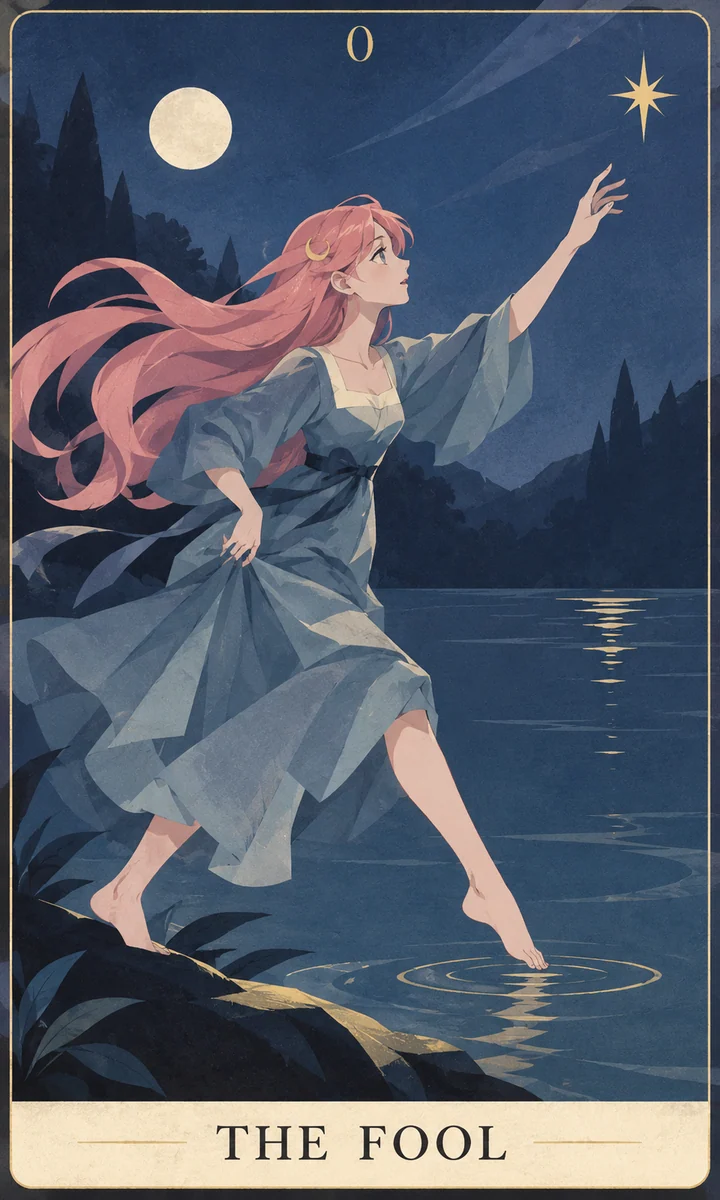
In our watercolor Fool, a woman reaches one bare foot from a solid rocky shore into dark, calm water under a night sky. A crescent moon shines above as she stretches an open hand toward a distant star, and soft ripples spread where her foot touches. There’s no cliff and no dog here. The beginning is a quieter one: a single step off familiar ground into something deeper and unknown. Curiosity moves her body, and even that first light touch is already sending ripples out into the world.
The Fool in love and relationships
In love, the Fool means fresh attraction, curiosity and an easy, unscripted connection, though excitement at the start isn’t the same as a long-term commitment.
The Fool as feelings
Upright · If you pulled the Fool for someone’s feelings, they likely find you fun, interesting and easy to be around. There’s curiosity and a wish to keep things light, without a lot of expectations. That can be early interest rather than a plan for the future, so watch what they do next before you read it as commitment.
Reversed · The feelings can tip two ways. They may want the fun without the responsibility, treating the connection as something they can walk away from at any time. Or they like you but pull back because they’re afraid of getting hurt or losing their freedom. Their actions tell you which: big promises with no everyday effort usually mean avoidance, while nervous words and slow moves usually mean fear.
A relationship starting from scratch
Upright · The relationship is often at an early stage: breaking the ice, flirting or trying something new. Neither of you carries much history or resentment, so things feel relaxed and there’s room to get to know each other fresh. The Fool doesn’t come with exclusivity or marriage built in, so if you want something steady, talk about what this is and turn the fun into some shared ground rules.
Reversed · The pace has slipped out of control. One person may be rushing things on impulse and making it awkward, or you can both see a problem but neither of you wants to face it, so the connection stays unsettled. Check whether you both define the relationship the same way before you push it in any direction.
Where this could go
Upright · Things are opening up and getting livelier, which can break a stalemate and let you try a way of being together that’s new to both of you. Stay open and let time together show how well you fit. Don’t ask for lifelong promises at the start; watch how you cooperate when ordinary life gets in the way, and don’t mistake early chemistry for a stable future.
Reversed · The relationship may hit a setback. The excitement fades fast and there isn’t much underneath, or one person keeps changing their mind until it’s hard to keep going. Rushing into living together or big commitments before you really know each other can bring disappointment quickly, while dodging every defining conversation leaves the connection drifting.
The Fool career meaning
At work, the Fool means a new field, a new project or a fresh way of doing things, and the challenge is balancing that sense of adventure with the basic skills the job still needs.
Starting out where the rules aren’t set
Upright · You’re facing a new role, a task you’ve never handled, or a workplace with no template to follow. Past experience won’t transfer directly, but you also aren’t held back by old habits, which gives you room to try new things. Agree on the basics, like who you report to and what you need to deliver, so your experiments happen inside a frame that works.
Reversed · Work may feel chaotic. You may have taken on more than you were prepared for and keep hitting walls, or you can see a clear chance to change but stay put because you’re afraid you won’t adapt. If you’re overloaded and mistakes are piling up, get expert help or scale back what you’ve promised. If you’re stuck hesitating, sketch the simplest workable plan, deliver a first version and improve it from there.
Growth through new ground and trial and error
Upright · This is a good time to try a different industry, start something of your own, or pick up new tools and methods. Treat it as a period of learning how things really work. Don’t chase polished, standardized results too early; your first job is to understand the landscape, and hands-on practice will teach you faster than waiting.
Reversed · An opportunity may hide a trap. A flashy pitch can pull your attention away from the hard facts: the contract, the pay, whether the team can actually deliver. Chasing a trend without checking can burn energy for nothing, and fear of failure can just as easily make you turn down a promising challenge. Compare the plan’s promises with the resources that really exist, and separate proven demand from wishful thinking.
Changing direction for the right reasons
Upright · Your attitude toward work is shifting. You may be willing to give up some status or comfort to follow something that feels more alive and creative. It’s a good moment to start a new chapter with an apprentice’s mindset, as long as real curiosity is driving the change rather than boredom.
Reversed · You may feel lost about direction. Switching jobs or fields again and again can be a way to dodge the hard part of building skill, or you may be fed up with where you are but lack the nerve to plan a realistic exit. Ask whether each new idea is really an escape from the dull middle stretch. Name the price you’d actually pay for a new direction, and build a cushion for the transition instead of tearing up your whole life.
The Fool money and finances
With money, the Fool points to trial-and-error spending, new ways of earning and choices you have no track record for, and it treats that money as the cost of learning, not a bet on luck.
New income that hasn’t proven itself yet
Upright · For income, the Fool is about testing something new: whether an idea can start to prove itself, and whether you’re willing to learn an unfamiliar way of getting paid. Excitement doesn’t mean the money is there yet. Keep the first steps small and reversible, and leave income that hasn’t arrived out of the budget for your fixed bills.
Reversed · Get-rich-quick stories or promises of high returns may tempt you to put core savings into something you don’t understand. Or you may overestimate how fast a new venture can earn, so early costs don’t come back on time. Cap the start-up money for any new project at an amount you could lose entirely without touching your basic living costs.
Spending on a fresh start
Upright · Spending here is the cost of starting something. Separate the preparation you really need from purchases made out of excitement. Leaving some room to try things and change course means one early purchase won’t lock you in.
Reversed · Spending gets careless: emotional shopping, swiping without checking the statement, losing track of fixed bills and debts until cash runs short. The opposite can happen too, when anxiety stops you from spending even small amounts on the basic tools a new venture needs. List your fixed costs and upcoming payments now, and keep living expenses in a separate account so impulse spending can’t eat into them.
How much risk you can actually carry
Upright · The Fool is open to the unknown, but security can’t rest on optimism alone. How much trial and error you can afford, and whether you could still cover your basic needs if the experiment failed, decides how much room this openness really has.
Reversed · Your sense of security has swung to an extreme. Either you ignore financial risk and live with no buffer, or you feel so insecure that you won’t spend anything and lose the flexibility to improve your life. Tracking what really comes in and goes out helps you see where you stand. Security comes from knowing your baseline clearly, not from a huge number or from letting things drift.
The Fool in a tarot spread
Your question sets the topic, and the position in the spread tells you what job the card is doing. Upright or reversed shows the state of the Fool’s themes; the position decides whether they describe where you are, what’s in the way, what to do or where things are heading.
- Present situation
- Upright: you’re at a genuine fresh start. The road ahead is unknown but wide open, and it suits an open-minded beginning. Reversed: this start has a blind spot, or you know you need to change but can’t bring yourself to decide.
- Obstacle
- Upright: being too casual, skipping long-term planning, or missing warning signs that have been there for a while. Reversed: serious recklessness, or being frozen by fear of making a mistake.
- Advice
- Upright: as advice, the Fool says to set down old baggage and assumptions, take the first step and learn by doing. Reversed: stop the impulse that’s running away with you and check your limits first, or break the move into a very small, safe experiment.
- Outcome
- Upright: points to a lively, exploratory phase. There may be no firm conclusion yet, but you come away with real experience. Reversed: without a correction, thin preparation can lead to a setback, or the plan may quietly fizzle out.
To read the Fool alongside the other cards in a spread, start with our Tarot beginner’s guide.
The Fool tarot card FAQ
What does the Fool tarot card mean?
The Fool means new beginnings, curiosity and the courage to step into the unknown before you have every answer. It’s card 0 of the Major Arcana. Upright, it encourages you to start with a light load and learn as you go. Reversed, it warns that you may be rushing past real risks, or letting fear of the unknown keep you from starting at all.
What does the Fool reversed mean?
The Fool reversed means your actions and your sense of risk are out of step. Sometimes that looks like recklessness: jumping in, ignoring warnings and calling it bravery. Other times it looks like paralysis, waiting for a guarantee before you move. If you’re rushing, set basic limits and pause anything you can’t undo. If you’re stuck, take one small step you can walk back.
How does someone feel about you if you pull the Fool?
Upright, the Fool usually means they find you fun, interesting and easy to be around, with real curiosity and no heavy expectations. Reversed, they may want the excitement without the responsibility, or they like you but hold back because they fear getting hurt or losing their freedom. A card can’t read someone’s mind, so let their actions over the coming weeks fill in the rest.
Does the Fool mean a relationship will last?
The Fool on its own doesn’t say a relationship will last or lead to marriage. It describes the fresh, curious start of something: easy chemistry and a willingness to explore together. Whether it becomes long term depends on what happens next, especially whether you’re both ready to take on everyday responsibilities and talk honestly about what you want.
Does the Fool card mean you’re being stupid?
No, the Fool isn’t about stupidity, even when it’s reversed. Upright, it’s one of the more hopeful cards in the deck, describing an open mind and a willingness to begin. Reversed, it points to misjudging risk, not to a lack of intelligence or a fate of failure: either moving too fast without checking the facts, or hesitating so long that nothing starts.
Why is the Fool numbered 0 in tarot?
The Fool is numbered 0, which places it outside the Major Arcana cards numbered I to XXI. The zero suits a beginning before any role or direction has been settled. In the modern idea of the Fool’s Journey, the Fool is the traveler who meets each of the other Major Arcana cards in turn; that’s a way of reading the deck, not a fixed historical rule.