
What does The Chariot mean in tarot?
The Chariot is about moving forward on purpose. The charioteer doesn’t wait for circumstances to line up; he takes the helm, sets a direction and keeps command. It’s the card of leaving familiar shelter behind and making real progress through will and focus.
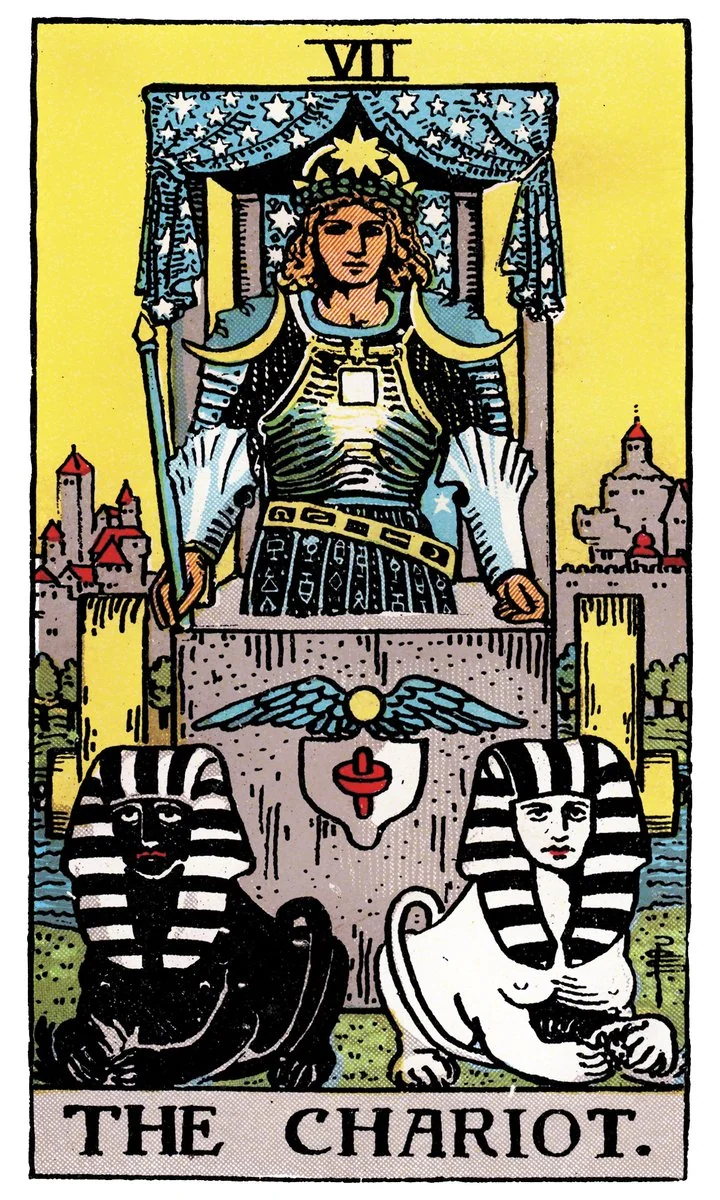
A walled city sits behind the chariot, and two sphinxes of opposite colors rest in front of it. There are no reins. Control comes from a clear mind, discipline and knowing your limits. The progress this card describes doesn’t come from flooring it, but from steadily steering two different drives down one chosen road.
- Upright keywords
- determination, focus, willpower, self-discipline, clear direction, hard-won progress
- Reversed keywords
- scattered energy, inner conflict, stalled progress, lack of direction, forcing things, control issues
- Steering opposites
The black and white sphinxes stand for contrasting impulses, like passion and reason. They don’t move forward because they happen to agree. The driver’s focus channels both of them in one direction. Real progress puts every part of your nature, the eager side and the cautious side, to work on one clear target.
- Discipline and structure
The charioteer stands inside a square stone car, wearing armor marked with crescent moons. Willpower needs a frame to work in. What you achieve out in the world depends on clear boundaries, steady routines and the resilience to keep your goals safe from every passing mood.
- Leaving familiar ground
In the background of the classic card, a walled city and a river lie behind the chariot. Moving forward means leaving proven comforts behind to test yourself somewhere bigger. The Chariot trades the comfort of the familiar for a journey you steer yourself.
The Chariot upright and reversed meaning
The Chariot upright meaning
Upright, the Chariot means clear intent, firm boundaries and forward motion that comes from pulling different forces together.
Steering a project through obstacles
Real progress happens when different resources and competing priorities all point at one clear goal. The competing demands don’t disappear; you manage them, and that keeps things moving. Get specific about your main objective, decide which demands need coordinating now, and set limits that keep the project moving past what feels comfortable.
Focus, discipline and a sense of control
You feel motivated again and able to steer your own impulses. That confidence comes from accepting that you want conflicting things without letting them drag your attention in different directions. Acknowledge the mixed feelings, but don’t let them derail what you’ve committed to. As advice, the Chariot says to stay on your chosen path through steady daily habits and calm self-command.
The Chariot reversed meaning
Reversed, the Chariot usually means a gap between what you intend, the energy you have and what you actually do: either inner conflict is stalling you, or you’re forcing a plan that isn’t ready.
Pulled in two directions
Inner disagreement or mismatched priorities stop you in your tracks. Different motivations pull sideways, and you end up spinning your wheels or frozen by competing demands. Work out which two motives or obligations are fighting for control. Step back and settle that conflict instead of demanding speed from energy that’s already split or drained.
Pushing too hard
Willpower turns rigid and controlling, pushing on past warning signs and strained relationships. Force gets mistaken for progress, which creates friction and, sooner or later, a breakdown. Ask whether your pace ignores real limits or other people’s needs. Ease off the micromanaging, check that your support is really there, and adjust the timeline before the momentum collapses.
Is The Chariot a yes or no card?
Yes. The Chariot is a yes, especially when the question is about going after something, pushing a plan forward or getting past an obstacle. It promises progress through focus and your own effort, not through luck. Reversed, it leans toward no or not yet: conflicting priorities need sorting out first, and if the outcome rests mostly on other people, your drive alone won’t settle it.
The Chariot symbolism
The classic Chariot mixes military, celestial and mythic details to show a clear mind steering raw instinct toward a win out in the world.
- The black and white sphinxes
Two sphinxes, one dark and one light, rest side by side in front of the chariot.
They stand for pairs like passion and reason. With no reins in sight, moving forward means coordinating both drives rather than trying to get rid of either one.
- The chariot and the armor
The charioteer stands upright in a square stone car, wearing armor decorated with crescent moons.
The armor and the car mark out boundaries and structure. They protect the driver from outside chaos while the work gets done, which is the discipline side of the card.
- The starry canopy
A blue canopy scattered with stars arches over the charioteer’s head.
The stars tie hard practical effort to higher ideals. They remind the driver that the push should serve a purpose that lasts beyond the race.
- The city and river behind
A walled city and a flowing river lie behind the chariot’s wheels.
These are the security and past achievements the driver has left behind. The real journey only starts once you move past familiar safe harbors.
Watercolor deck
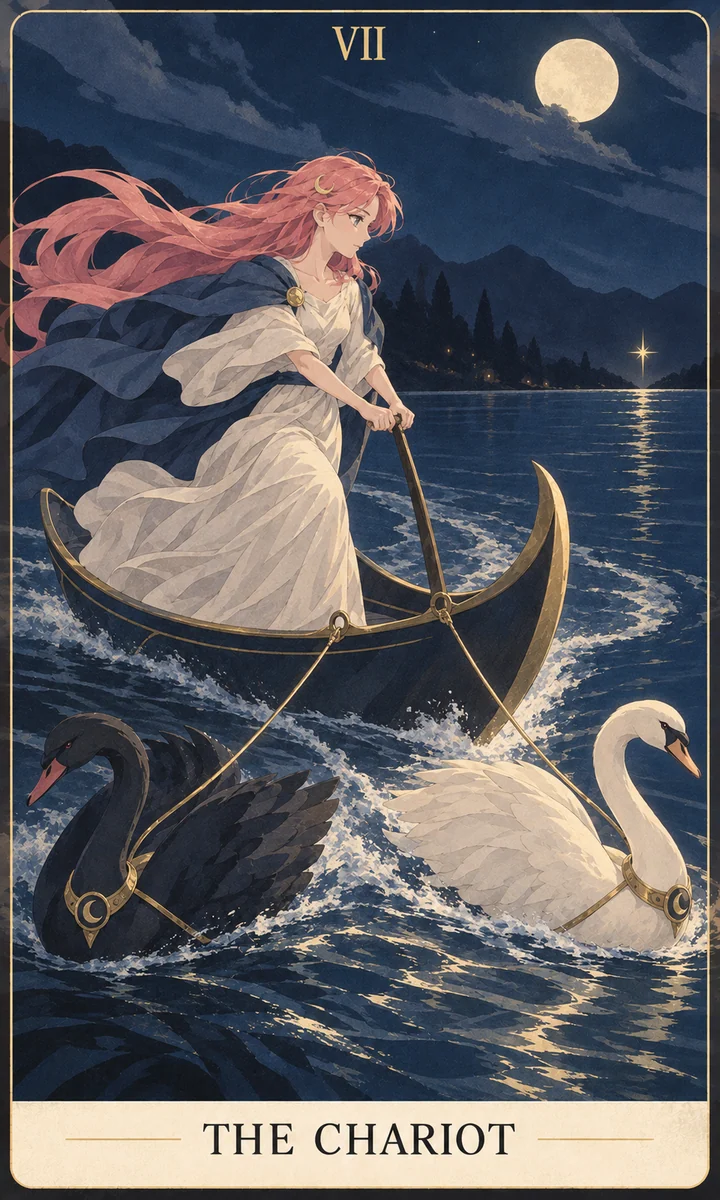
In our watercolor Chariot, a woman steers a crescent-shaped boat across the water, pulled by one black swan and one white swan beneath a single guiding star. Swapping the stone chariot for water softens the message: steering here means constantly, gently balancing emotional currents that pull different ways, not forcing your way through with rigid control.
The Chariot in love and relationships
In love, the Chariot usually means pursuing someone with clear intent or a couple working toward the same goal; reversed, it points to power struggles, mixed impulses or one person setting the pace alone.
The Chariot as feelings
Upright · The Chariot as feelings suggests someone who wants to approach you, pursue you or give the connection a clear direction, and who pays attention to how fast things move. Initiative alone isn’t agreement, though. Watch whether that initiative is steady and respectful, and how they handle it when you want a different pace.
Reversed · Their feelings may be hidden behind heavy emotional armor or pulled apart by mixed impulses. They may feel pressure to perform, or hesitate to commit to a future together. Real attraction under this card shows up as open movement toward you, not as demands for control.
Heading the same way together
Upright · You share a clear direction and work together to get past practical obstacles. Your differences turn into team strength instead of endless arguments. Healthy steering means you both agree on where you’re going and how fast.
Reversed · Power struggles start when one person steers without the other’s consent. Or your life goals pull in opposite directions, leaving the relationship stuck. Ask whether shared decisions reflect real agreement or just one person going along with the other.
Getting past a standstill
Upright · The relationship moves past hesitation as both of you put in real effort. Expect clearer expectations and practical plans for the next step, whether that means handling distance, juggling schedules or adjusting habits together.
Reversed · Progress stalls because of defensiveness or competing priorities. Pushing for a commitment too early only raises the tension until the hesitation underneath is dealt with. Moving forward together takes coordinated adjustments, not sheer willpower.
The Chariot career meaning
At work, the Chariot means ambition, follow-through and the ability to steer a complex project to the finish; reversed, it points to conflicting directions, micromanagement or overreach.
Driving a project through complexity
Upright · You’re in a position to handle demanding responsibilities and keep a project moving. Success comes from getting different people or competing deliverables to point at one outcome. Map out who owns what and by when, and make clear who has the final say.
Reversed · Conflicting instructions, micromanagement or resource bottlenecks are dragging the project down. Energy leaks into turf battles, and key deadlines slip. Settling who has the final say stops conflicting orders from stalling the work.
Stepping into a leadership role
Upright · Leadership opportunities are opening up that call for decisive initiative and practical focus. Showing you can handle pressure puts you in line for competitive roles. Take the ones where your mandate is clear and backed by real resources.
Reversed · Chasing an opportunity recklessly risks overextending yourself. Or self-doubt and fear of responsibility keep you from making a good career move. Before you say yes, check that you’d have the authority you need to succeed.
Committing to your own path
Upright · Your career benefits from trading routine security for more independence. Focus hard on specialized skills to speed things up, and keep checking that your long-term ambitions match what the work asks of you day to day.
Reversed · The path you picked may not hold up because of poor planning or unrealistic timelines. Ask whether your current efforts fit your real strengths and capacity. Momentum built on solid skills lasts; momentum built on bravado doesn’t.
The Chariot money and finances
With money, the Chariot means disciplined management, an active budget and clear limits; it rewards focused effort but doesn’t turn bold moves into guaranteed profit.
Earning through focused effort
Upright · The Chariot ties earning to directed effort: concentrated resources, measurable progress and the ability to deliver. Initiative helps you go after an opportunity, but returns still depend on demand, terms and how well you execute. Put your energy into income streams that already work before launching side projects.
Reversed · Returns falter because effort is spread too thin or a venture was poorly run. Competing expenses outpace what comes in, eating into what you worked hard for. Compare each income stream with the time it takes, and cut back where the math doesn’t work.
Keeping the budget under control
Upright · When several goals compete for the same money, spending needs an order of priority. Decide which commitment comes first and how much it gets, rather than speeding up every plan without enough behind any of them.
Reversed · Impulse spending throws off your cash flow, often driven by a wish to look successful. Money flowing out unchecked weakens your savings and your ability to absorb a shock. Look for status-driven purchases and set firm spending caps to protect money meant for bigger goals.
Protecting your financial independence
Upright · Control means knowing what you can adjust. Separate fixed obligations, optional spending and income that depends on outside events; even strong execution can’t remove every uncertainty.
Reversed · Your footing feels shaky because of too much credit or reckless commitments. Aggressive risk-taking threatens the basics and needs correcting now. Check your debt against your income and your emergency cash, and pay down high-interest debt before putting money into growth.
The Chariot in a tarot spread
Where the Chariot lands in a spread changes what it describes. Your question sets the topic; the position tells you what part the card plays in the answer.
- Present situation
- Upright: you’re making decisive progress, guided by clear intent and firm boundaries. Reversed: things have stalled because of competing priorities, inner conflict or overreach.
- Obstacle
- Upright: stubbornness, refusing to adapt or running over other people’s concerns. Reversed: a lack of discipline, conflicting desires or not taking charge of your circumstances.
- Advice
- Upright: as advice, the Chariot says to pick a direction, lean on your discipline and steer past your comfort zone. Reversed: stop forcing it, settle the conflict between what you want and what you’re doing, and fix the gaps before you move on.
- Outcome
- Upright: a real milestone reached through focus, coordination and persistence. Reversed: derailment or burnout from pushing an uncoordinated plan, which means the approach needs rebuilding.
To read the Chariot alongside the other cards in a spread, start with our Tarot beginner’s guide.
The Chariot tarot card FAQ
What does the Chariot mean in a tarot reading?
The Chariot, card VII of the Major Arcana, means moving forward on purpose. It stands for focus, self-discipline and steering opposing forces toward one clear goal. It’s about getting past obstacles through resolve and structure, not reckless speed, and it often shows up when you have to leave familiar ground to get what you want.
What does the Chariot reversed mean?
Reversed, the Chariot means a gap between your goals and what you’re actually doing. It often points to inner conflict, scattered focus or a stalled project, or to the opposite problem: micromanaging and forcing an outcome before the groundwork is ready. It doesn’t mean everything has to stop. It means speeding up isn’t the only answer, so first find what has slipped out of control.
What does the Chariot mean in love?
In love, the upright Chariot means pursuing someone with clear intent, or two people working as a team to get past practical obstacles. Reversed, it points to control issues, life plans that pull in different directions, or one partner setting the pace of the relationship alone. Either way, the card is about direction: whether you’re both steering toward the same place.
How does someone feel about you if you pull the Chariot?
The Chariot as feelings usually means someone wants to move toward you and give the connection a clear direction. They may be determined, even competitive, about it. Initiative isn’t the same as agreement, so watch whether their pursuit respects your pace. Reversed, they may feel torn, guarded behind emotional armor or under pressure, which can come out as hesitation or a need to control.
Why are there sphinxes on the Chariot card?
The two sphinxes, one black and one white, stand for opposing forces like passion and reason. There are no reins, so the charioteer has to steer them through focus and will rather than force. That’s the heart of the card: you don’t win by getting rid of one side of yourself, but by pointing both sides in the same direction.
What is the difference between the Chariot and Strength?
The Chariot is about outward control: using structure, boundaries and willpower to steer competing drives toward a goal. Strength is about inner steadiness: calming raw instinct through patience and compassion, without armor or force. If you’re asking “how do I get this plan moving?” you’re in Chariot territory. If you’re asking “how do I stay steady under pressure?” you’re closer to Strength.