
What does the Six of Pentacles mean in tarot?
The Six of Pentacles is about how practical help moves between people. It’s more than a picture of kindness: it’s also about how resources get shared, who sets the rules, and what the person receiving is expected to give back. Whenever help is given, it brings relief and creates a relationship at the same time.
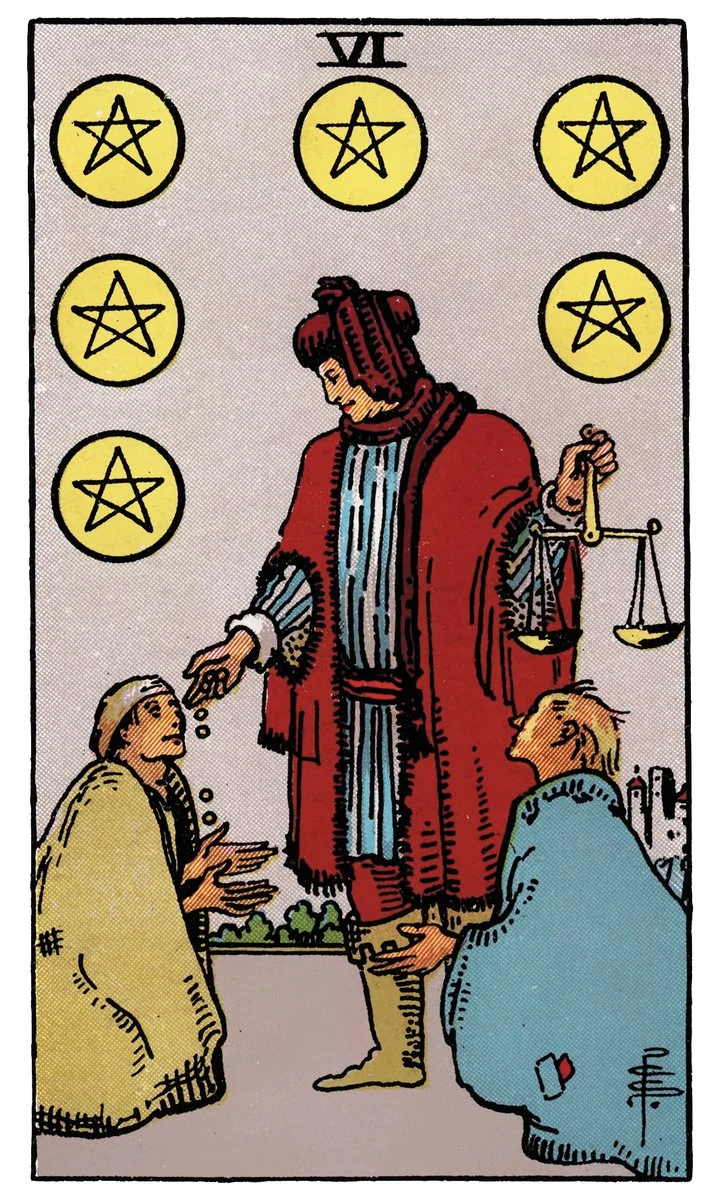
In Pamela Colman Smith’s classic design, a wealthy merchant holds a pair of scales in one hand while dropping coins to a kneeling person with the other. Generosity sits right next to measurement. The card asks whether the help puts people back on equal footing or keeps them in someone’s debt.
- Upright keywords
- generosity, charity, giving and receiving, sharing resources, fairness, support
- Reversed keywords
- strings attached, one-sided giving, debt, favoritism, power imbalance, dependence
- Giving with a set of scales
The central figure holds both wealth and a tool for measuring, so his giving follows judgment, not impulse. The scales call for fair standards, but they’re also a reminder that whoever holds them decides who gets what. Real generosity looks at both the immediate need and whether the process is fair.
- The people who ask
The kneeling figures stand for need and inequality. Needing help is a normal part of life, but their lower position shows how depending on someone can shrink your choices. Ask whether the arrangement respects their dignity or makes them perform gratitude to get their share.
- Money that moves
Coins passing from hand to hand show wealth as something that circulates rather than sits in a pile. Security grows when people build reliable ways to support each other. In daily life, notice whether value flows easily between you and others, or gets stuck because of fear, pride or old resentment about who deserves what.
Six of Pentacles upright and reversed meaning
Six of Pentacles upright meaning
Upright, the Six of Pentacles means resources are shared thoughtfully and fairly, bringing real relief without humiliation.
Help that arrives when it’s needed
Help comes in a concrete form, such as money, mentoring or an extra pair of hands. The person giving uses fair criteria rather than whims, so it reaches the people who need it. If you’re on the receiving end, you can accept it without assuming there’s a catch. If you’re the one giving, the best help builds the other person’s ability to stand on their own.
Knowing what you can spare
You know what you have to spare, and you see that keeping everything to yourself blocks a healthy flow. Helping doesn’t mean draining your own security, and needing help doesn’t make you smaller. Be honest about the exchange: give what you can sustain, and receive with thanks while keeping your independence.
Six of Pentacles reversed meaning
Reversed, the Six of Pentacles usually means help that comes with conditions, creating resentment, obligation or favoritism.
Gifts with strings attached
An offer of help carries unspoken expectations of obedience, loyalty or deference. Or someone keeps asking for support with no plan to stand on their own, and the giver’s goodwill runs dry. Watch for arrangements that leave one person permanently in debt, or let the giver set terms that go far beyond the help itself.
When help feels like a leash
When help starts to feel like a leash, weigh what it gives you against what it costs your independence. Reasonable oversight is one thing; micromanaging your choices is another. If you’re the one holding back or bargaining with your support, ask yourself whether it comes from compassion or from wanting others to keep needing your approval.
Is the Six of Pentacles a yes or no card?
Yes. The Six of Pentacles is a yes, especially for questions about getting help, funding, a fair deal or support from someone else. It shows resources moving to where they’re needed through fair give-and-take. If your question is about a relationship between equals, it’s a yes with a condition: be clear about who holds the power, and reversed it leans no until uneven terms or hidden strings are sorted out.
Six of Pentacles symbolism
The scene weighs measuring against giving, a reminder that every material gift carries social weight.
- The scales
The merchant holds a pair of balance scales in his left hand.
The scales bring calculation, fairness and judgment into an act of charity. Rather than scattering money at random, the giver weighs what he hands out against his own standard. Generosity is tied to judgment here: sharing resources is a deliberate choice, with real consequences for both people’s finances and standing.
- The kneeling figures
Two people kneel on the ground in front of the standing giver.
Their posture shows a clear hierarchy. One receives coins while the other waits, so giving involves choosing who gets what and when. Their position reflects real need, and also how depending on someone can put you below them for a while. The question is whether the help will lift them up or keep them on their knees.
- The giving hand
His right hand drops coins into an open palm.
The direct contact shows value passing from one person to another. Generosity becomes something concrete, not just a good intention. Because the coins fall into an open hand, the gesture also shows the receiver taking part, and the immediate relief practical help brings when goodwill alone isn’t enough.
- The merchant’s red cloak
The giver wears a rich red cloak over lighter clothes.
Rich colors like red have long signaled authority, success and influence. Together with his serious expression, the clothing marks him as more than a kind passerby: he controls the resources, and his own security lets him hand out what he has to spare.
Watercolor deck
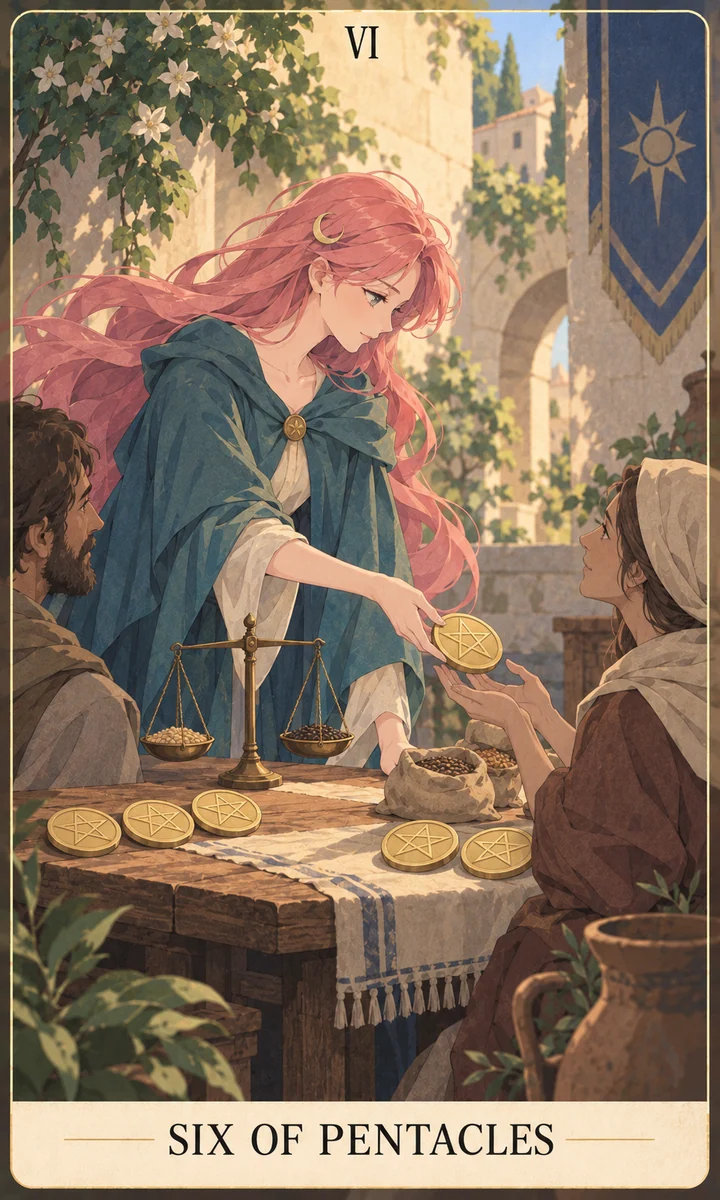
The watercolor moves the exchange to a table. One figure leans forward to offer coins while the other reaches toward them, with scales, coins and bags of provisions on the table between them. The setting makes the help feel concrete and familiar. The two people still play different roles, so the card is about both the support given and the choices the receiver keeps.
Six of Pentacles in love and relationships
In love, the Six of Pentacles is about balance in giving and receiving care, and whether kindness is freely shared or kept on a tally.
Six of Pentacles as feelings
Upright · They genuinely want to make room for your situation, offering time, attention and patience when you’re stretched thin. They want to support you without keeping score.
Reversed · They may see affection as an investment that entitles them to your compliance, or they may feel constantly shortchanged and see you as distant or demanding. Real interest leaves you free to respond, instead of treating kindness as payment in advance.
How the relationship is working
Upright · There’s a fair give-and-take: you take turns supporting each other as life requires, and chores and emotional care are shared evenly.
Reversed · The relationship tilts toward a giver-and-dependent pattern. One person controls the time, money or warmth, and the other has to keep asking for consideration. Ask whether you both feel like equal adults, or whether one of you holds the upper hand.
Where it’s heading
Upright · Honesty about your limits leads to a balanced reliance on each other, and trust grows through small, reliable acts of care.
Reversed · Constant scorekeeping and one-sided compromise eventually breed deep resentment. Things improve only if you restore an equal voice and equal contribution, or recognize that one partner prefers the control of being the only provider. To reconcile, you both need to let go of unspoken debts and meet again as equals.
Six of Pentacles career meaning
At work, the Six of Pentacles means fair pay, open sharing of resources and mentoring that helps rather than exploits.
Your approach to work
Upright · You know what your work is worth and what fair pay looks like, and you’re happy to share knowledge or back up colleagues when you have room to spare.
Reversed · You may feel undervalued by managers who take the credit, or find yourself doing unpaid favors in the name of future opportunity. Check whether what’s asked of you matches your actual contract and real chances to advance, not vague promises of goodwill.
Support and resources at work
Upright · Mentoring, grants and practical support come through open processes that reward skill and real need. Leaders hand out tasks and budgets fairly.
Reversed · Favoritism and gatekeeping get in the way. Access to tools or senior attention depends on flattery and loyalty, not merit. Put agreements in writing, and make sure accepting help doesn’t cost you your ideas or your independence.
Where your career is heading
Upright · Good sponsorship and dependable teamwork open a steady path to more responsibility and fair pay. Over time, you move from receiving guidance to giving it.
Reversed · Relying on others for too long can stall your progress, leaving you stuck in a junior role or dependent on one unpredictable patron. Moving forward means building a reputation of your own that doesn’t rest on one person’s goodwill.
Six of Pentacles money and finances
For money, the Six of Pentacles is about how resources are shared, and the terms that come with giving and receiving.
Income and returns
Upright · The focus is on how money and rewards are shared in relation to need and contribution.
Reversed · Shares may be uneven, or the terms unclear. The card speaks about giving and sharing; it doesn’t confirm that a payment will arrive.
Giving and lending
Upright · Giving and lending go to clear recipients, within limits that work for everyone.
Reversed · Support may be more than the giver can afford, or it may come with pressure and control. What matters is both whether you can afford it and whether the other person still has a choice; accepting help isn’t a failure of independence.
Financial balance
Upright · Balance means reliable support and a fair split of responsibilities, not necessarily equal amounts.
Reversed · Control of money may put all the decisions in one person’s hands. Lasting stability depends on clear terms, reliability and room to negotiate.
Six of Pentacles in a tarot spread
Where the Six of Pentacles falls in a spread changes what it describes. Here is how it usually reads in five common positions.
- Present situation
- Upright: money, resources or support are changing hands, and it’s worth noticing who sets the terms. Reversed: the exchange is building dependence instead of independence.
- Feelings
- Upright: a wish to help, or real gratitude for help received. Reversed: protectiveness over what they have, or unease about depending on someone, with gratitude mixed with a sense of obligation.
- Obstacle
- Upright: a gap in power between giver and receiver makes it hard to meet as equals. Reversed: help with hidden conditions, or a constant sense of entitlement, is distorting the connection.
- Advice
- Upright: as advice, the Six of Pentacles says give openly without trying to control the outcome, or accept the help you need. Reversed: whichever side you’re on, keep your right to make your own decisions.
- Outcome
- Upright: things settle into balanced, mutual respect as long as the terms stay clear. Reversed: quiet resentment builds if help keeps being used as leverage.
Read the Six of Pentacles alongside related cards and guides: Five of Pentacles · Four of Pentacles · Justice · Tarot beginner’s guide.
Six of Pentacles tarot card FAQ
What does the Six of Pentacles mean?
The Six of Pentacles means generosity and the sharing of money, resources or influence between people who aren’t on equal footing. It’s about fairness, charity and give-and-take. The card asks how help is offered, and whether it builds a healthy community or creates lasting dependence.
What does the Six of Pentacles reversed mean?
The Six of Pentacles reversed means unequal exchanges, help with strings attached or debts left unpaid. It can describe charity used to dominate someone, a receiver taking advantage of a generous giver, or resources handed out through obvious favoritism. In each case, the give-and-take has lost its balance.
What does the Six of Pentacles mean as feelings?
As feelings, the Six of Pentacles means they want to support you in practical ways, or they feel they owe you something. Look at how the affection works between you: does it feel like an open, shared exchange, or does one of you feel constantly on trial for the other’s approval?
What does the Six of Pentacles mean in love?
In love, the Six of Pentacles describes a relationship with considerate give-and-take, where emotional work and everyday chores are shared fairly. Each partner steps in to help the other through rough patches, without later using that care as leverage in an argument.
Does the Six of Pentacles reversed mean someone is selfish?
Not necessarily. In love, the Six of Pentacles reversed more often points to an imbalance in how the relationship works than to bad intentions. One person may overdo the rescuer role and leave the other with little say, or you may both be quietly keeping score over small sacrifices.
Does the Six of Pentacles mean someone will give you money?
It can point to receiving help, such as a loan, a grant, fair pay or support from family, but it describes an exchange rather than promising a payment. What the card really looks at is the terms: who decides, what’s expected in return, and whether the help leaves you freer or more dependent.