
What does The Hanged Man mean in tarot?
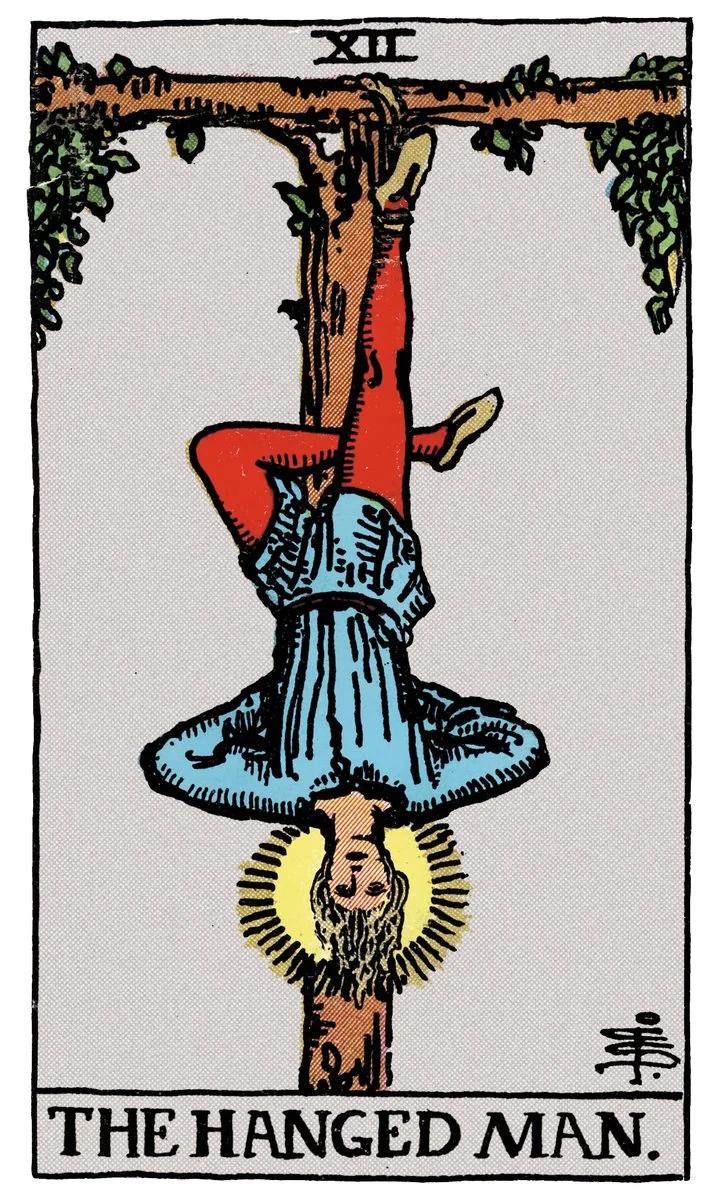
The Hanged Man is about a pause you choose, not a punishment you suffer. A young man hangs upside down by one ankle from a frame of living wood, yet his face is calm and a golden halo glows around his head. In a reading, the card tells you to stop forcing the outcome. When the usual approach has hit a wall, letting go of control over the timing is often what shows you the way forward.
The details explain why. The green leaves on the wood show that this standstill is part of a cycle of growth, not a penalty or an ending. Hanging upside down turns the world around, so progress here means questioning your usual assumptions and looking at the problem from the opposite side. The halo shows that insight arrives once the frantic, defensive activity stops and patience takes its place.
- Upright keywords
- a purposeful pause, surrender, a new perspective, letting go of control, patience, a worthwhile sacrifice
- Reversed keywords
- stalling, indecision, pointless sacrifice, resentment, avoiding a decision, feeling stuck
- A pause with a purpose
The figure hangs from living wood, yet he looks calm rather than distressed. That contrast links being held back with the chance to use the pause instead of only fighting it. In a reading, admit what can’t move right now, then ask what the waiting makes possible: new information, a better plan or a different understanding. A delay isn’t useful just because this card showed up.
- Seeing things from another angle
The upside-down body is the clearest picture of a change in perspective. That might mean trying someone else’s point of view, rethinking a goal or questioning an assumption you’ve never tested. Understanding another person doesn’t require agreeing with them or giving up your own needs. The value lies in spotting the option or fact your first approach missed.
- What letting go costs
The figure gives up ordinary movement, and the halo shows what he gains: insight. You trade some speed, certainty or attachment to an old plan for a clearer understanding. If the waiting brings no new information and no realistic chance of change, the sacrifice has slid toward the reversed card’s stuck, pointless suspension.
The Hanged Man upright and reversed meaning
The Hanged Man upright meaning
Upright, the Hanged Man means a pause that pays off: you step back from the struggle, stop forcing things and start questioning the assumptions that kept you stuck.
When things outside you stall
Circumstances are asking you to stop pushing for quick results. Things may look frozen, but the delay works in your favor: it keeps you from wasting energy on moves that would only create friction or lock in a mistake. Notice where you’ve been forcing a timeline or pressing others to give way, and step back on purpose. Use the lull to spot patterns you’ve overlooked, gather the facts you skipped and let slower processes mature on their own.
A shift in what matters to you
Inside, your perspective is turning upside down in a useful way. Things that once felt essential are losing their urgency, while things you ignored start to matter. Surrender here means dropping your self-protective defenses so you can see the situation as it is. Ask where pride has kept you hurting longer than necessary, and which belief you’re most afraid to give up. Once you can tolerate not knowing the answer yet, the defensiveness eases and there’s room for a real breakthrough.
The Hanged Man reversed meaning
Reversed, the Hanged Man usually means a pause that has lost its purpose, whether you’re resisting a compromise you can’t avoid or making sacrifices that lead nowhere.
Waiting that teaches you nothing
The standstill drags on, but it no longer brings any new understanding. This often happens when you’re avoiding a trade-off you know is coming and complaining about the situation instead of accepting it. The pause becomes cover for indecision, avoidance and emotional paralysis. Ask whether you’re waiting for things to sort themselves out, and whether the inaction is really a fear of being responsible for the choice. Name the concession you’re avoiding, then decide whether to accept the cost or change course.
Sacrifice that has stopped making sense
You may be putting up with discomfort or giving up your own needs with no realistic payoff in sight. Self-sacrifice has become a habit rather than a conscious choice, and giving more under these conditions only builds quiet resentment and burnout. Decide in advance when your patience runs out. Weigh what staying in limbo costs you against what you can realistically expect to gain. If the sacrifice brings neither goodwill nor growth, end the commitment soon.
Is The Hanged Man a yes or no card?
Maybe. The Hanged Man is a maybe that usually means “not yet,” because it describes a pause rather than a clear go or stop. Something still needs time, or you need to look at the question from another angle before the answer becomes clear. Reversed, it leans toward no for as long as the stalling continues; if you’re asking whether you should wait, though, the upright card says yes.
The Hanged Man symbolism
In the classic Rider–Waite–Smith card, every detail makes the same point: this suspension is chosen, and it leads to insight rather than tragedy.
- The living wooden frame
The figure hangs from a T-shaped frame of wood that is sprouting green leaves.
Because the wood is alive, the suspension stays connected to growth. The pause isn’t the end of anything; it works like winter, a quiet season that makes later renewal possible.
- The upside-down body and crossed leg
He hangs by his right ankle, with his left leg bent behind the right knee to form a figure four.
The neat, deliberate shape shows composure inside apparent helplessness. Seeing the world upside down loosens the habits of thought you picked up from others and shows you what the ordinary view hides.
- The calm face
His face looks peaceful and absorbed, with no grimace, sweat or sign of struggle.
The calm tells you the suspension is voluntary. The suffering eases once you stop fighting what is real, and an outside limit becomes inner freedom and time for patient study.
- The halo
A glowing golden ring of light surrounds his head.
The light shows that giving up the urge to control leads to insight. When outward activity stops, clear understanding can take root, just as the living wood promises new growth after the pause.
Watercolor deck
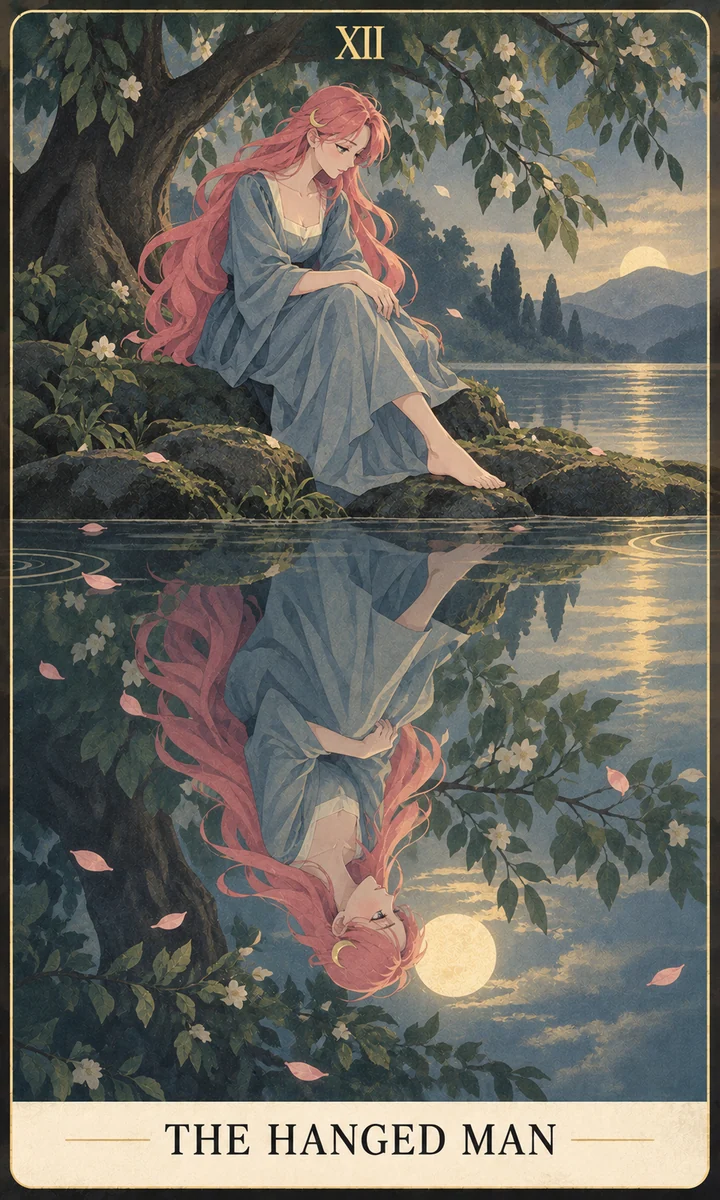
In our watercolor Hanged Man, a woman sits quietly beside a living tree on the riverbank, and her upside-down reflection lies perfectly still in the water below. Her body is free on dry land, so the image presents suspension as a practice of reflection rather than captivity. When you stop the usual rush, the still water shows what the noise kept hidden.
The Hanged Man in love and relationships
In love, the Hanged Man points to a pause, patience and compromise, and asks whether the giving goes both ways or only one.
The Hanged Man as feelings
Upright · If you pulled the Hanged Man for someone’s feelings, they’re likely holding back, rethinking how they feel or unsure about a compromise. They aren’t reacting on impulse; they want to see the situation clearly first. The pause doesn’t prove devotion, though. Watch whether they explain it, consider your needs and come back with a real response.
Reversed · They may feel stuck or unappreciated, as if they’ve made all the compromises and received little warmth in return. That resentment can show up as quiet withdrawal or a refusal to talk openly. If their silence is turning cold rather than thoughtful, raise the underlying grievance directly.
A relationship on hold
Upright · The relationship is in a holding pattern, and outward progress has paused. That gives you both room to reset expectations and practice patience. When each of you lets go of rigid preferences, you can find common ground without turning every disagreement into a contest of wills. If you’ve both been adjusting over the past few months, this pause is making you stronger.
Reversed · The relationship is weighed down by indecision or lopsided sacrifice. One partner keeps giving up boundaries to keep the peace while the other avoids real commitment, and the unspoken sacrifices pile up. If one person carries all the emotional work, set clear limits on what you’ll keep doing before resentment eats away at trust.
Where it goes from here
Upright · The relationship moves forward once you stop expecting a quick resolution. It deepens when neither of you presses the other for the next milestone. Give it room to breathe, and understanding can grow on its own. A healthy pause has a purpose, so notice whether your conversations are bringing you closer to clarity.
Reversed · Expect more delay because someone won’t make a decision. A breakup may drag on longer than it needs to, or a situationship may go on and on because no one will say honestly where things stand. Set a reasonable timeframe for getting clarity; endless stalling usually means someone doesn’t want to face the answer.
The Hanged Man career meaning
At work, the Hanged Man points to a plateau or a stalled project, and to the value of stepping back and rethinking your ambitions from an unusual angle.
When work is on hold
Upright · Projects or negotiations may be on hold because of red tape, a budget freeze or a reorganization. Pushing harder won’t speed things up. Use the slowdown to review your work, fix structural problems and tighten the paperwork behind it.
Reversed · The delay comes from stubborn management, disorganized leadership or your own refusal to adapt to new policies. You may be fighting battles you can’t win, or putting up with poor conditions without doing anything about them. Separate the roadblocks you can’t control from the ones your own stubbornness creates, and change your approach where the problem is yours.
An unconventional opportunity
Upright · The next opportunity may ask you to drop familiar ideas about prestige and hierarchy. A lateral move, an unusual role or a training period can look like a step back on paper and still give you expertise a standard promotion wouldn’t. Judge it by the skills it builds, not the title.
Reversed · You may be hanging on in a dead-end job, hoping loyalty will finally be rewarded. Or you might grab a premature offer just to escape the discomfort of waiting, without weighing what it asks you to give up. Look hard at the trade-offs: accept a short-term inconvenience if the move helps you grow, and decline firmly if it asks for endless sacrifice.
Rethinking what you want from work
Upright · Your values around work are changing at the root. Goals built only on status or approval are starting to feel hollow, and you want work that leaves room for a balanced life. Use this pause to work out what you actually want from a career, and what really drives your ambition.
Reversed · You may feel stuck in apathy, neither committing to your current path nor daring to try a new one. Refusing to retrain, or to start lower in a new field, keeps the paralysis going. Write down what you’re truly willing to give up for your goals, such as free time, routine comfort or where you live. Knowing your acceptable trade-offs turns vague anxiety into a direction.
The Hanged Man money and finances
With money, the Hanged Man points to delayed or frozen funds, deliberate spending restraint and telling real security apart from spending out of habit.
Money that hasn’t arrived yet
Upright · The Hanged Man points to returns that are still up in the air. Separate a payment that’s been agreed and is waiting to go through from an expectation that hasn’t become an agreement yet. Then ask what the waiting depends on, and don’t budget around income you can’t confirm.
Reversed · Delays cause real strain because of poor planning or holding a losing position too long. Refusing to cut your losses on a failing investment, or letting unpaid invoices sit, leaves you more exposed and stretches out cash-flow problems you could have avoided. Tighten spending while you wait, and decide whether some commitments should be closed out to protect what you have left.
What the pause costs you
Upright · Spending here is about what a pause or a change of approach costs. A temporary trade-off can make sense if you can afford it, you know what it’s for and you’ve set a point at which to reassess.
Reversed · Money leaks through sacrifices that bring nothing back, like covering for someone who won’t take responsibility or paying for subscriptions you don’t use. The opposite happens too: skimping on essential maintenance until it turns into a much bigger repair bill. Cut what you pay out of guilt or habit, keep up the maintenance that protects what you own and say no to bailing others out at your own risk.
Staying secure while things are on hold
Upright · Your security depends on the resources and choices you have while things are on hold. Setting clear limits on a commitment helps more than proving you’ll sacrifice without limit. Compare what you actually need with what you have and what you’ve already committed. Decide what you can adjust during the pause, and pick a time to reassess based on confirmed numbers, not hoped-for returns.
Reversed · Insecurity lingers because you won’t adjust your lifestyle to your current finances. Denying the limits, or using credit to keep up the appearance of comfort, can turn a temporary dip into a lasting crisis.
The Hanged Man in a tarot spread
Your question sets the topic, and the position in the spread tells you what job the Hanged Man is doing. Upright or reversed shows the state of its themes; the position decides whether they describe where you are, what’s in the way, what to do or where things are heading.
- Present situation
- Upright: you’re in a pause you need, and pushing ahead now would backfire; accept the slowdown and look for what you missed. Reversed: you’re stuck in a holding pattern that isn’t helping, kept there by avoidance or a refusal to compromise.
- Obstacle
- Upright: your need to control the timeline and get your way is what’s really blocking progress. Reversed: indecision, self-pity or playing the unappreciated martyr keeps you from moving.
- Advice
- Upright: as advice, the Hanged Man says to stop fighting the situation, give up on winning right away and look at the problem from the opposite side. Reversed: break out of the stalemate; name the sacrifice that’s needed, make the hard decision and move on.
- Outcome
- Upright: patience and a willingness to adapt bring real clarity, and you solve the problem with a fresh, lasting insight. Reversed: the standstill wears you down and breeds resentment unless you decide when the waiting ends and drop sacrifices that lead nowhere.
To read the Hanged Man alongside the other cards in a spread, start with our Tarot beginner’s guide.
The Hanged Man tarot card FAQ
What does the Hanged Man tarot card mean?
The Hanged Man means a purposeful pause, surrender and seeing things from a new perspective. Upright, stepping back from the struggle lets you see what pushing harder couldn’t. Reversed, it points to stalling, resisting a trade-off you can’t avoid or making sacrifices that no longer lead anywhere. It is card XII of the Major Arcana, and its core question is what the waiting is teaching you.
What does the Hanged Man reversed mean?
The Hanged Man reversed means a standstill has outlived its usefulness. You may be stalling out of fear, refusing a compromise you can’t avoid or putting up with poor treatment like a martyr. The way out is to name the decision you’re putting off and set a clear point at which the waiting ends.
What does the Hanged Man mean in love?
In love, the upright Hanged Man means a pause for quiet reflection and give-and-take, where understanding your partner’s point of view matters more than winning the argument. Reversed, it warns of codependency, one-sided sacrifice or staying in limbo because neither of you will raise the real problem. Either way, notice whether the waiting is bringing you closer to clarity.
How does someone feel about you if you pull the Hanged Man?
Upright, the Hanged Man suggests they’re working through their feelings privately and holding back rather than reacting on impulse. Reversed, they may feel emotionally stuck, unappreciated for the sacrifices they’ve made or quietly resentful because their needs haven’t been said out loud. A card can’t tell you exactly what someone thinks, so watch whether they explain the distance and respond to your needs.
What does the Hanged Man mean as advice?
As advice, the Hanged Man says to stop forcing the outcome and look at the problem from another angle. Step back, let go of the timeline you’ve been pushing and use the pause to gather what you’ve missed. Reversed, the advice flips: stop waiting, name the sacrifice that’s needed and make the decision you’ve been avoiding.
Is the Hanged Man about waiting or giving up?
The Hanged Man is about waiting with a purpose, not giving up. Upright, you step back to gain perspective while conditions develop. The test is what the waiting produces: fresh insight and a calmer mind mean it’s working, while bitterness, fatigue and paralysis mean it has turned into stalling and it’s time to decide.